01 Oct 2026
|24 min
How product teams are using AI for research in 2026
We surveyed 428 designers, product managers, engineers, and researchers at Future Product Days in Copenhagen about where AI fits in their research workflow, what slows them down, and what they'd want it to do next.
The big picture: What we discovered
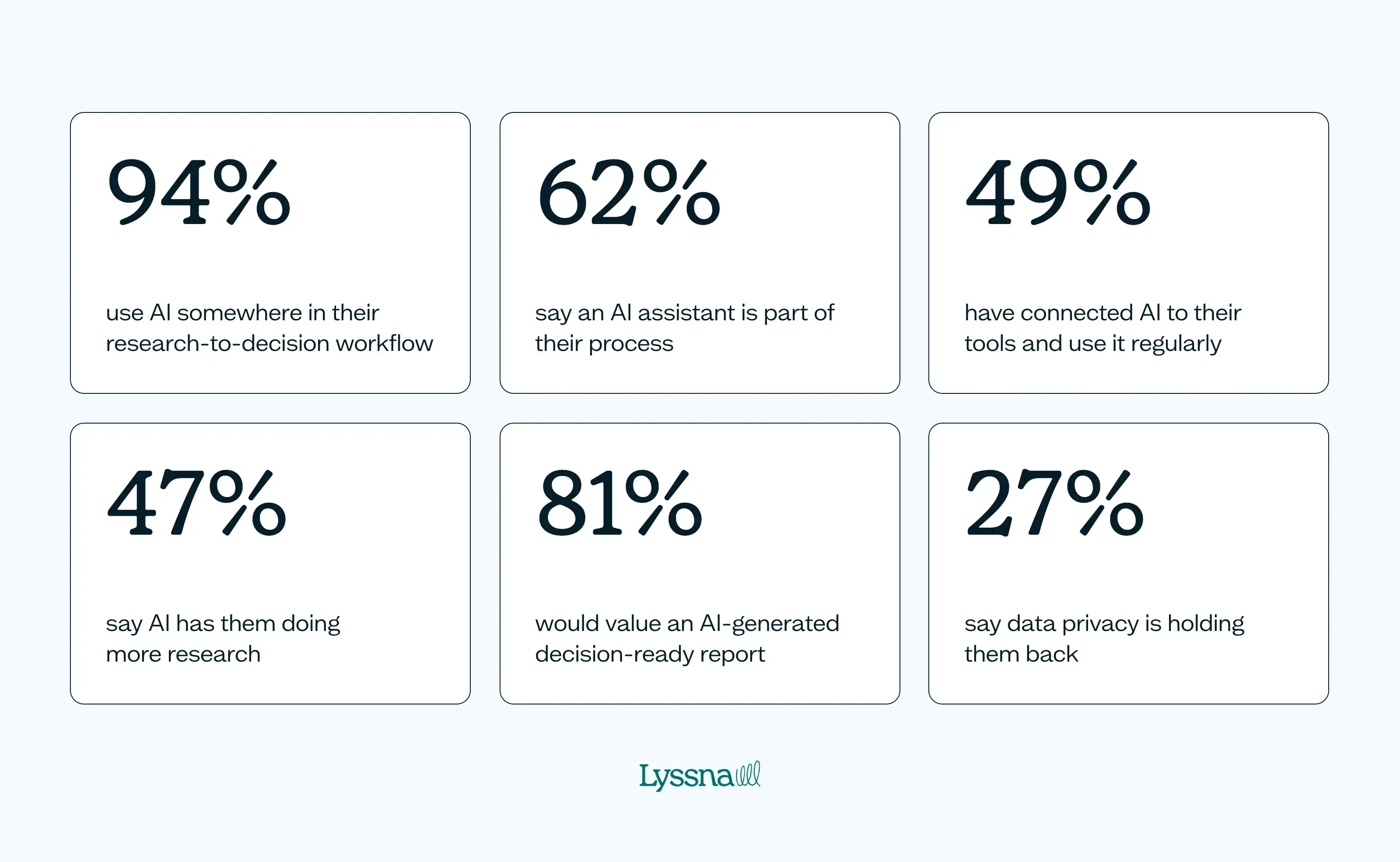
94% already use AI somewhere in their research-to-decision workflow, and 55% use it throughout.
62% say an AI assistant like Claude or ChatGPT is part of their research-to-decision process.
49% have connected an AI assistant directly to their tools and use it as part of their regular workflow.
47% say AI has them doing more research – while 20% say they now rely on AI more than doing the research themselves.
81% say a decision-ready report generated from their research data would be valuable.
Data privacy (27%) and trust in accuracy (25%) are the biggest things holding people back from using AI directly with their research data.
Why AI in the research-to-decision workflow matters now
For a lot of product teams, AI assistants aren't an experiment anymore. They're being used all the time – helping draft interview guides, summarizing feedback and data, and turning notes into something a team can act on.
In conversations at our booth at Future Product Days, a theme that kept coming up was that using AI for research felt necessary just to keep pace with how fast product development is moving – often while teams were shrinking and being asked to do more with less. Research was also increasingly falling to product managers and designers, many with one UX researcher to support them, or none at all. For them, AI was a way to scale their research and build more rigor into it.
That raises new questions. It's no longer "should we use AI for research?" but "how does our research actually get into these tools – and can we trust what it gives us back?"
Getting from research to a decision has always meant more than running a study – pulling data together, synthesizing it, writing it up, and getting the right people to pay attention. We wanted to know where AI is helping with that work, where it's falling short, and what people want from it next.
So we asked the people at the event.
Here's the short version of what we found: AI hasn't replaced research. It's changed who's doing it – and raised the bar for trust. You'll see that tension throughout this report: more people doing research, more of it running through AI assistants, and more questions about whether what comes back out can be relied on.
What we wanted to find out
Our survey covered five areas:
Where AI sits today: How widely people use AI in their research-to-decision workflow, and which tools are part of that process.
Connecting AI to tools: Whether people have connected an AI assistant to the tools they already use, and which tools they'd most like connected.
What AI has changed: Whether using AI has changed how much research people do.
The biggest slowdowns: Which steps take the longest once a study wraps up.
What people want next: The workflows, reports, and outcomes people want AI to deliver – and what's stopping them.
How we conducted this research
We ran this survey in partnership with Marvin at Future Product Days, held in Copenhagen from September 22–24, 2026. The conference describes itself as "the world stage for product people" and brings together product designers, UX professionals, product leaders, software engineers, AI architects, and founders.
Attendees completed a short survey of up to 14 questions at the event, as part of a competition. We collected 428 complete responses. There was no screener, so anyone attending could take part.
A few things are worth keeping in mind as you read this report:
This is a self-selected, AI-engaged audience. People who choose to spend three days at a product conference – and then stop to answer a survey about AI – are likely to already be interested in AI. Read these findings as a snapshot of this community, not a benchmark for every product team.
We didn't ask where people are based. We kept the survey short so people could complete it quickly at the event, so we don't have a country breakdown. Future Product Days is held in Copenhagen and draws attendees from across Europe, so keep that context in mind when reading these findings.
Researchers are a small group in this sample. Just 18 people (4%) identified as researchers, so we've flagged any researcher-specific findings as signals rather than conclusions.
Open-ended answers have been grouped by theme. Where we report how many people mentioned a theme, those counts are approximate.
A quick note on language
Throughout this report, we use "research-to-decision workflow" to mean everything from gathering evidence to acting on it. That includes formal user research, but also the everyday work of pulling together feedback, data, and notes to make a product decision. It's a deliberately broad definition – because, as you'll see, many of the people doing this work aren't dedicated researchers.
Who took part in the survey
Before we get into the findings, here's who we heard from – because it shapes how to read everything that follows.
Research isn't just for researchers
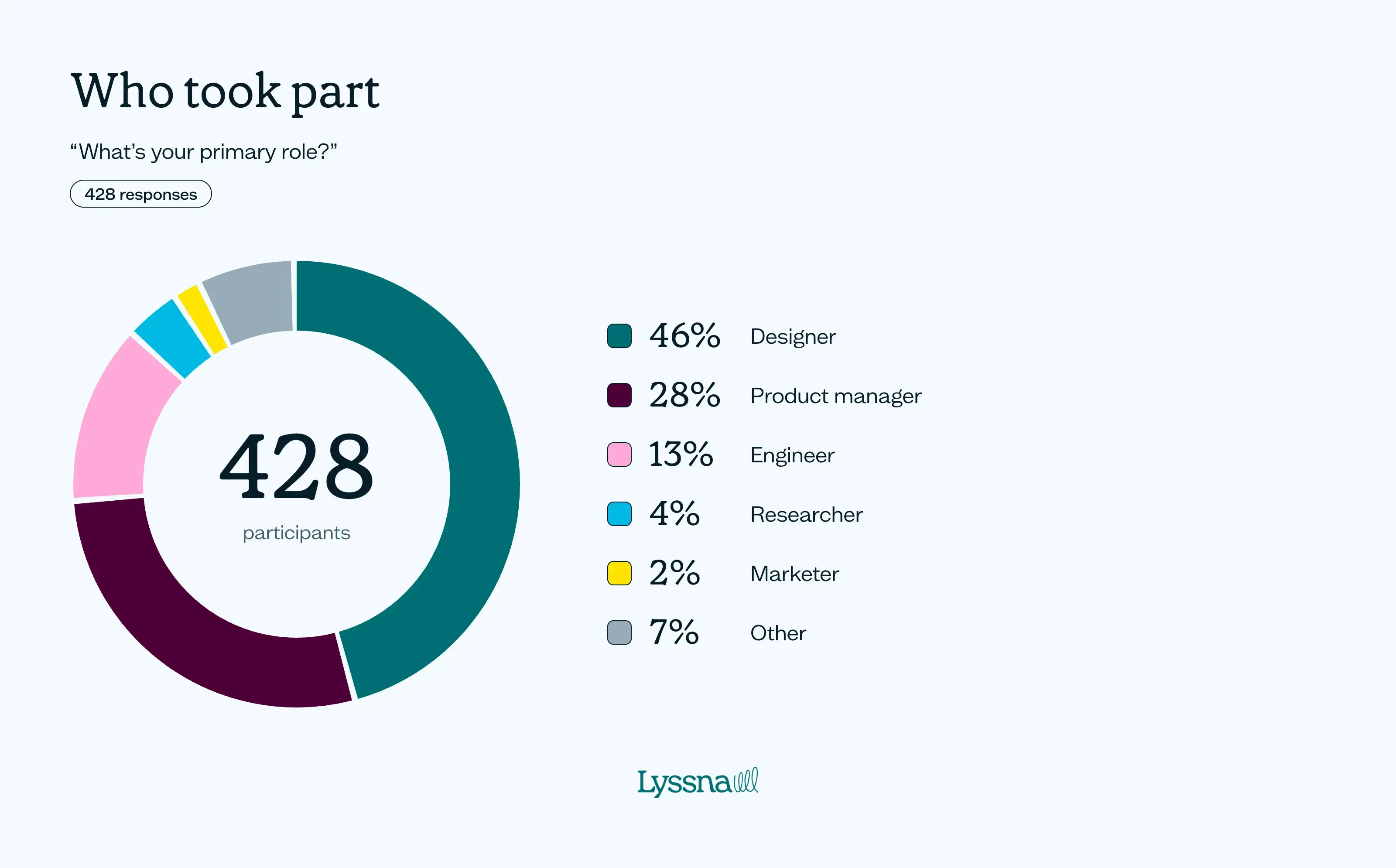
Designers made up the largest group of participants (46%), followed by product managers (28%) and engineers (13%). Researchers (4%) and marketers (2%) were smaller groups, and the remaining 7% included strategists, product owners, design leads, and people in sales.
That mix reflects the event itself. Future Product Days is aimed at product designers, UX professionals, product leaders, and engineers, so it's no surprise designers and product managers make up most of the sample, and that researchers are a smaller group than they might be at a research-focused event.
This also matches what we saw in our earlier research on synthesis: the people gathering evidence and turning it into decisions are increasingly designers and product managers – not only dedicated researchers. (Link: From chaos to clarity: How teams synthesize research in 2025)
Lyssna Design Advocate, Joe Formica, sees this firsthand. "The workshops I hosted at Future Product Days were packed with designers and PMs, not dedicated researchers," he says. And across the workshops he runs for Lyssna, he sees a few challenges come up again and again:
They're spread thin. Research is one of many hats they wear, so time and resources are always tight.
Running the study isn't the hardest part. Many can run a solid study to test a new design. Turning findings into action, presenting them in a compelling way, and focusing on what will get buy-in is where they have less experience.
They need fast, focused results. It's rarely broad, exploratory research. It's usually a product designer making a this-or-that feature decision, who needs to move quickly and back it up reliably.
Industries represented
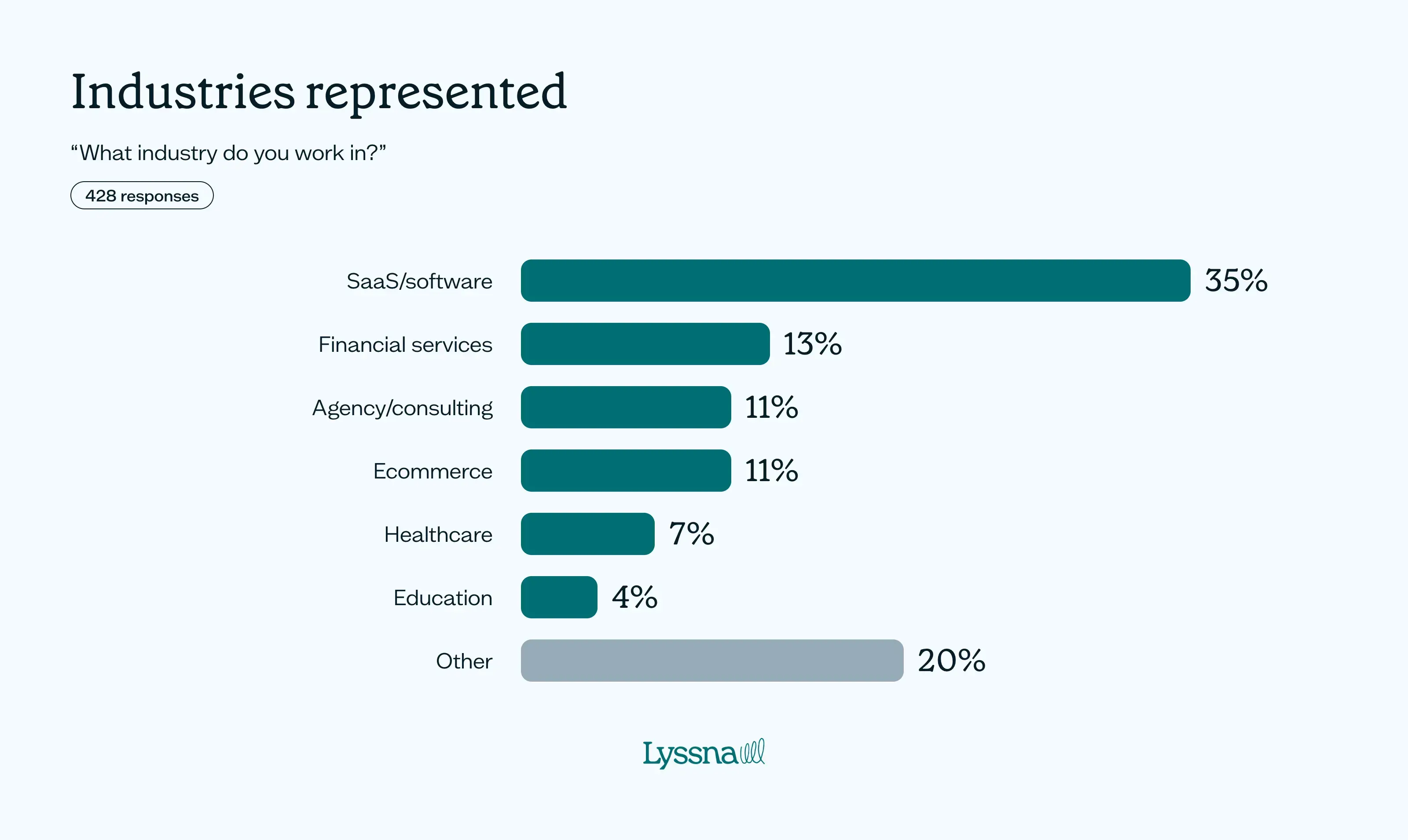
Just over a third of participants (35%) work in SaaS or software. Financial services (13%), agency or consulting (11%), ecommerce (11%), healthcare (7%), and education (4%) were also represented. The 20% who chose "other" work across a wide range of industries, including automotive, energy, gaming, government, fashion, media, and telecommunications

What we think: Research is no longer just a job for researchers. Designers and product managers are fitting research in between other responsibilities, and researchers are increasingly the ones supporting them – reviewing study plans, answering questions, and making sure findings hold up. The right tools can take some of that load, so good research practice doesn't depend on a researcher being in the room every time.
Where AI sits today
We started with the basics: how much are people using AI in the research-to-decision workflow, and which tools do they turn to first?
AI is already part of the process
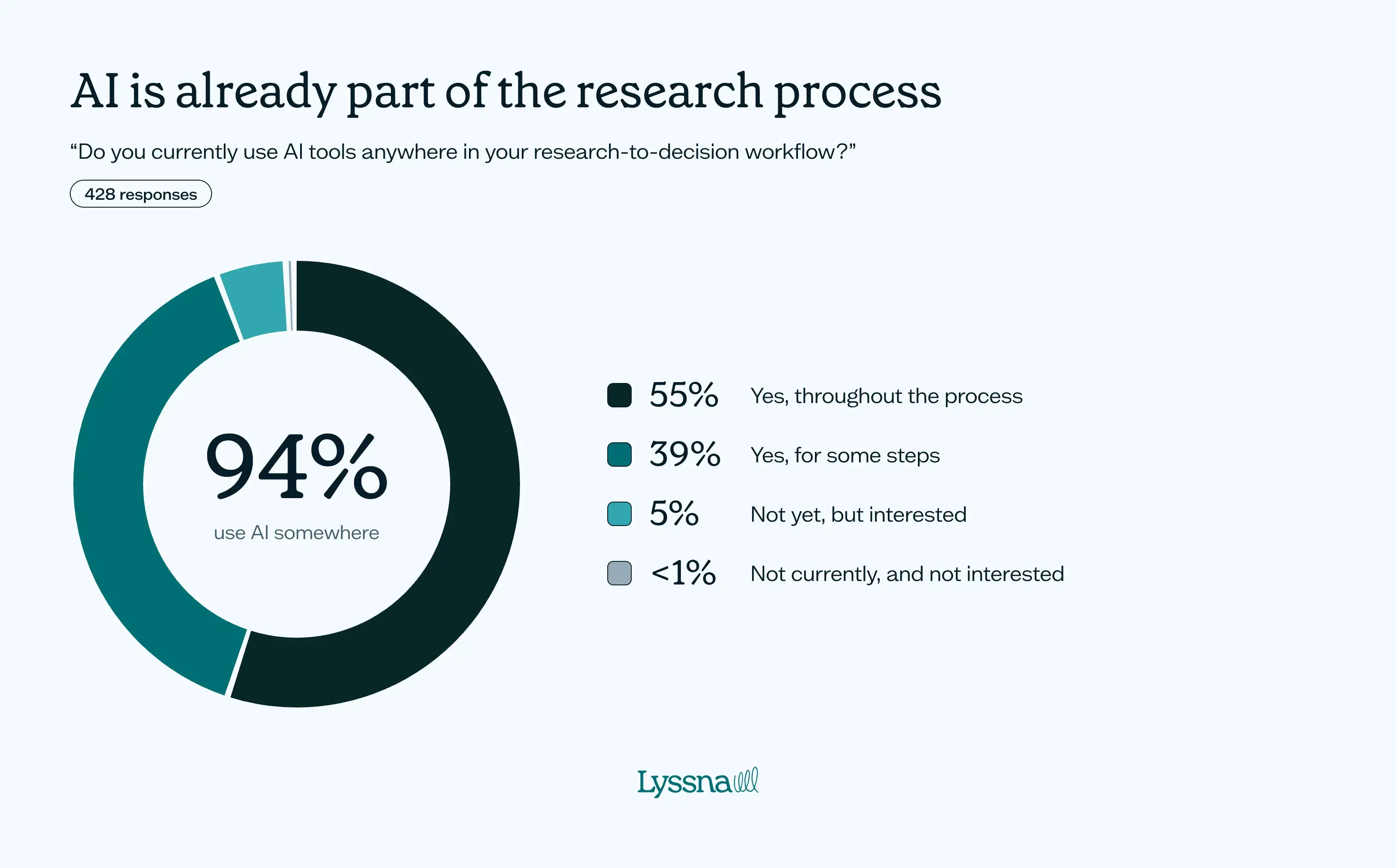
Almost everyone we surveyed (94%) already uses AI tools somewhere in their research-to-decision workflow. More than half (55%) use it throughout the process, and another 39% use it for some steps.
Only 5% said they're not using AI yet but are interested, and just two people out of 428 said they're not using it and aren't particularly interested.
There were some differences by role. Engineers (74%) and marketers (70%) were the most likely to say they use AI throughout the process, compared with 56% of product managers and 48% of designers. Both are smaller groups in our sample, with 57 engineers and just 10 marketers, so treat these differences as directional.
By industry, people working in ecommerce (69%) and healthcare (68%) were the most likely to use AI throughout. Education was the clear outlier: only 27% use AI throughout, and 27% said "not yet, but interested." That's a small group (15 people), but it shows that not every sector is moving at the same pace.
AI assistants are part of most teams' research process
When we asked which of these tools is part of their research-to-decision process, 62% chose an AI assistant like Claude or ChatGPT. Far fewer chose a repository or analysis tool (12%), a dedicated research or survey tool (10%), or spreadsheets and docs (6%).
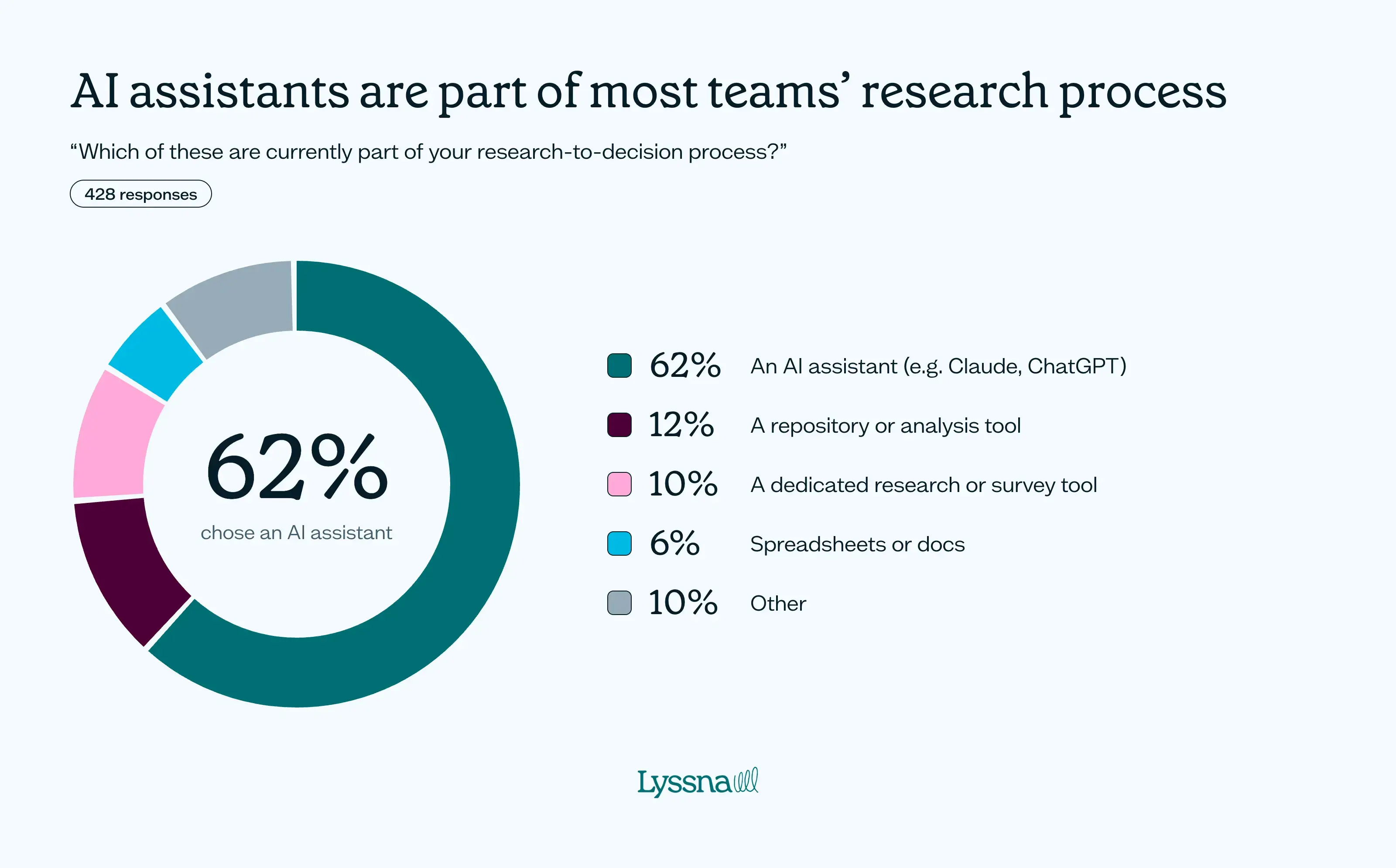
This question asked people to pick one answer, so it tells us which tool people think of first rather than every tool they use. A few participants used the "other" option to tell us they use a mix (or in one case, "All of the above").
What we think: An AI working from real participant data and an AI working from guesswork can sound equally confident. As AI assistants become a normal part of getting from research to decisions – and as teams are increasingly expected to use them – it's more important than ever to connect your AI tools to your research data.
Connecting AI to the tools teams already use
Connecting AI to your research is one example. But how many people have actually connected an AI assistant to the tools they already use? This is where we saw some of the biggest differences between roles.
Half have connected AI to their tools
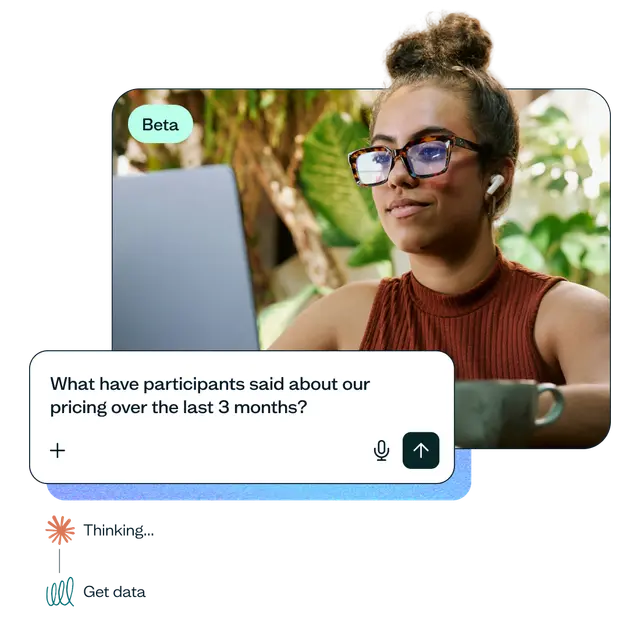
One of the biggest shifts in how people use AI assistants is connecting them directly to other tools. The Model Context Protocol (MCP) is one of the main ways this happens: it lets an AI assistant like Claude or ChatGPT connect to another tool, so you can ask questions about that tool's data without copying and pasting.
We asked whether people had connected an AI assistant directly to their research or product tools (for example, via MCP). Almost half (49%) said yes, and that they use it as part of their regular workflow. That's not too surprising – more and more tools now offer MCP servers, which makes connecting an AI assistant much easier than it was even a year ago.
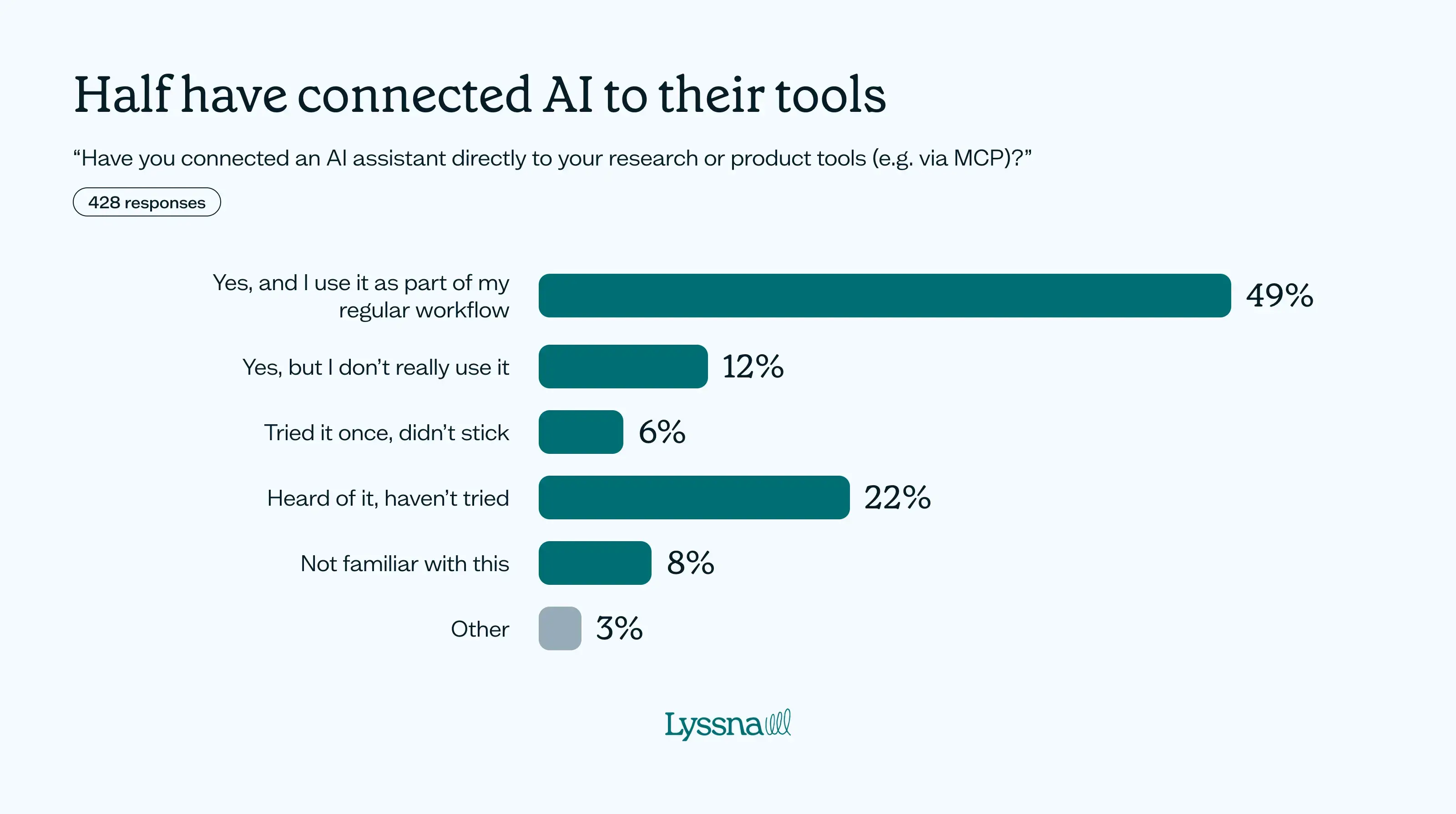
Another 12% have connected an AI assistant but don't really use it, and 6% tried it once but it didn't stick. Meanwhile, 22% have heard of it but haven't tried it, and 8% aren't familiar with it.
Engineers were well ahead here: 72% have connected AI to their tools and use it regularly, compared with 55% of product managers and 39% of designers. Again, that's not too surprising – engineers are often the people closest to setting up integrations like this. What's more interesting is the gap for designers: 89% of designers want an AI assistant connected to Figma, but only 39% have connected AI to their tools and use it regularly. The demand is clearly there, but the setup hasn't caught up yet.
For some people, the barrier isn't interest – it's permission. Several participants used the "other" option to tell us they're not allowed to connect AI to their tools:
"Not allowed / out of policy."
"Heard of it, not allowed to use."
"Not yet, we work in the government protected environment."
Where people want AI connected
We also asked which tools people would most want an AI assistant connected to. Figma came out well ahead, chosen by 71% of participants (although designers made up almost half of our sample). Jira (44%), Slack (40%), and Confluence (40%) followed, then Microsoft Teams (34%), Google Docs (33%), and Notion (22%).
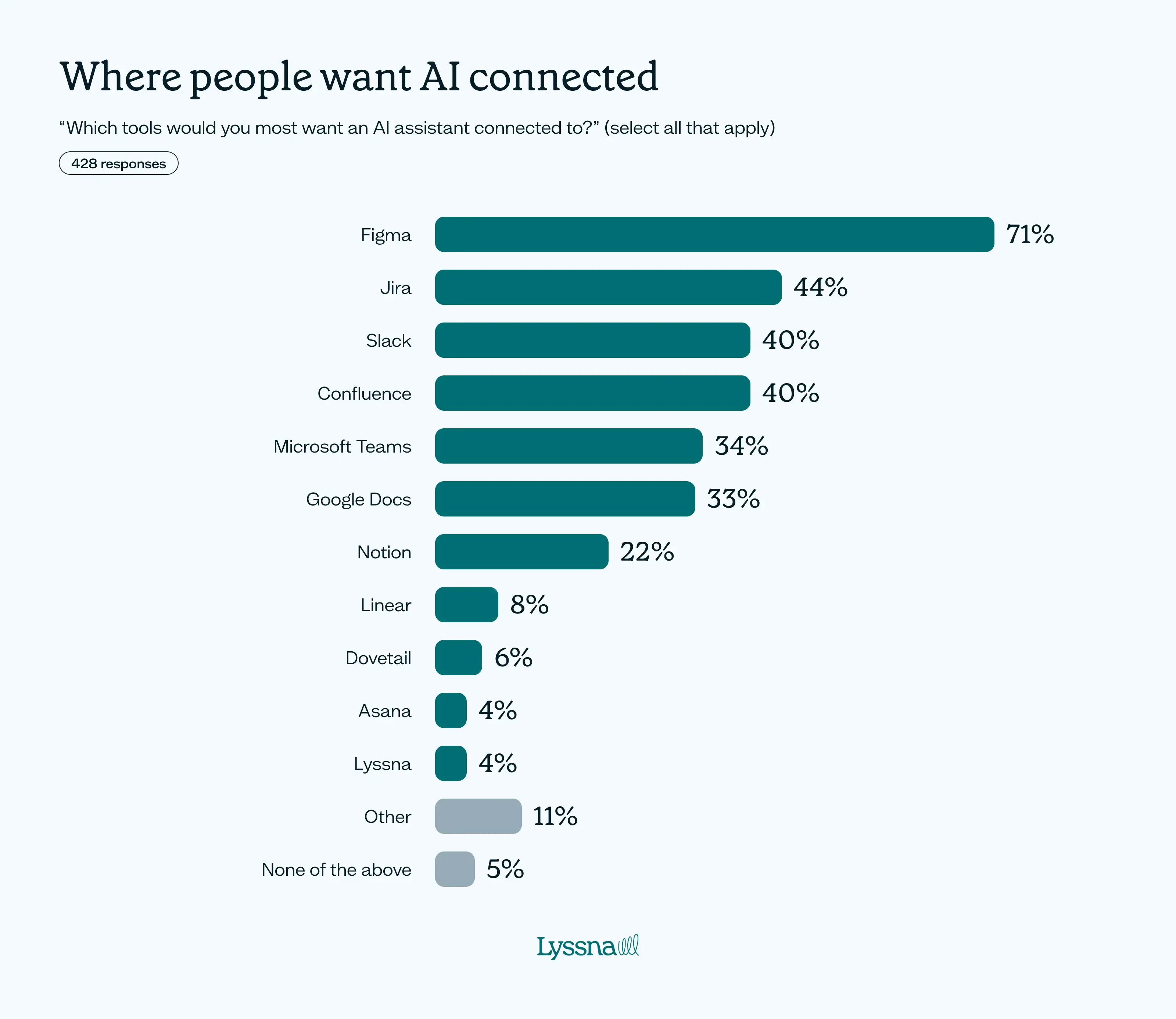
Research-specific tools were much further down the list: Dovetail (6%) and Lyssna (4%) – though that says as much about how few researchers took part (4% of the sample) as anything else. GitHub was the most common tool people added themselves.
What people want connected also varied by role. Designers overwhelmingly chose Figma (89%), while product managers leaned toward Jira (58%) and Confluence (48%).
What we think: People want AI connected to the tools where their day-to-day work happens – and for a group made up mostly of designers and product managers, that's design, planning, and communication tools. For product managers especially, the appeal is obvious: if your research and your Jira board are both connected to the same AI assistant, going from a finding to a recommendation to a ticket can happen in minutes instead of days. Research has the most impact when it's part of the tools where work happens.
Has AI changed how much research people do?
One of the questions we were most curious about: is AI replacing research, or encouraging more of it?
More research, not less
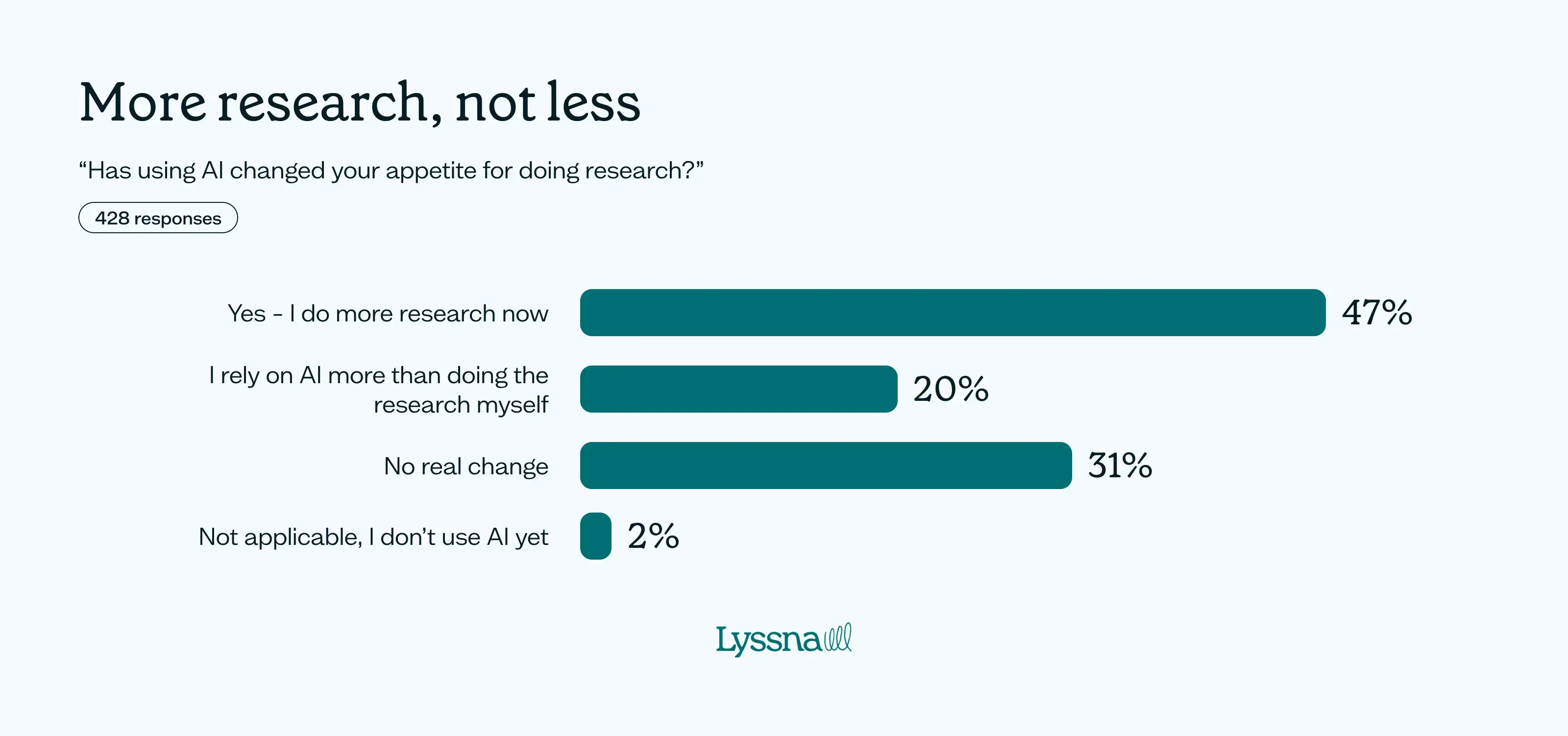
Almost half (47%) said using AI has made them do more research, and another 31% said there's been no real change.
That lines up with what we heard from product leaders earlier this year. In a survey of 107 senior product leaders we ran with Delight Path, 35% said they're doing more research now than before, and only 8% reported doing less. (Link: Product teams are doing more user research in the AI era)
People who have connected AI to their tools were especially likely to say they're doing more research. Among those who use a connected AI assistant as part of their regular workflow, 56% said they do more research now, compared with 24% of people who weren't familiar with connecting AI to their tools. We can't say one causes the other, but the two clearly go together.
A similar pattern shows up by how much people use AI overall. Of those who use AI throughout their process, 57% said they're doing more research, compared with 38% of those who use it for some steps.
But not everyone is using AI to do more research. One in five (20%) said they now rely on AI more than doing the research themselves. We didn't ask why (a follow-up question we'll be adding next time!), but we suspect speed has something to do with it. As AI makes it faster to build and ship, the pressure to make decisions quickly goes up too.
Joe Formica, Design Advocate at Lyssna, sees the risk in that:
"AI can be extremely useful for things like secondary research, competitive analysis, or getting directional context on a subject, where you don't need to talk to customers. But relying on it in place of real research is a risk. With so much pressure to build and ship, it's easy to use AI as a shortcut around talking to actual customers. And that shortcut can feel convincing. It can even win a decision in a stakeholder meeting. But it won't necessarily lead you down the right path, and sometimes you don't realize that until long after the fact."
Researchers are the exception
Researchers told a different story. Most (61%) said AI hasn't really changed their appetite for research, compared with 31% of participants overall. With only 18 researchers in the sample, this is a signal rather than a finding – but it may reflect that researchers were already doing research, while AI is making it easier for everyone else to start.
What we think: There will always be barriers to doing research – time, budget, access to the right people. AI won't remove them, but it does seem to be making research easier to start, especially for non-researchers. The goal should be using AI to free up time for talking to users, not to replace those conversations.
What slows teams down after a study wraps up
Even with AI in the mix, people still get stuck on the work that comes after a study is complete. Manual synthesis or write-up was the most common slowdown (32%), followed by pulling data from multiple tools (26%), getting the right people in the room (19%), and distilling findings for a non-researcher audience (13%).
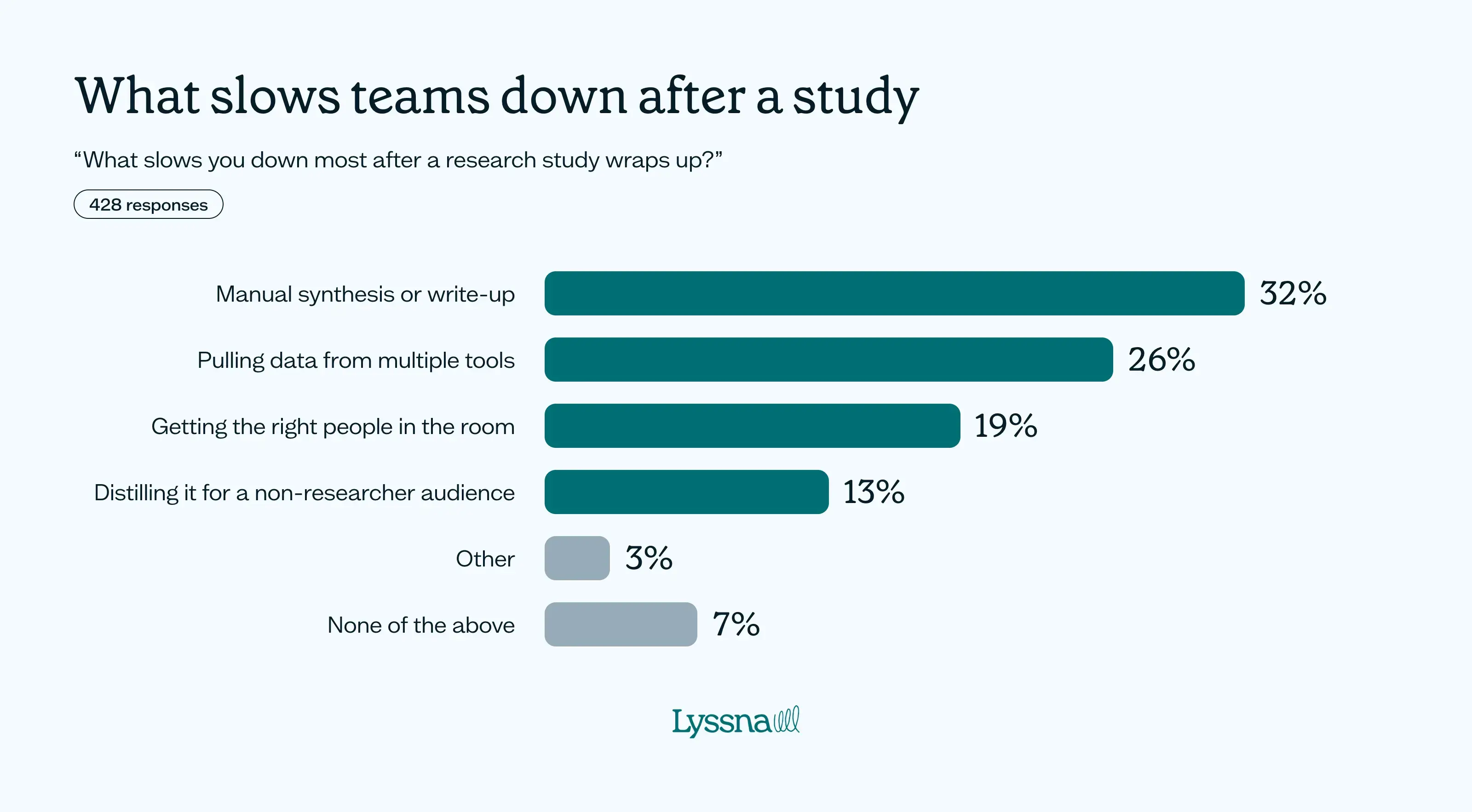
Product managers were the exception: for them, pulling data from multiple tools (33%) edged out manual synthesis (29%) as the biggest slowdown. For designers, synthesis came first (35%).
Some of the answers people wrote in themselves pointed to a newer kind of work – checking what AI produces:
"Fact checking."
"Checking for AI bias / errors."
"Checking whether the gathered info makes sense."
What we think: AI hasn't removed the work that comes after a study, but it has changed it. Less time goes into synthesis and write-ups, and more into checking what AI produces: confirming a quote against the transcript, double-checking how many participants raised a theme, and noticing the finding that's missing. The work is shifting from writing to editing, and that takes judgment. It also means tools need to make checking easy – an AI summary you can't trace back to real participants just moves the risk further down the line.
What people want AI to do with their research
Knowing where people get stuck, we wanted to find out what they'd most like AI to take off their plate.
The most wanted workflows
We asked which AI-powered workflow would most improve people's research process if they could build it today. Auto-synthesizing findings across studies came out on top (33%), followed by auto-generating reports from raw data (28%), auto-drafting recommendations for the team (18%), and auto-recruiting the right participants (14%).
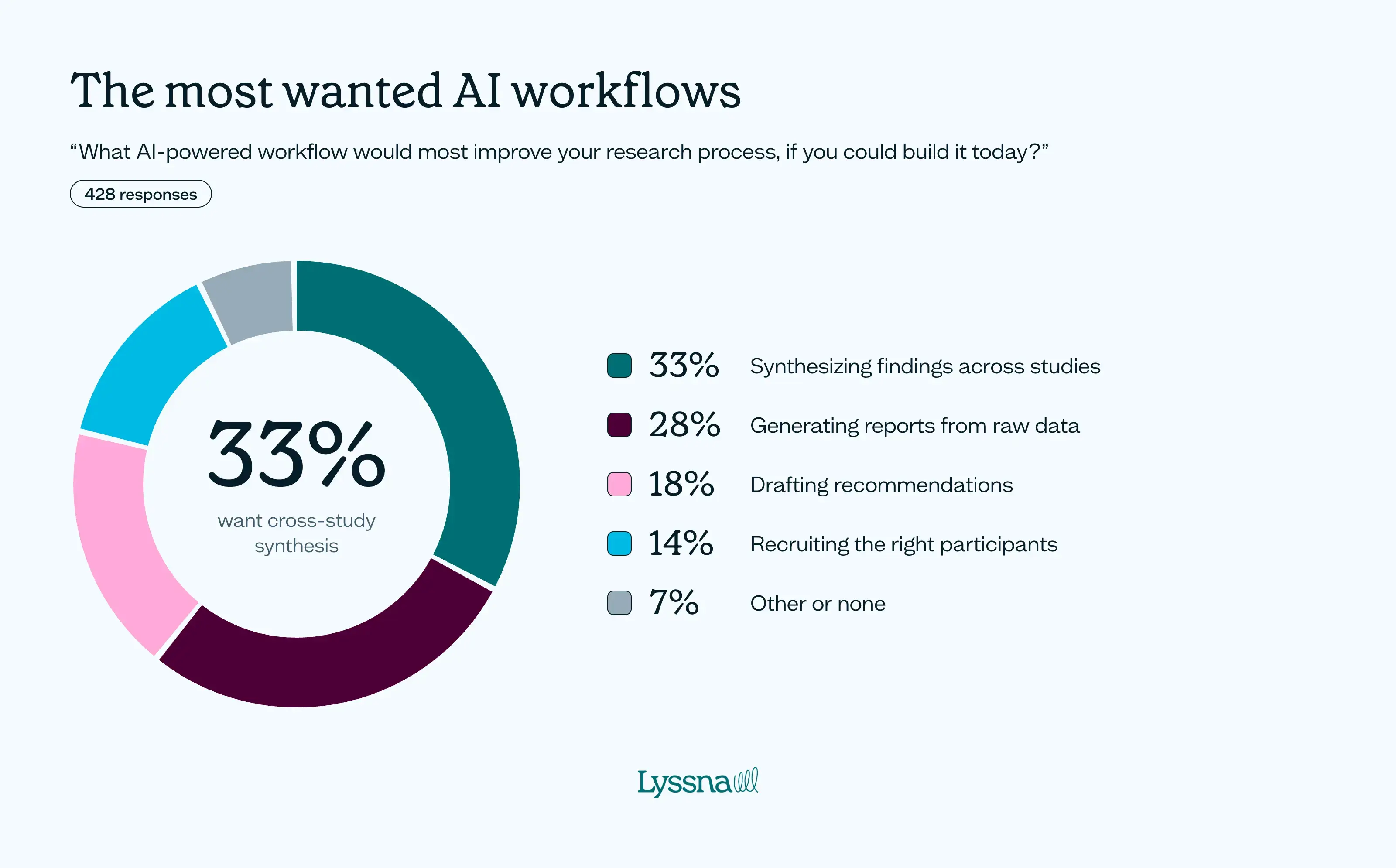
Product managers were more likely than average to choose drafting recommendations (27%). Researchers stood out for choosing recruitment (44%) – again, a small group, but a reminder that finding the right participants is still a real challenge for people who run research most often.
In their own words
We also asked an open question: "If an AI assistant could do one thing with your research data automatically, what would it be?" We received 258 answers. Here are the themes that came up most often.
Find the patterns people miss
By far the most common request, from around 80 people, was help finding patterns and insights in research data – and ideally, ones people wouldn't spot on their own.
"Help me see patterns, either confirm the ones I see or show me patterns I didn’t notice."
"Provide me with insights I wouldn’t identify myself. Be able to pull out data and visualizations based on prompts. Talk with the data."
Turn research into decisions
Around 40 people wanted AI to go beyond summarizing and recommend what to do next.
"Automatically turn research data into clear, actionable insights – identify the most important patterns, explain why they matter, and recommend what we should do next, rather than simply summarizing the data."
"Analyze it and give me decision options."
Connect the dots across sources
Around 35 people wanted AI to bring together research from multiple places, or compare new findings with past research.
"See the big picture and compare to previous findings."
Get it right, and show the evidence
Around 30 people talked about accuracy – including avoiding hallucinations and checking conclusions against the evidence.
"Answer my questions based on the data without hallucinating and inventing new data."
"Continuously recheck conclusions against new evidence."
Shape it for the audience
Around 20 people wanted AI to tailor research for the people who need to act on it.
"Present it in a way that fits the audience best."
"Summary for different teams, e.g. marketing, PMs, developers."
Challenge me, don't agree with me
A smaller group wanted AI to act less like an assistant and more like a critical thinking partner.
"Challenge me instead of agreeing with everything."
"The obvious answer would be gathering and collecting from different endpoints BUT I’d love to have an AI assistant that co-creates the synthesis with me. When I am summarizing and drawing conclusions I would love to have a tool that says “wait, we have gathered data that opposes this statement” or “do you want to use direct citation from user testing bc I can find some suitable options for this statement.”
Don't lose the human side
A few people pushed back on automation altogether – or asked that it not come at the cost of understanding real people.
"Please do not kill empathy with automation 💔"
"Present it briefly, but without loosing the essence of humans (edge cases, things that haven’t been said, etc.)."
What we think: The most interesting answers weren't about saving time. People want an AI that finds what they missed, suggests what to do next, and shows its evidence – closer to a sharp colleague than a summarizing tool. That's a higher bar than "make it faster," and it's one tools will need to meet. A faster summary only helps if it leads to a better decision.
The decision-ready report
A theme running through this survey is that the hardest part of research is turning it into something people can act on. So we asked how people would feel about AI doing more of that work for them.
Would a decision-ready report help?
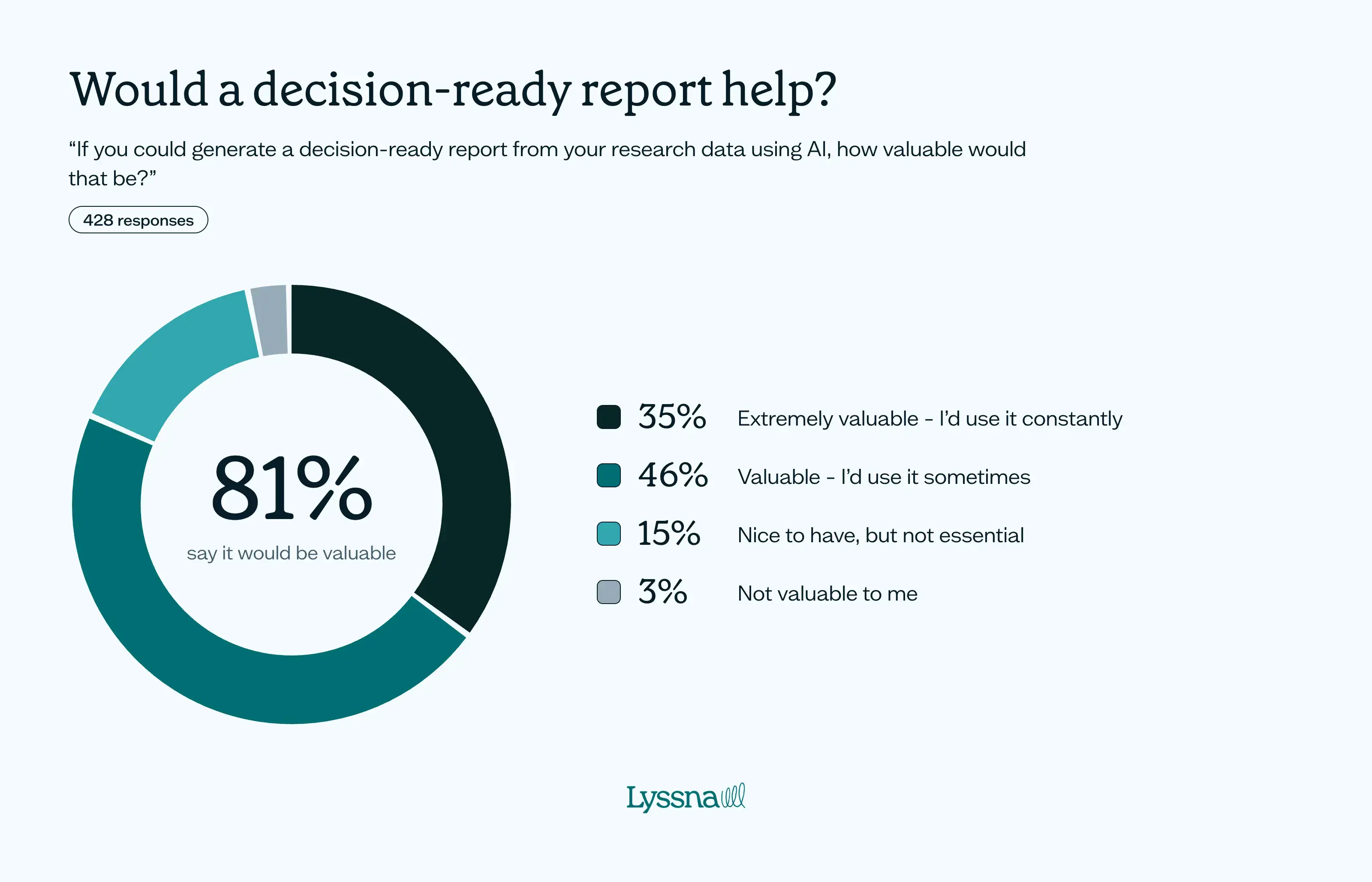
We asked how valuable it would be to generate a decision-ready report from research data using AI. More than four in five (81%) said it would be valuable, including 35% who said it would be extremely valuable and they'd use it constantly. Only 3% said it wouldn't be valuable to them.
What would make an AI research report useful
We asked people who saw at least some value in a decision-ready report what would make it most useful (414 responses). No single format won. Key stats and charts (49%) and recommended next steps (49%) were tied at the top, followed by a slide-ready summary (46%), plain-language takeaways for people outside the research team (44%), a live dashboard (43%), and direct quotes from participants (42%). Video clips from interviews were chosen by 22%.
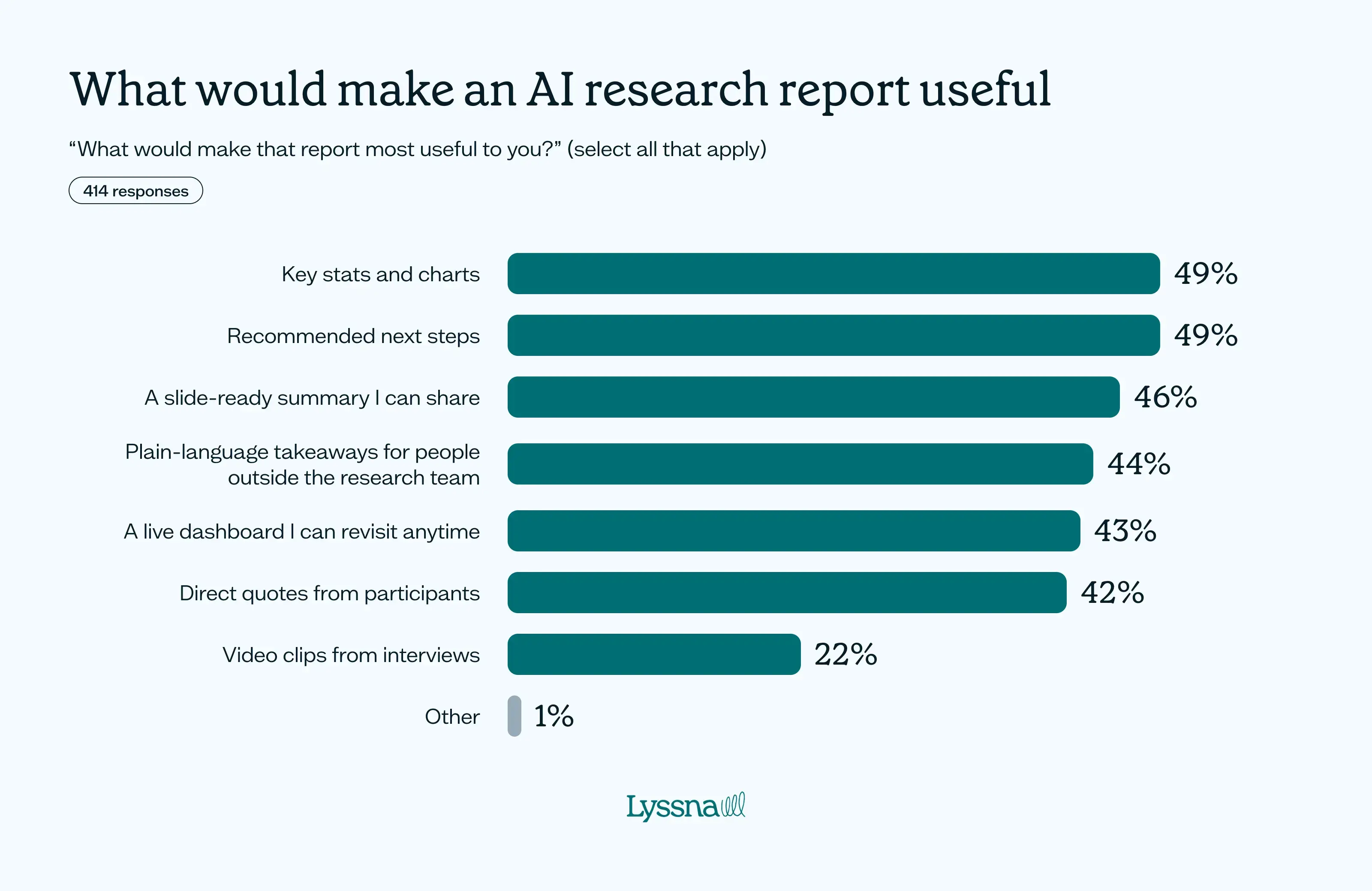
Roles valued different things. Designers were more likely than product managers to want direct quotes from participants (53% compared with 31%), while product managers leaned toward a live dashboard they could revisit (50%).
This likely reflects how each role uses research. Designers often need to validate a design decision, and a participant's own words can be more persuasive than a summary. Product managers are more likely to be tracking progress across a roadmap, so they want something they can come back to as things change.
Would it change how often people do research?
We also asked the same group whether a report like this would make people run research more often. Most (85%) said yes – 36% said a lot more and 49% said a little more.
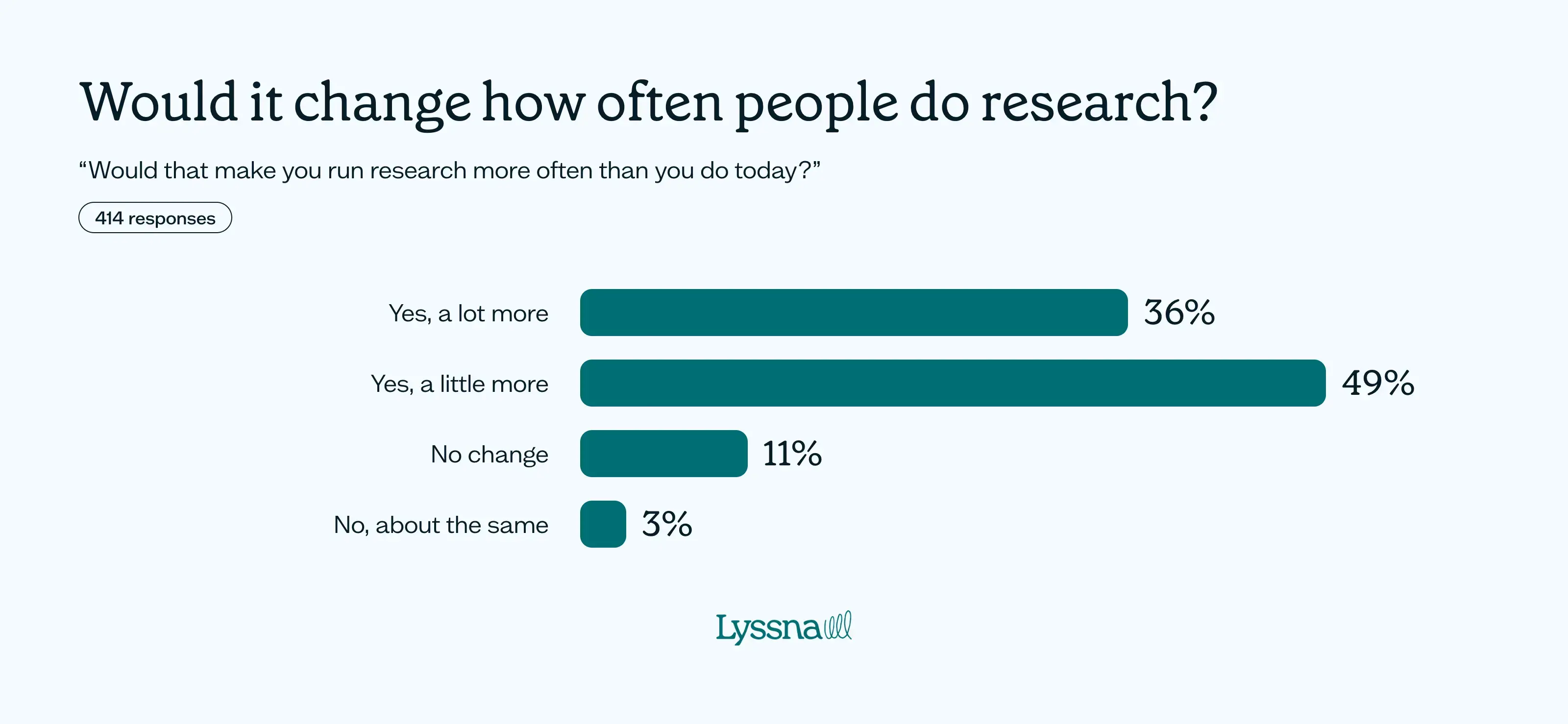
This is people predicting their own behavior, so it's best read as a sign of intent rather than a forecast. Researchers were the most cautious group here too, with 31% saying it wouldn't change how often they run research.
What we think: What people want is flexibility – the ability to generate a report from their research when they need it, then shape it for the intended audience – a slide for stakeholders, quotes for designers, a dashboard for product managers. And if that makes research easier to share, it's likely to get used more, too.
What's holding people back from using AI with research data
The biggest group (29%) said nothing – they're already doing it. But data privacy or security concerns (27%) and trust in accuracy (25%) were close behind.
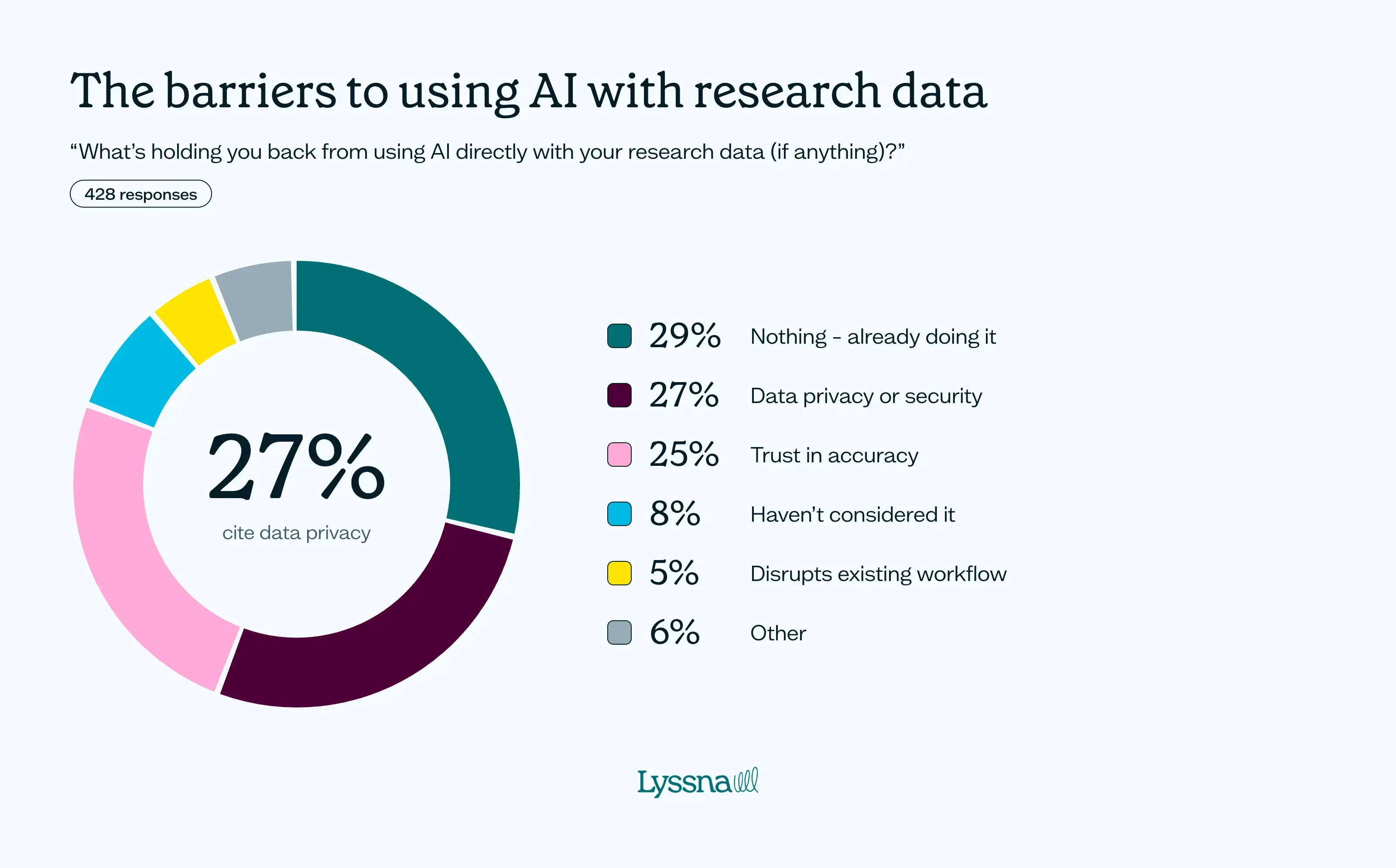
Fewer people said they hadn't really considered it (8%) or that it would disrupt an existing workflow (5%).
Trust matters most for people who have already set up a connection. Among people who have connected an AI assistant to their tools but don't really use it, trust in accuracy was the most common barrier (40%). For them, the challenge isn't setup – it's confidence in what comes back.
Privacy concerns were highest among people who have heard of connecting AI to their tools but haven't tried it (35%). In the education sector, almost half (47%) said privacy was their main concern, although that's a small group.
For others, the decision isn't theirs to make. Several people who chose "other" pointed to company policies, client restrictions, or limits on what can be shared with AI tools – echoing the participants who told us earlier that they're not allowed to connect AI to their tools at all.
And some wanted to protect the thinking that research involves. As one participant shared:
"This is when good ideas actually happen. I don’t want to outsource this skill."
What we think: Concerns about accuracy and privacy are fair, and we think they put as much responsibility on the tools as on the people using them. People will rely on AI more with their research when they can see where an answer came from and know how their data is being handled. That means tools being upfront about what the AI is doing, where its limits are, and what happens to your data. (It's something we've written about in how we approach AI at Lyssna.)
What we think this means for product teams
More people are doing research with AI assistance, and trust is becoming the thing that matters most. Here's what we think that means for teams.
Bring your research to where AI already is. 62% of the people we surveyed already have an AI assistant in their research-to-decision process. Rather than adding another tool, look at how to connect your research to the assistant your team already uses.
Make AI answers easy to check. Among people who have connected AI to their tools but don't really use it, trust in accuracy was the top barrier. When an AI tells you what your participants think, you should be able to see the quotes, numbers, and studies behind it. If checking is easy, people keep using it. If it doesn't, they give up.
Share research in a way anyone can act on. Most of the people turning research into decisions here were designers and product managers, not researchers. And 44% wanted plain-language takeaways for people outside the research team. Findings only land if the people acting on them can understand them.
Use AI as a sounding board, not a shortcut. Some of the most interesting answers asked AI to push back. We think that's the right instinct. The risk with AI isn't only that it gets things wrong, it's that it can make a weak conclusion sound convincing. An AI that challenges you, for example by pointing out a quote that contradicts your conclusion, makes you look harder at what participants actually said – instead of just confirming what you already thought.
Get ready for AI that acts, not just answers. We didn't ask about AI agents, but they're arriving fast. Soon (if you aren't already) you might ask an agent to turn findings into tickets, share them with stakeholders, and follow up. The more AI does on your behalf, the more it matters that it's working from real participant data.
The teams that get the most from AI will be the ones that make sure it's working from what real people actually said and did.
How Lyssna can help
Lyssna has AI built in at every step of the research process, from recruiting participants to summarizing results. And if your team is already using an AI assistant, Lyssna's MCP server lets you connect it to your research. You can use Claude, ChatGPT, or another MCP-compatible assistant to ask questions across your studies, interviews, and surveys, find research by describing a topic, and pull verbatim quotes from real participants. Because every answer draws on data from real people, it's easier to check where an insight came from before you share it with stakeholders.
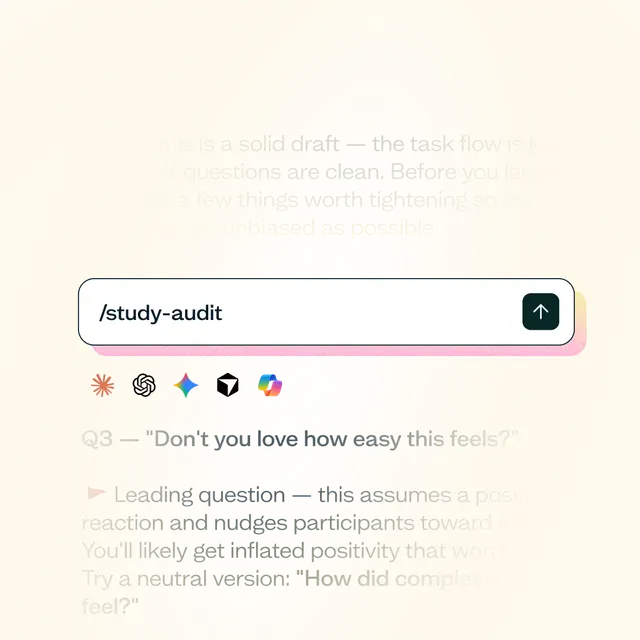
Once you're connected, our free AI Skills Library – built by researchers, for researchers – helps with the parts of the process people told us slow them down. Use it to synthesize study results into findings backed by verbatim quotes, turn findings into ranked next steps, and share them in the right format for each audience, from a quick Slack update to a stakeholder report. There's also a study audit skill that flags leading or unclear questions before you launch.
Whether you're a designer pulling together feedback for your next iteration or a product manager preparing for a roadmap decision, it means less time copying and pasting between tools, and more time acting on what your research tells you.

Diane Leyman
Senior Content Marketing Manager
Diane Leyman is the Senior Content Marketing Manager at Lyssna. She brings extensive experience in content strategy and management within the SaaS industry, along with editorial and content roles in publishing and the not-for-profit sector

You may also like these articles