10 Jul 2026
|12 min
Product teams are doing more user research in the AI era
The assumption that AI would replace research is proving wrong. Here's what the data actually shows.


When AI tools started reshaping how product teams work, a reasonable assumption emerged: research would be the first thing to go. Why spend weeks talking to users when you could ship a feature in days, measure what happens, and iterate?
The data says otherwise.
We partnered with Delight Path on the State of Product Leaders Report Q2 2026, a survey of 107 senior product leaders that was built and hosted on Lyssna, with our research panel helping recruit participants. Together, we explored six areas: AI pressure, the agentic shift, user research, feature adoption, team structure, and how the product leadership role itself is changing.
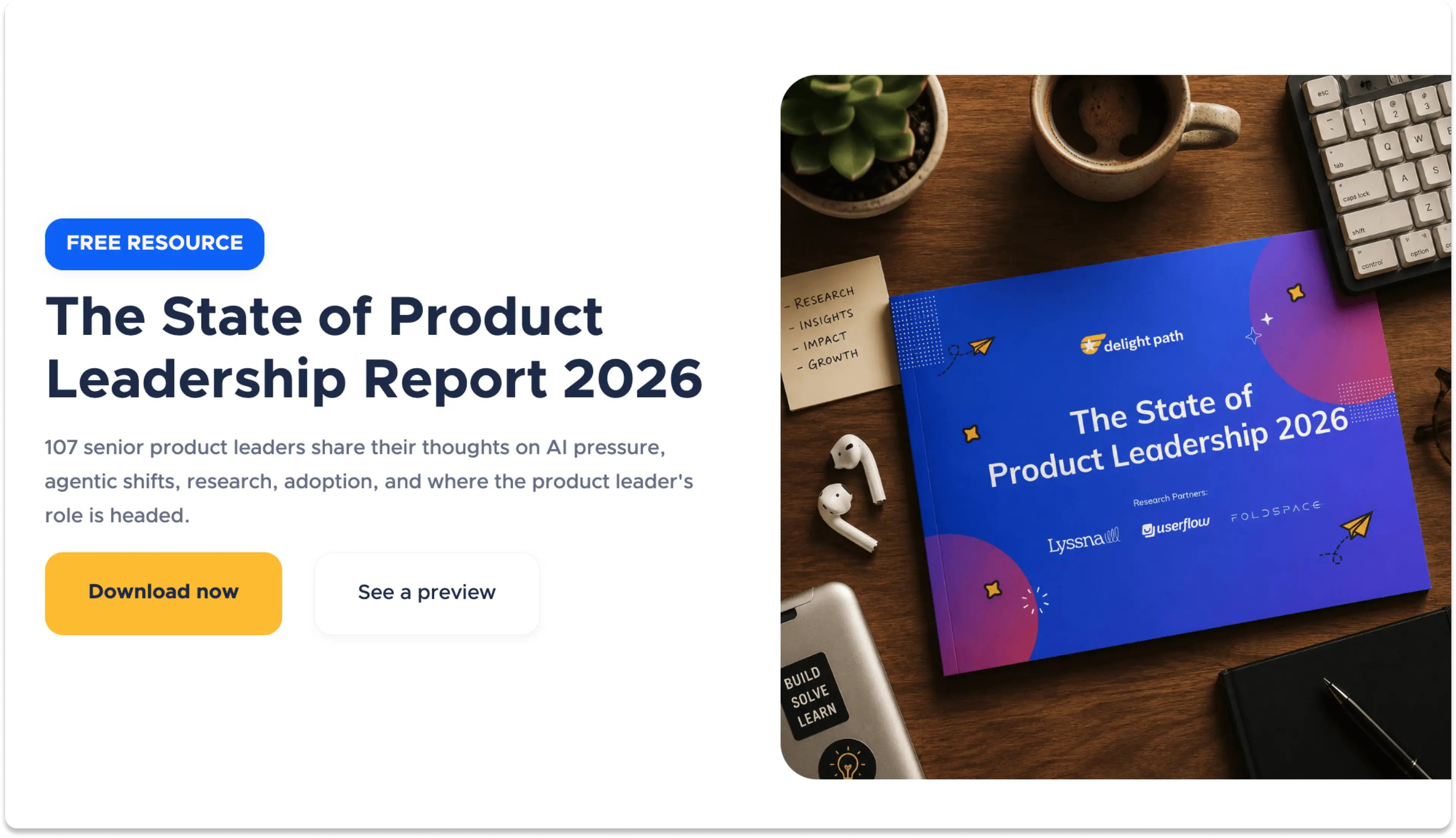
We want to dig into one part of the findings in particular: what's happening to user research as AI becomes a bigger part of their workflow. But first, a bit of context on why this report exists and what it's measuring.
Key takeaways
More research is happening, not less – over a third of product leaders report doing more research since AI entered their workflow, not less.
AI speeds up execution, which raises the cost of shipping the wrong thing – making research more important, not less.
80% of product leaders now use AI for research, but rigor hasn't kept pace with adoption.
Sample size, cherry-picked findings, and missing statistical backing are the top reasons leaders question research credibility.
If you're running research solo under deadline pressure, Lyssna's research panel and Synthesize feature can help you move fast without cutting corners on rigor.
How this research was conducted
Delight Path ran this survey in Q2 2026, pulling respondents from the Product Leaders Lab community, the Delight Path newsletter, and Lyssna’s research panel. 107 product leaders took part, and the seniority skews senior: nearly two-thirds hold a Director, VP, or CPO title.
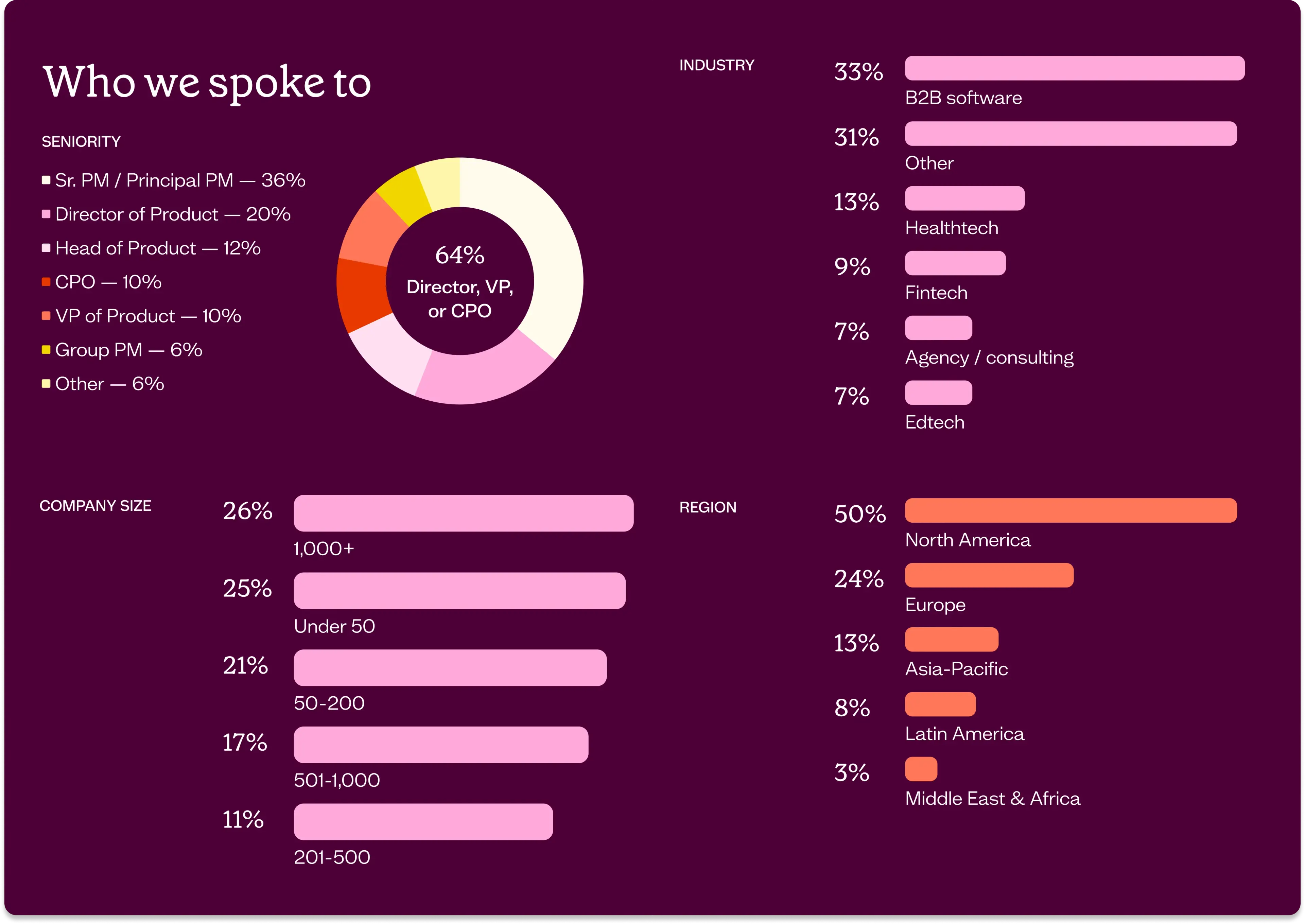
The sample spans a real mix of company sizes, from teams under 50 people through to organizations with 1,000-plus employees, with no single size dominating the results. Industry-wise, B2B software made up the largest single segment at a third of respondents, followed by smaller slices from healthtech, fintech, agency and consulting work, and edtech. Geographically, half the respondents were based in North America, with the rest spread across Europe, Asia-Pacific, Latin America, and the Middle East and Africa.
Worth flagging: this is a survey of people already engaged with the Product Leaders Lab community, so it likely captures leaders who are more plugged into peer conversations about AI than the average product leader might be. That context is useful to keep in mind as you read the numbers below.
Why we're talking about this report
Whether you're a solo PM juggling research on top of everything else, or sitting on a leadership team trying to figure out your AI roadmap, the pressure is the same: do more, faster, with AI, and prove it's working.
77% of the product leaders surveyed are under moderate, significant, or extreme pressure from their C-suite to move faster on AI. Only 5% say there's no pressure at all.
Level of C-suite pressure | Share of product leaders |
|---|---|
Extreme | 12% |
Significant | 38% |
Moderate | 27% |
A little | 17% |
None | 5% |
Here's the catch: pressure and clarity aren't moving at the same speed. Only 10% of product leaders say their C-suite is strongly aligned on what AI should actually do for their product. Nearly a third describe their leadership as misaligned or not aligned at all.
That same pattern – pressure arriving faster than clarity – shows up again when you look specifically at how product leaders are using AI in their research practice.
More research is happening, not less
When we asked how AI has changed the volume of user research across their teams, 35% said they're doing more research now than before. Another 31% say the type of research has shifted even though volume is similar, and 22% haven't seen a change yet. Only 8% reported doing less, and just 4% said they don't do formal research at all.
How AI has changed research volume | Share of product leaders |
|---|---|
We do more research now | 35% |
Type shifted, volume similar | 31% |
No change yet | 22% |
We do less | 8% |
No formal research | 4% |
This is an encouraging signal and not the story most people expected. With vibe coding and AI tooling making it easier than ever to spin up a working product without testing it on real users, let alone talking to them, it would have been easy for research to quietly slip down the priority list.
Instead, the data suggests the opposite is more common, but this makes sense when you think about what AI actually changes.
The faster you build, the more research matters
The core tension in any product team is the gap between what you can build and what you should build. For most of product history, the constraint sat firmly on the building side. Ideas were plentiful, but the shipping was slow.
AI is collapsing that gap. Teams can now ship faster than ever, which means the cost of shipping the wrong thing has never been higher. If you could build two features a month, a wrong call cost you two months. If you can build ten, that same wrong call costs proportionally more, and the errors compound faster.
Research is how you keep speed pointed in the right direction. And the product leaders in this survey seem to understand that. Two survey participants put it plainly:
"With AI accelerating delivery, it is more important than ever to have clear guidance on what to build."
“The cost to build has gone down and the value now is in knowing what to build."
Both are making the same observation. AI changes the economics of building. It doesn't change the need to understand your users.
80% of product leaders are already using AI for research
It's not just that teams are doing more research. They're doing it differently. 80% of product leaders are already using AI tools to conduct or synthesize user research. 34% are using them heavily.
How product leaders are using AI for research | Share of product leaders |
|---|---|
Yes, experimenting | 46% |
Yes, heavily | 34% |
No, but planning to | 16% |
No | 5% |
Part of what's driving the volume increase is accessibility. Teams that never had a dedicated research function are now running studies. Product managers are synthesizing interview transcripts in minutes instead of hours. The barrier to getting a meaningful signal from real users has dropped significantly.
That's genuinely good news. More research, done faster, getting to the people who need it sooner. But there's a catch.
The real shift: From analysis to judgment
As Tristan Gamilis, CPO and co-founder of Lyssna, notes in the report:
"When AI tools do the synthesis of user research, the hard work shifts to interrogating the output, which takes real care when everything AI produces looks plausible. The real skill is knowing what your evidence actually supports, and staying honest about what it can and can't tell you."
That reframes where the skill actually sits. AI can speed up the unglamorous parts of synthesis – pulling out patterns, drafting summaries, organizing themes. What it can't do is tell you whether your sample was representative, whether your findings are robust enough to act on, or whether you're seeing a real pattern or a convincing-sounding hallucination. That judgment still sits with the person running the research, AI-assisted or not.
This lands hardest for the people doing research without a dedicated researcher on the team, which, per the report, describes most product leaders surveyed. When you're both the one running the study and the one under pressure to deliver a quick answer, a clean AI-generated summary is tempting to take at face value. Building in even a short pause to stress-test that output isn't a delay. It's the difference between insights you can act on with confidence and insights that just look like you can.
More research doesn't automatically mean more trustworthy research
If product teams are doing more research, faster, and with more AI assistance, the question is whether the quality of that research is keeping pace with the volume.
The data suggests it isn't, at least not yet. 49% of product leaders say sample size is the most common reason they question research credibility, followed by cherry-picked findings (45%) and no statistical backing (42%). Further down the list, leaders also point to methodology that isn't explained clearly (37%), researchers who can't defend their approach (29%), results that conflict with other data (24%), rushed timelines (20%), and findings presented with too much certainty (13%).
Reason for questioning research credibility | Share of product leaders |
|---|---|
Sample size too small | 49% |
Findings feel cherry-picked | 45% |
No statistical backing | 42% |
Methodology not explained clearly | 37% |
Researcher can't defend approach | 29% |
Results conflict with other data | 24% |
Timeline seems rushed | 20% |
Too much certainty in findings | 13% |
Research volume is up, but confidence in that research hasn't kept pace. The teams that help product leaders trust what they're seeing – not just produce findings faster – will have the advantage.
A few things that help:
Be transparent about your process. When research is moving fast, the "how" often gets skipped in the readout. A short explanation of who you recruited, how many participants took part, and what approach you used is often enough to head off the most common credibility concerns before they surface in a stakeholder meeting.
Be honest about what the research can and can't tell you. Product leaders don't expect every study to have statistical significance. They do expect you to be upfront when it doesn't. Flagging that findings are directional and naming what you'd need to validate them further signals rigor rather than undermining it.
Use AI to speed up synthesis, not replace judgment. AI tools are genuinely useful for processing large volumes of qualitative data quickly. But the insight – the "so what" that connects observation to recommendation – still requires someone who understands the context. Use AI to go faster and use your judgment to go deeper.

See where your research process might need a second look
If any of this sounds familiar – running studies solo, leaning on AI to speed up synthesis, presenting findings under deadline pressure – it might be worth building in a lightweight check before you act on what AI hands back.
Lyssna's AI-powered Synthesize feature is built around that exact balance: it speeds up the unglamorous parts of synthesis while keeping you in control of the narrative.
Where else is AI pressure showing up?
Research is one piece of a bigger picture in this report. A few other findings worth knowing about:
Ownership of AI strategy is still unsettled. Roughly half of product leaders say the product team owns the AI and agent strategy at their company. One in five say no one has claimed it yet. That kind of gap tends to compound rather than resolve itself as decisions get delayed and priorities drift while nobody's clearly accountable.
Trust is the biggest barrier to AI feature adoption, not confusion. When we asked product leaders what stops users from adopting AI features, trusting the output ranked well above understanding how a feature works or fitting it into an existing workflow. The credibility problem we're seeing in research is showing up in the product experience too.
A meaningful share of teams are flying blind on whether AI features are even working. Nearly a third say they have no dependable way to measure whether their AI features deliver value at all.
Where this leaves product leaders
Despite the uncertainty, the overall mood leans hopeful. Roughly half of respondents say their experience in the role has improved over the past year, and the large majority land somewhere on the optimistic end of the spectrum about where product leadership is headed. Most expect AI to broaden their responsibilities rather than narrow them – as building gets easier, deciding what's worth building becomes the harder, more valuable skill.
What product leaders want most isn't another framework or course. It's research on what's actually working at other companies (84%) and a peer community at their level (51%).
As Ramli John writes in the report introduction, that's not a content problem. That's a connection problem.
"The best insight still comes from real human connection. Whether that's a user interview that reframes how you see the problem, or a peer conversation with another product leader who's navigated something you're about to face, AI can speed up the analysis but it can't replace the moment when another person says the thing that changes how you think. That's true in research and it's true in how we grow as leaders."
Ramli John
Founder, Delight Path
If you're feeling the pull between moving fast and trusting what you find when you do, you're in good company. Most of the leaders in this report are navigating exactly the same thing.
How Lyssna can help
If you're running research solo and under pressure to move fast, Lyssna gives you a way to keep pace without cutting corners on rigor. Recruit the right participants from our research panel, run studies across every core research method in one platform, and use Synthesize to speed up the unglamorous parts of analysis – while you stay in control of what the findings actually mean.
FAQs about how product leaders are running user research with AI
Want the full picture? Download The State of Product Leadership 2026 from Delight Path
You may also like these articles