17 Sep 2026
|8 min
Making your research reusable with AI
Research doesn't have to go stale after one project. See how a connected AI assistant makes your past research reusable across your team.

Making your research reusable with AI means connecting studies you've already run to an assistant that can answer questions about them – so people beyond the research team can ask instead of rerunning a study or waiting on you.
Every research study you run adds knowledge to your organization, but that knowledge doesn't automatically get easier to find later – it just sits there until someone remembers it exists, or reruns the study because they don't.
That's increasingly not the researcher's problem alone to solve. Designers and product managers already do a large share of research themselves, often without the context the original researcher had, according to our Research Synthesis Report – so the people who most need to reuse past research are often not the people who ran it.
This chapter is about how to make your research searchable and findable using AI, so it's still useful the next time someone needs it, not just while the project's fresh.
Key takeaways
As organizations grow, so does the challenge of finding past research.
Non-researchers, including designers and product managers, already run research – the people who most need self-serve access to past research often weren't the ones who ran it.
AI can help you find and query a past study, but good documentation still makes the answer faster and more trustworthy.
Connecting an AI assistant to your research tool means someone whose access allows it can ask a question and get an answer grounded in real data, instead of rerunning a study that already exists.

How documentation makes research reusable
An AI assistant can only surface research that exists in your research tool in the first place.
Some dedicated AI research repository tools use AI to auto-tag and organize studies as you add them. If your AI assistant is connected to a general-purpose tool like Notion or Google Docs instead, that connection might be write-capable too, letting it create pages, add tags, or update documents on your behalf.
Lyssna's MCP server connects to studies you've already run in Lyssna, surfacing your data and transcripts, rather than doing the organizing work for you. Connecting an AI assistant doesn't fix a backlog of undocumented studies, but it makes well-documented ones easier to find.
In practice, that means a study needs to exist in Lyssna – as a usability test, survey, or interview – for an assistant to be able to find it. Semantic search (matching by meaning, not exact keywords) means it doesn't need a clean title or matching tags to surface relevant quotes straight from transcripts and responses, but what good documentation still buys you is context: a title and summary make it faster to tell which study an answer came from, and whether the finding is still relevant.
Documentation basics | Why it matters for AI retrieval | Quick example |
|---|---|---|
A clear, specific title | Doesn't change what surfaces – semantic search finds relevant studies either way – but it's the fastest way to tell which study an answer came from | Checkout flow usability test – mobile, Q1" beats "Study 14" |
A few consistent tags | Groups related studies together for browsing or scoping your own query | "onboarding," "mobile," "pricing" |
A short written summary in your repository | Gives an assistant something concise and accurate to quote, instead of leaving it to stitch that together from raw transcript excerpts | 2–3 sentences: what you tested, what you found, what you'd act on |
Using AI to close the documentation gap
If creating consistent summaries for your research studies is the part that keeps slipping, that's a good use for a general-purpose AI assistant on its own: it can make writing up any single study faster and more consistent.
Joe Formica, Design Advocate at Lyssna, put it plainly in a live workshop on building a continuous interview habit: "Consistency beats intensity. If it takes a lot of time to put them in a neat Notion database, don't do it. Find a quicker way. If it's taking you a while to type up summaries, create a Claude skill that you can drop the transcript in, give it a format, and get a good summary in 10 seconds." He was talking about continuous interviewing specifically, but the advice holds for any documentation backlog.

Pro tip: Ask an AI assistant to draft a reusable one-page study summary template – sections for goal, method, key finding, and confidence level work well – so documentation quality is consistent.

Connecting your research tool to an AI assistant
Connecting your research tool to an AI assistant usually means a Model Context Protocol (MCP) server – a connector that lets AI assistants query your data directly, without you copying anything across by hand. What it can do depends on the tool: some connectors are read-only, some can write back into the source tool too.
Lyssna's MCP server connects assistants like Claude, ChatGPT, Microsoft Copilot, Cursor, and Gemini directly to studies you've already run, so someone can ask a question instead of manually digging back through old studies. For the full connection walkthrough and use-case tour, see MCP for AI research.
A few specifics about how it works:
It's self-serve – connecting is an open connection via URL, no support ticket required.
It respects the permissions you already have – it only surfaces what your own Lyssna access already allows, including anything scoped to a specific Space you're part of.
It's read-only – there's no creating, editing, or organizing studies through it. Some MCP integrations are write-capable, letting an AI assistant tag, update, or organize records on your behalf – that's a different model from what's described here, where the documentation still has to happen in Lyssna itself before an assistant can find it.

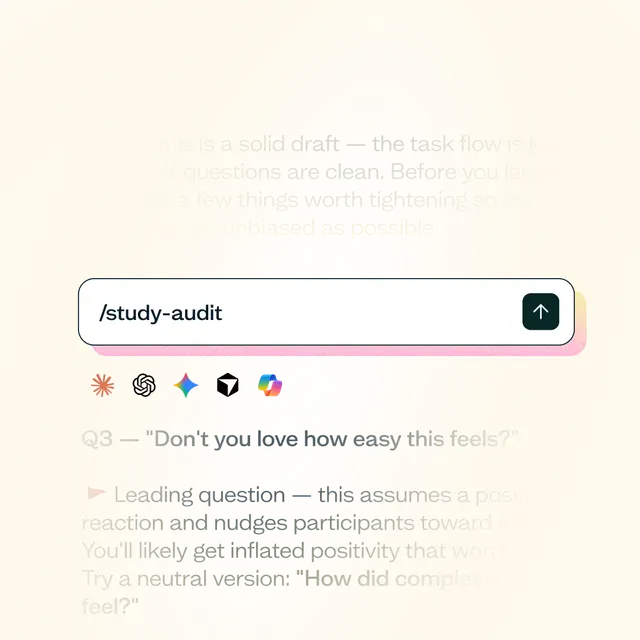
Skill spotlight: Lyssna's Ask Your Research Anything skill is built for exactly this question – "do we already know anything about this?" – and gives a straight, honestly-caveated answer grounded in everything you've already researched, not just a pile of matching quotes.
What reusable research actually unlocks
Whether you're the UX researcher who ran the original study or the designer or product manager who wants to reuse it, connecting research changes who can act on it. This means that someone who wasn't the original researcher can ask their own question and get an answer grounded in real data, instead of pinging the research team or rerunning a study that already exists.
That matters more as access to research spreads further beyond the research team itself, and connecting research to an AI assistant is one concrete way that access actually happens.
Frances James, Director of International UX Research at Indeed, described managing this manually across two teams: she keeps two spreadsheets open in browser tabs "24/7," she said, "so that I can just jump in quickly and easily answer questions for anybody that might come up about what my team's working on, and just know what's going on for everybody." That's a real, working solution – and also exactly the kind of manual triage that connected, queryable research is meant to replace.

Info tip: An AI assistant surfacing an old finding doesn't mean it's still true. Treat "this was researched before" as a starting point for judgment, not a substitute for it – especially if the study is old enough that the product or the audience has since moved on.

What are the limits of making research reusable with AI?
Whether an AI assistant can act on your research, not just find it, depends entirely on how that connection is built. Some MCP integrations are write-capable, letting an assistant tag, clean up, or reorganize a repository directly. Others are read-only: they help someone find and ask about research that already exists, without doing any of that organizing work. AI itself can genuinely help with organizing – drafting summaries, suggesting tags – but that's a separate capability from what a read-only connection does on its own, and it's worth knowing which one you're actually working with.
Access still needs a human decision. Not all research should be equally queryable by everyone, and that judgment call gets more important, not less, once asking a question is this easy – permissions and access controls are doing real work here, they aren’t just a formality.
And an AI surfacing an old finding doesn't mean it's still true: a "this was researched before" answer is a starting point, not necessarily a replacement for running new research.
How Lyssna can help
Lyssna's MCP server connects your AI assistant directly to studies you've already run – usability tests, surveys, and interviews – using semantic search, so a question can be answered from what participants actually said even without an exact study name.
On the organizing side, Spaces – Lyssna's way of grouping studies by team, topic, or goal, with access scoped to who's actually in each Space – is what makes "respects your existing permissions" mean something concrete rather than an abstract promise: what an assistant can surface for you follows the same Space membership and access you already have.

Further reading: For the groundwork this chapter builds on – querying across studies, pulling quotes without leaving your assistant, and checking whether research already exists before commissioning something new – see Analyzing and synthesizing with AI.