24 Nov 2026
|14 min
Concept testing
Learn how concept testing helps validate new product ideas, reduce risk, and build what users really want.

Concept testing is one of the most reliable ways to find out whether an idea is worth building. It's the process of showing an early idea – a feature, a flow, a design direction, or a pricing model – to people in your target audience and measuring how they respond.
That matters because it's easy to get attached to an idea. Everyone in the planning meeting might like a new feature, but liking an idea internally isn't the same as knowing your users want it. And once design and engineering time goes in, walking away gets much harder. Ford put $250 million into the Edsel and lost $350 million on it, according to Business Insider. Most product teams aren't betting that much on one idea, but a feature that takes a quarter to build and then goes unused is a costly mistake at any scale.
Whether you're a product manager deciding what makes the roadmap or a designer choosing between two directions, the methods, examples, and step-by-step process below will help you get a clear read on an idea early – along with an honest look at what concept testing can't tell you.
Key takeaways
Concept testing shows whether people understand an idea, want it, and prefer one version over another.
How you present concepts matters as much as the method you use to collect feedback.
Match your stimulus to the question: polished mockups can lift ratings for reasons unrelated to the idea.
Concept tests measure what people say they'd do, so follow promising results with a test of real behavior.
With Lyssna, you can run a concept test and reach 10M+ panelists across the Lyssna panel and our partner panels, or invite your own participants.
What is concept testing?
Concept testing is a research method for evaluating an idea with your target audience before you invest in building it. Participants see a description, sketch, mockup, or prototype of the concept and answer questions about how clear, appealing, relevant, and believable it is. The results help you decide whether to move the idea forward, which version to pursue, or what to change first.
What counts as a concept
A concept is an early version of an idea you want to test before building it – the core of what it is, who it’s for, and why they’d want it. For product and UX teams, that usually means one of the following:
A new feature or capability.
A user flow, like a new onboarding or checkout sequence.
A value proposition or positioning statement.
A pricing model or packaging change.
A visual or interaction design direction.
Marketing teams test concepts too – ad creative, campaign messages, and taglines. We cover that in our guide to concept testing in marketing.
Where concept testing fits in product development
Concept testing sits between discovery and design in the product development process. Discovery research, like user interviews, helps you understand the problem. Concept testing checks whether your proposed solution lands with the people who have that problem. Usability testing comes later, once you have something people can use, and checks whether they can actually use it.
The earlier you test, the cheaper it is to act on what you learn. As Andrew Millar, Design Manager at Lyssna, puts it in our article on research across the product lifecycle:
"At the early stage, you want to get feedback as often as you can."
Concept validation testing
Concept validation testing is a later-stage check of a single, refined concept against success criteria you set in advance. Early concept testing is exploratory ("Which of these ideas is worth pursuing?"), while validation is confirmatory ("Does this version clear the bar we agreed on?"). You'll also hear design validation testing used in a similar way for a near-final design.

When to run a concept test
Run a concept test when your idea is still early enough to change easily, and you have a decision that depends on how users respond to it. Most concept tests support one of three decisions: whether to build something at all, which of several directions to pursue, or what to change before you commit.
A useful gut check before you start: if no result would change your plan, it's not the right moment for a concept test. Test while the answer can still shape what you build.
Concept testing methods
Concept testing methods fall into two groups: how you present concepts to participants, and how you collect their feedback. Every concept test combines one of each. A monadic survey, for example, pairs a presentation design (showing each participant one concept) with a feedback method (a survey).
How you present concepts
Monadic testing is a concept testing design where each participant sees only one concept. If you're testing three concepts, you recruit three separate groups and compare their results. Because nobody sees an alternative, each concept gets a clean, unbiased read – the closest thing to how people meet a product in real life. The trade-off is sample size: every extra concept needs its own group.
Sequential monadic testing shows each participant several concepts one at a time, in randomized order. It needs fewer participants, but earlier concepts color reactions to later ones. Protomonadic testing is a sequential monadic test that ends with a direct comparison. Participants rate each concept on its own first, then pick a favorite, so you get individual scores and a final preference from the same people.
How you collect feedback
Once you've chosen a presentation design, you need a way to capture reactions. Most concept tests use a survey, but other methods answer more specific questions.
If you're comparing finished designs, comparative usability testing may be a better fit.
What to show participants
What you show participants – the stimulus – shapes what they tell you. The right stimulus is the simplest one that lets people understand the idea well enough to react to it. That might be a written concept statement, a sketch or wireframe, a polished mockup, a clickable prototype, or a short video.
A few principles help you get honest reactions:
Match fidelity to the question. If you're asking whether people want the idea, a written statement or rough sketch keeps attention on the idea. If you're asking which design direction works better, show designs.
Keep written concepts short. Three to five plain sentences covering the problem, the idea, how it works, and the main benefit is usually enough.
Tell participants it's an early idea. People are more candid when they know nothing is final and there are no right or wrong answers.
Remember that polish can lift ratings. A beautiful mockup can make an idea feel more real and more appealing than it is.
Keep everything else constant. When you test several concepts, use the same format, length, and level of polish for each one so you're comparing ideas, not presentation.

Does polish change how people rate an idea? What we found
How much difference does polish actually make? We ran a small study with the Lyssna panel to find out.
We tested one concept: a shared shopping list in a supermarket app. Everyone in a household adds what they need, and the app splits the cost at checkout based on who added what. We made two versions of the same screen with identical copy and layout – a rough, grayscale wireframe and a polished, branded mockup.
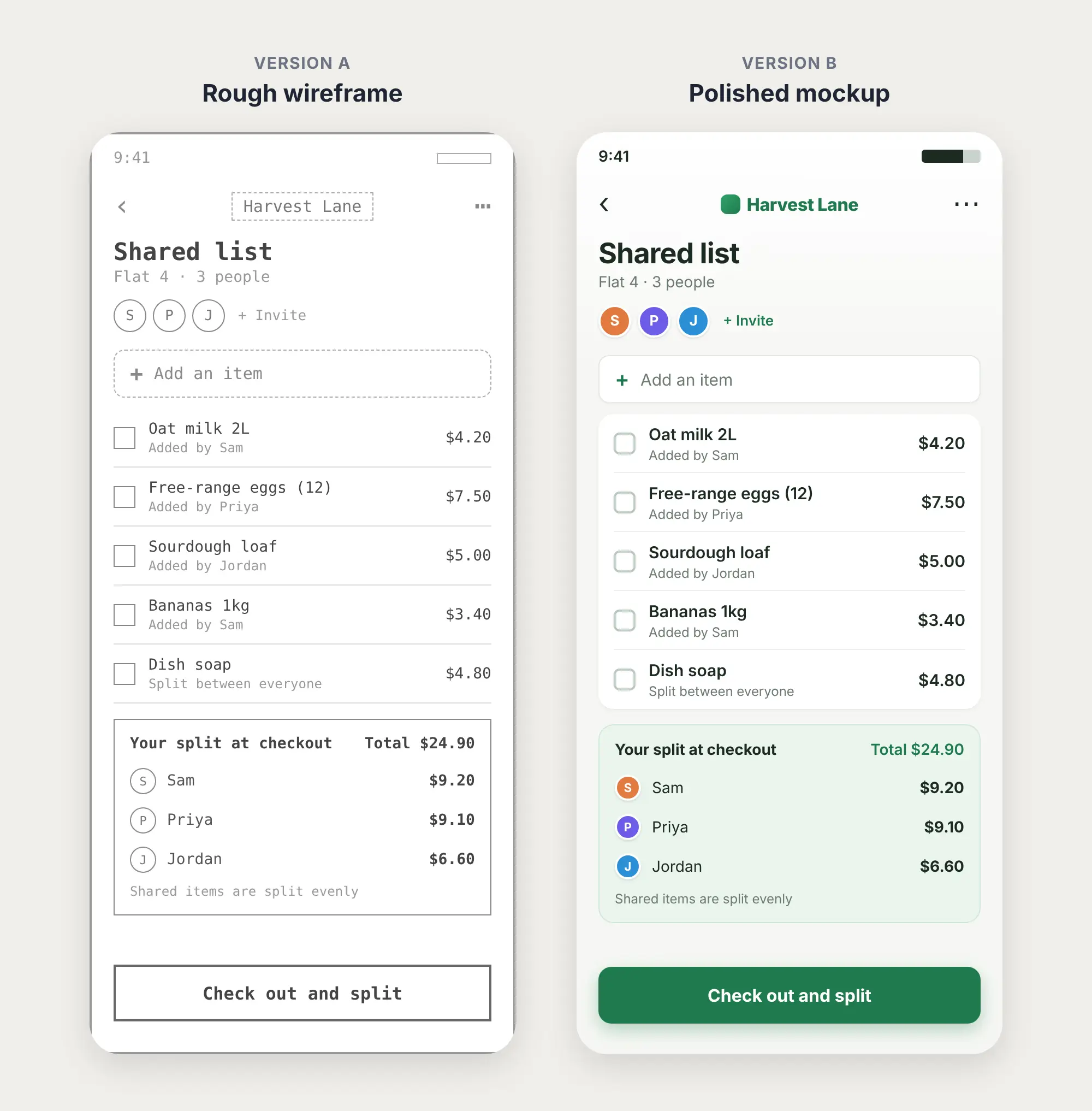
Using a monadic design survey, we showed each version to a separate group of five participants. Both groups answered the same five questions: their first reaction, how appealing the idea was (1–5), how likely they'd be to use it (1–5), why, and how finished the idea looked (1–5).
Participants clearly saw the polished version as more finished, and it drew slightly more enthusiasm – both top appeal scores came from that group. But just as many people in each group said they'd be likely to use it.
The bigger difference was in what people talked about. Participants who saw the wireframe mostly discussed whether the idea fit their household:
"I don't split my groceries with my partner so we don't really have a use for this"
"I think it could be useful for a family or a group of people living together."
Participants who saw the polished mockup compared it with tools they already use and asked about the details:
"This is a good idea and reminds me of a shared note on Apple notes app."
"in general, I like the concept. I think there are some weird areas that I'm confused about on how it functions, such as adding an item and how to calculate the price."
One participant who saw the mockup even described a benefit the concept never claimed: saving on delivery and service fees.
Five people per version is a very small sample – one person changing their answer moves a result by a fifth – so treat this as an illustration, not proof. The rough version kept people focused on whether they need the idea, while the polished version drew feedback on execution and invited people to imagine benefits that weren't there.
What we’d recommend: For a go/no-go decision, test the rough version with a larger group. Save the polished version for when you’re refining a concept you’ve already decided to pursue.
How to run a concept test
Running a concept test comes down to six steps: set your goals, choose your audience, prepare the concept and questions, pick a method, analyze the results, and turn them into a decision. Here's an overview, followed by the detail for each step.
Step 1: Define objectives and success criteria
Start with the decision the test needs to support, then decide what result would move it. "Learn what people think of the idea" won't settle a debate. "At least half of participants rate the concept 4 or 5 for appeal, and the main objections are ones we can fix" will.
Joe Formica, Design Advocate at Lyssna, recommends agreeing on this up front. In a workshop on designing research studies that produce clear, actionable results, he explained:
"What are the goals of this? What criteria is going to allow us to make that decision? If you align on this beforehand, then theoretically there's no debate once the results come in."
Step 2: Choose your audience
Test with people who match the users the concept is for. A screener survey helps you filter for the right behaviors, roles, or needs – for example, people who manage projects at work.
How many people you need depends on the decision. For a directional read on a single concept, 20–50 responses per concept is usually enough to spot clear patterns. To compare concepts with confidence, aim for 50 or more per concept, and more again if small differences matter. For moderated interviews, 5–15 participants per segment usually surfaces the main themes. The sample size calculator gives you a starting point you can adjust from there.
The stakes of the decision matter too. As Joe puts it in our sample size and confidence workshop, ask yourself: "Is this a concept test to get a direction, or is this the final study that's going to determine what we launch with?" You can watch the full workshop below.
Step 3: Develop your concept and questions
Prepare your stimulus using the principles above, then write questions that measure the things your success criteria depend on. Ask open-ended questions before rating scales so participants describe their reaction in their own words before you frame it for them.
A short concept test might include questions like these:
What's your first reaction to this idea? (open-ended)
In your own words, what does this feature do? (open-ended)
How appealing is this idea to you? (1–5 scale)
How likely would you be to use this if it were available? (1–5 scale)
Why did you give that answer? (open-ended)
What, if anything, would stop you from using it? (open-ended)
For a full bank of questions grouped by what they measure, see our guide to concept testing questions. Before you launch, pilot the test with a handful of people to catch confusing wording.
Step 4: Select your method
Use the methods tables above to pair a presentation design with a feedback method. A monadic survey suits a go/no-go call on one idea; sequential monadic or protomonadic testing suits choosing between a few directions on a tighter budget. Add moderated interviews when you need to understand why.
To see how to set these up, jump to How Lyssna can help with concept testing below.
Step 5: Analyze the feedback
Look at ratings and open-ended answers together. Ratings tell you how strongly people feel; the open-ended answers tell you why.
A common way to summarize rating scales is top-2-box: the share of participants who chose 4 or 5 on a five-point scale. It's easier to act on than an average. Then read the open-ended answers and group them into themes, such as confusion about how something works, objections, or comparisons to tools people already use.
Look for gaps between measures. For example, if most participants rate a concept highly for appeal but far fewer say they'd use it, the idea may sound good without solving a problem they have. Finally, segment your results by audience – a concept that splits opinion overall may be very popular with one group.
Step 6: Turn findings into decisions
Compare your results with the success criteria you set in step 1, then make the call: move forward, refine and retest, or stop. Share the decision with stakeholders alongside a few verbatim quotes that show the reasoning – they're often more persuasive than the numbers. If you refine the concept, test the new version with a fresh group so earlier exposure doesn't skew the results.

Concept testing examples
These examples show how teams have used concept testing to make real decisions, from an early-stage charity idea to a sustainable household brand.
Example 1: British Red Cross tests an early idea for reuniting families
The decision: whether potential donors would understand and support "Air Miles for Refugees," an early idea from the British Red Cross team that reunites families separated by conflict or disaster. Donated air miles would fly family members to the UK to join relatives.
What they tested: a prototype landing page, built in Figma, that explained the concept and how donating would work. The team built and tested it as part of a four-day sprint.
The method: a prototype test with participants from the Lyssna panel, focused on comprehension and appeal. As Louis Patterson, Innovation Delivery Officer at British Red Cross, explains: "If people don't understand it, then they're either not the right audience or the product isn't right."
The result: "We can see from the findings that people do understand the concept," Louis says.
What happened next: "The next steps are now to amend the prototype based on the feedback and test feasibility of developing the product from a technical point of view." Read the British Red Cross story.
Example 2: Bower Collective reaches a specific audience
The decision: how to make sustainable household products appeal to people who care about sustainability but haven't yet chosen what to buy.
What they tested: Figma prototypes of product designs, alongside customer interviews.
The method: prototype testing and interviews with a tightly defined audience. Fiona Cliffe, Head of Product at Bower Collective, explains why targeting mattered: "We have a very specific target market. They're female, 40+, and with a specific household income."
The result: customers worried that sustainable cleaning products might be less effective than conventional ones.
What happened next: Bower shifted its focus to product efficacy, including a laundry product that emphasizes fragrance and performance, and added guidance to onboarding on how much product a household needs. Read the Bower Collective story.
Concept testing vs usability testing (and other methods)
Concept testing asks whether people understand and want an idea; usability testing asks whether people can use a design to complete a task. They answer different questions at different stages, so most products benefit from both. Here's how concept testing compares with other methods you might consider.
What concept testing can't tell you
Concept testing tells you how people react to an idea, not how they'll behave once it exists. That makes it a strong early signal and a weak final verdict.
What people say isn't what they do. Participants who say they'd "definitely use" a feature often don't once it ships. Stated intent tends to overstate real behavior, so treat likelihood-to-use scores as relative – useful for comparing concepts, less useful for forecasting adoption.
A preference isn't proof of need. A comparative test tells you which concept wins. It doesn't tell you whether any of them is good enough to build.
It isn't a usability test. People can love an idea and still struggle to use the design built around it. Once the concept moves forward, test the design separately.
Results only hold for the people you tested. A concept that does well with your current power users may not land with new customers. If several audiences matter, test each one.
Scores need context. A single average rarely settles anything on its own. Joe Formica describes the problem:
"If we see a 3.5 out of five, how confident do we feel? Imagine a meeting with five people on your product team, stakeholders, everyone trying to look at that number and say: should we spend the next couple months launching this?"
To get the most from a concept test, set success criteria up front, use rough stimulus when you're measuring demand, read the open-ended answers as closely as the scores, and follow a promising result with something closer to real behavior, like a prototype test or a limited beta.

Can AI help with concept testing?
AI can speed up parts of concept testing, but it can't replace the people you're building for. It's most useful for the work around the test: drafting concept statements and question variations, checking questions for leading wording, and summarizing large volumes of open-ended answers so you can spot themes faster.
Where it falls short is standing in for your audience. Synthetic or simulated respondents generate plausible-sounding answers based on patterns in their training data, not on anyone's real needs or habits. That might help you stress-test a survey draft, but it isn't a sound basis for a go/no-go decision.
AI has made building faster and cheaper, which makes it more important to know what's worth building. Mateja Milosavljevic, CEO and Co-Founder at Lyssna, puts it this way: "The cost to build has gone down and the value now is in knowing what to build."
Common concept testing mistakes
Most concept testing mistakes come from testing at the wrong time, asking the wrong way, or reading too much into the results. Here's how to avoid the most common ones.
How Lyssna can help with concept testing
Getting a concept in front of the right people quickly is often the hardest part. When a roadmap decision is waiting on feedback, slow recruitment or a complicated setup can mean the test never happens. Lyssna is a user research platform that helps you run a concept test, recruit your target audience, and analyze the results in one place.
Start from a template. The How to test a product concept or feature template gives you a ready-made structure you can adapt.
Choose the right test type. Combine Surveys, Five second testing, Preference testing, First click testing, or Prototype testing with Figma prototypes in a single study, or run moderated sessions with Interviews.
Run monadic and sequential tests. Use variation sets so each participant sees only one version of your concept, or randomize the order of sections to show several concepts in turn.
Recruit the right people. Reach 10M+ panelists across the Lyssna panel and our partner panels, or invite your own participants. Whichever way you recruit, you can set up screeners and review results in the same place.
Make sense of the results. Analyze your results with AI summaries for open-text responses, filters for demographics and answers, and tags. Then share them through read-only links or CSV exports.
Bring your results into your AI tools. Connect Claude, ChatGPT, or another AI assistant to Lyssna's MCP server through the Model Context Protocol (MCP), then ask questions across your concept tests and get answers grounded in real participant responses.
"We've used Lyssna to quickly vet ideas and gather consumer insights to inform early-stage decisions."
Maria Colespring
Sr. Director, New Product Innovation, Cinch Home Services
Learn more about concept testing with Lyssna, or sign up for a free plan to get started with Lyssna today.
FAQs about concept testing
The number of participants you need for concept testing depends on the decision. For a directional read on one concept, 20–50 responses per concept is usually enough to spot clear patterns. To compare concepts with confidence, aim for 50 or more per concept, and for moderated interviews, 5–15 participants per segment. The sample size calculator gives you a starting point.
Conduct concept testing when you have an idea that's still cheap to change and a decision that depends on how users react. That's usually after discovery research and before significant design or engineering work. You can test again later with a refined version as a concept validation test.
Concept testing evaluates whether people understand and want an idea, while usability testing evaluates whether people can use a design to complete tasks. Concept testing happens before you build; usability testing needs a prototype or a live product. Most products benefit from both.
Yes, you can test multiple concepts in one study. Show each participant one concept and compare groups (monadic testing), or show each participant several concepts one at a time in random order (sequential monadic testing). Keep it to around three or four concepts per participant to limit fatigue.
To avoid bias in concept testing questions, avoid leading questions, use neutral wording, ask open-ended questions before rating scales, and randomize the order when you show several concepts. Don't signal which concept is your favorite, and keep every concept at the same level of polish.
If concept testing results are negative, read the open-ended answers to find out why before you drop the idea. Negative results often point to a fixable problem – an unclear explanation, the wrong audience, or one objection you can address. If the core problem doesn't resonate, stopping early is a good outcome: you've avoided building something people don't need.

Kai Tomboc
Technical writer
Kai has been creating content for healthcare, design, and SaaS brands for over a decade. She also manages content (like a digital librarian of sorts). Hiking in nature, lap swimming, books, tea, and cats are some of her favorite things. Connect with her on LinkedIn.

You may also like these articles