
Overview
This template helps you screen research participants based on how frequently and recently they use your product, so your insights come from people with the right kind of engagement. It includes a ready-to-run screener with three qualifying questions you can adapt to any product or study type.
Why product usage behavior matters
When you screen participants for usage behavior, your research becomes clearer and more focused. Instead of mixing participants with very different relationships to your product, you can understand each group on its own terms – from first-time users to daily power users.
Usage frequency and recency aren’t just background details. They shape how people experience your product: what they remember, what frustrates them, what they’ve learned over time, and what they’ve never encountered. A new user and a long-time user aren’t just different audiences, they’re having entirely different experiences.
This template gives you a simple, structured way to identify those differences before your study begins, so your insights are more accurate and easier to act on.
This template will help you discover
Whether participants have used your product recently enough to give accurate, memory-based feedback.
How usage frequency shapes behavior, needs, and expectations across different user segments.
How to separate heavy users from light users so you can compare their experiences directly
How the product usage behavior screener works
Screener questions make sure you're talking to the right people from the start. This template uses three questions to understand each participant's usage behavior and filters out anyone who isn't a good fit.
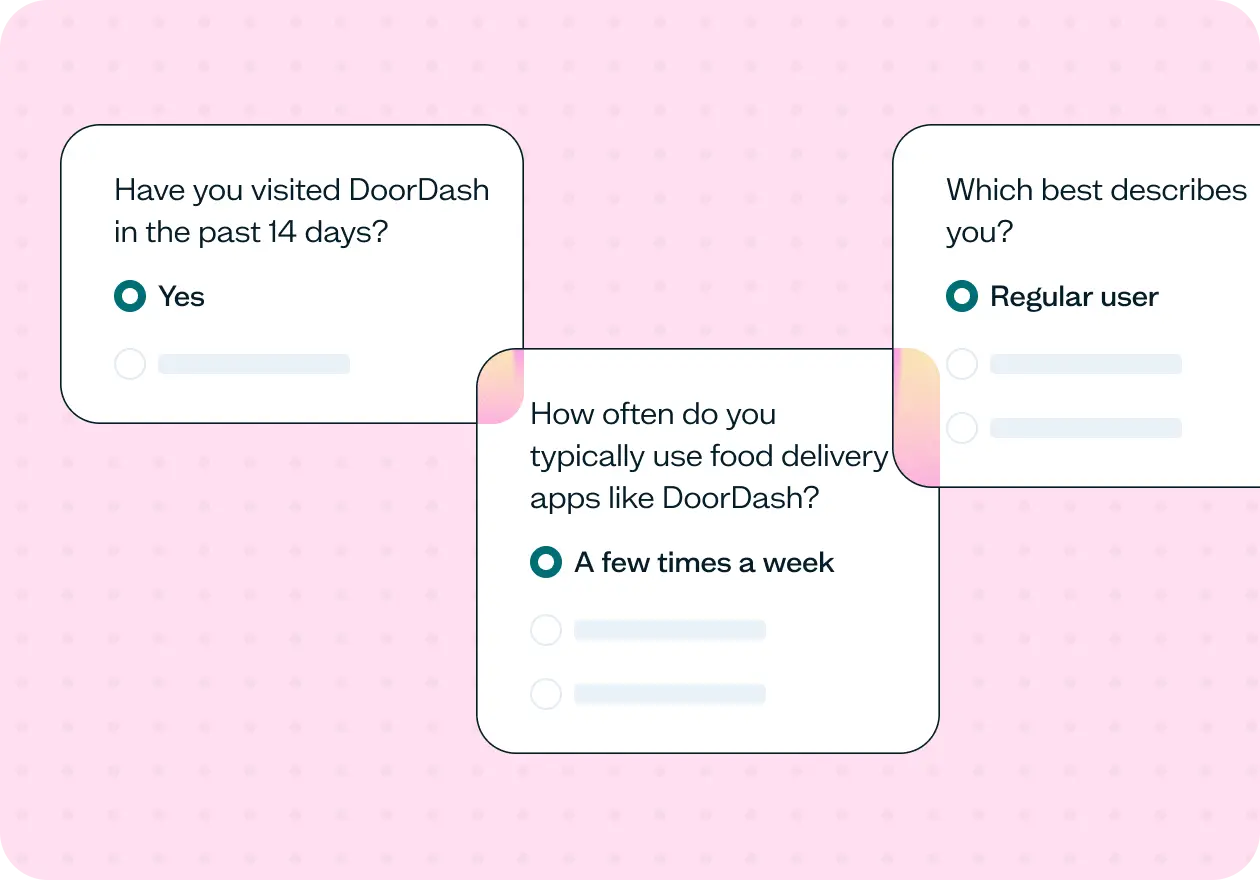
The first question captures recency, specifically whether the participant has used the product within the past 14 days. This means that everyone who proceeds can speak to an actual, recent experience rather than a faded or reconstructed one.
The second measures frequency, placing participants on a spectrum from daily to occasional use. This is where you draw the line between engaged users and occasional ones, and where you can split your sample if you want to compare heavy versus light usage patterns.
The third question identifies user type. Is the participant a regular user, returning after a break, or encountering it for the first time? This gives you control over the mix of participants, or lets you focus on a specific segment depending on your research goals.
While this template pairs the screener with a follow-up survey, it can be added to the start of any study where usage behavior matters.
Here are the research methods where this template is most useful:
Survey – filter participants before asking about satisfaction, habits, or unmet needs, so responses reflect real usage patterns.
Usability testing – make sure participants have enough experience to complete realistic tasks, avoiding confusion caused by first-time use.
First-click testing – validate navigation and decision-making with users who understand the product context.
Interviews – talk to participants who can speak in depth about real usage, behaviors, and long-term experience.
Card sorting – gather input from users whose mental models are shaped by real product usage.
How to use this template
To get the most value from this template, adapt the screener placeholders to your specific product and research goals before launching.
Begin with the recency question. Replace [brand/site/app] with your product name and set an appropriate timeframe. A 14-day window works well for most digital products, but you may want to shorten it for high-frequency tools (like daily habit apps) or extend it for lower-frequency ones (like travel or finance products).
Next, adjust the frequency options. The default ranges – daily, a few times a week, about once a week – are a strong starting point, but you should refine them based on what “engaged” means for your product. For example, weekly usage may be enough for a food delivery app, while a fitness tracker might require daily use.
For the user type question, decide how you want to handle returning users. You can exclude them for a cleaner sample of active users, or include them if you're exploring churn, re-engagement, or changes in behavior over time.
Once your screener is set, decide which study type you want to pair it with. This template includes a survey as an example, but the screener questions can be used at the start of any study.
Finally, use the results view to understand how your participants break down across recency, frequency, and user type before you begin analysis. This gives you a clear view of who your data represents.

See an example of the screener results
Click the ▸ icon to reveal screener results
When to use this template
When you want to study a specific usage segment such as daily users or lapsed users.
When you're running usability testing and need participants with recent, hands-on product experience.
When you're investigating habit formation or long-term engagement and need to control for usage frequency.
Who this template is for
Whether you’re running a structured UX study or just need quick, reliable feedback from the right people, this template helps you qualify participants based on what they actually do.
UX researchers running usability tests, habit studies, or journey mapping sessions who need genuinely engaged participants.
Product managers and designers who want to understand how different user types (like heavy vs light users) experience the same product.
Growth and engagement teams looking into why some users drop off while others keep coming back.
CX and insights teams across SaaS, ecommerce, streaming, fintech, food delivery, or travel – where user behaviour can vary a lot.
FAQs about screening users based on product usage behavior
You may also like these templates

The navigation test is god's gift to UI designers. It probably has the best power-to-simplicity ratio of any software, ever.

Nick Franklin
CEO at ChartMogul