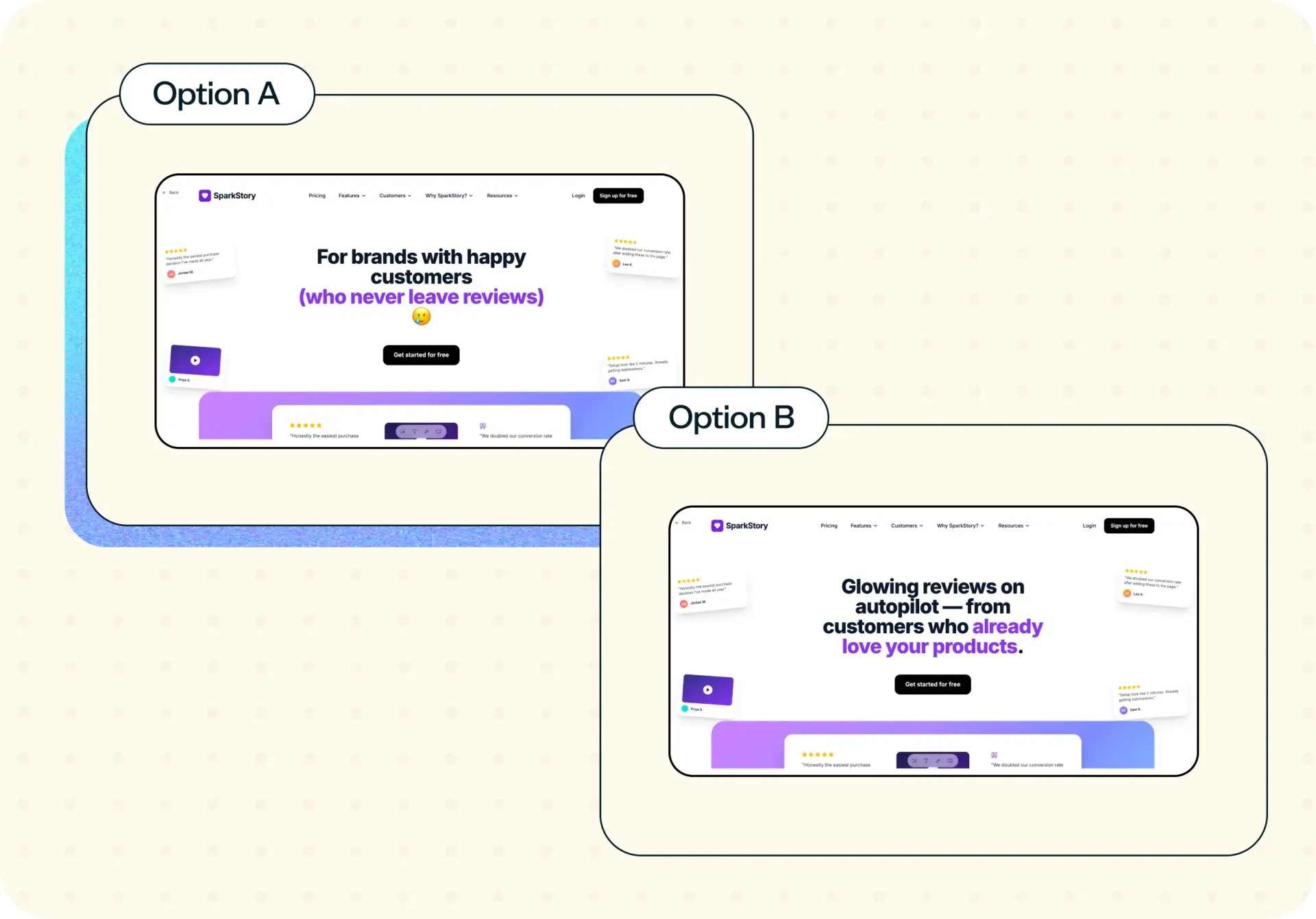

Your headline has one job: making someone want to read the next line. Get it wrong, and even the best product goes unnoticed.
It's easy to end up with two headline directions that are both well-written and still have no clear winner – because the strongest signal doesn't come from a gut reaction or a team debate, it comes from your actual audience.
Without that signal, you're left tweaking, wordsmithing, and guessing which direction will actually land.
This template helps you test two headline directions head-to-head using a five second test split test, so you can see which one creates an instant connection – and how to refine it.
The problem with untested headlines
Users decide whether to keep reading in seconds, not minutes. If a headline doesn't create an instant connection, they move on – no matter how good what's behind it is.
Teams struggle to catch this on their own because they're too close to their own copy. Internal debate can tell you which headline the team prefers, but it can't tell you which one will resonate with the people you're actually trying to reach.
Common signs your headline needs testing:
You have two or more headline directions and no clear way to choose between them.
Team debates keep circling back to opinion rather than evidence.
You've been tweaking and wordsmithing the same headline for weeks without more clarity.
You're not sure which pain point or benefit will actually resonate with your audience.
Conversion on your homepage is underperforming and you're not sure if the headline is the reason.
What this template helps you discover
Whether you're deciding between two headline directions or refining a single one, this template gives you a clear picture of what's actually resonating with your audience – and what isn't.
You'll find out:
Which headline direction scores higher on relevance, so you have a clear signal instead of a guess.
What users think and feel in the first five seconds of seeing your headline.
How relevant each headline direction feels to your audience's actual challenges.
Which specific pain points or outcomes create the strongest connection.
What themes come up naturally when users describe their own frustrations.
Whether a new, unaddressed pain point emerges that neither headline covers.

What you'll test
First impressions
What's the immediate, personal reaction a headline creates? This captures what stands out before users have time to analyze anything – the reaction that determines whether they keep reading.
Relevance
How strongly does the headline connect to the challenges your specific audience actually faces? Scoring this on a scale gives you a comparable score between headline directions.
Underlying pain points
What frustrations does your audience describe in their own words, independent of which headline they saw? This often surfaces themes neither headline addressed yet.
Language and phrasing
Which specific words or phrasing stand out to participants – a particular pain point, an emoji, an outcome-focused phrase? This tells you what to carry forward into your next version.
How the research works
This template uses a five second test split test – two identical five second tests, each with the same follow-up questions, shown to different participants at random.
Five second test
Participants see one homepage design for five seconds, then answer a short set of follow-up questions.
This captures an honest, unfiltered first reaction to a single headline direction – without the chance to compare it side-by-side with the alternative.
An open first-impression question reveals what a headline makes someone think or feel.
A relevance scale gives you a comparable score between headline directions.
An open pain-point question surfaces frustrations independent of which headline someone saw.
Because participants only ever see one headline direction, you get a clean read on immediate impact – not a side-by-side preference.
How to use this template
The best way to see this template in action is to watch it applied to a real product decision. In the video below, we walk through a working example using SparkStory – a tool that helps business owners collect, manage, and display customer reviews and testimonials. The SparkStory team had two strong homepage headline directions and no clear way to choose between them.
The walkthrough covers how to adapt the template to your own headline directions, set up a five second test split test so each participant only sees one version, and write follow-up questions that measure relevance and surface open-ended themes.
You'll also see how to recruit targeted participants using the Lyssna panel, how to read relevance scores alongside first-reaction and open-ended responses, and how to turn what you learn into your next headline iteration. Whether you're choosing between two homepage headlines or refining messaging across your site, you'll come away with a fast, repeatable way to get the answer from real users.
When to use this template
When launching a new homepage or landing page.
When expanding into a new audience segment with different pain points.
When rebranding or updating your positioning.
When you're about to invest in a paid campaign built around a specific headline.
When you've made assumptions about what resonates and want to validate them before committing.
Who this template is for
Marketers testing headline or campaign copy directions.
Product marketers and copywriters refining homepage messaging.
Founders and small business owners writing their own website copy.
UX researchers running structured message testing.
Anyone who's rewritten the same headline five times and still isn't sure which one is right.
FAQs about headline testing
You may also like these templates

The navigation test is god's gift to UI designers. It probably has the best power-to-simplicity ratio of any software, ever.

Nick Franklin
CEO at ChartMogul