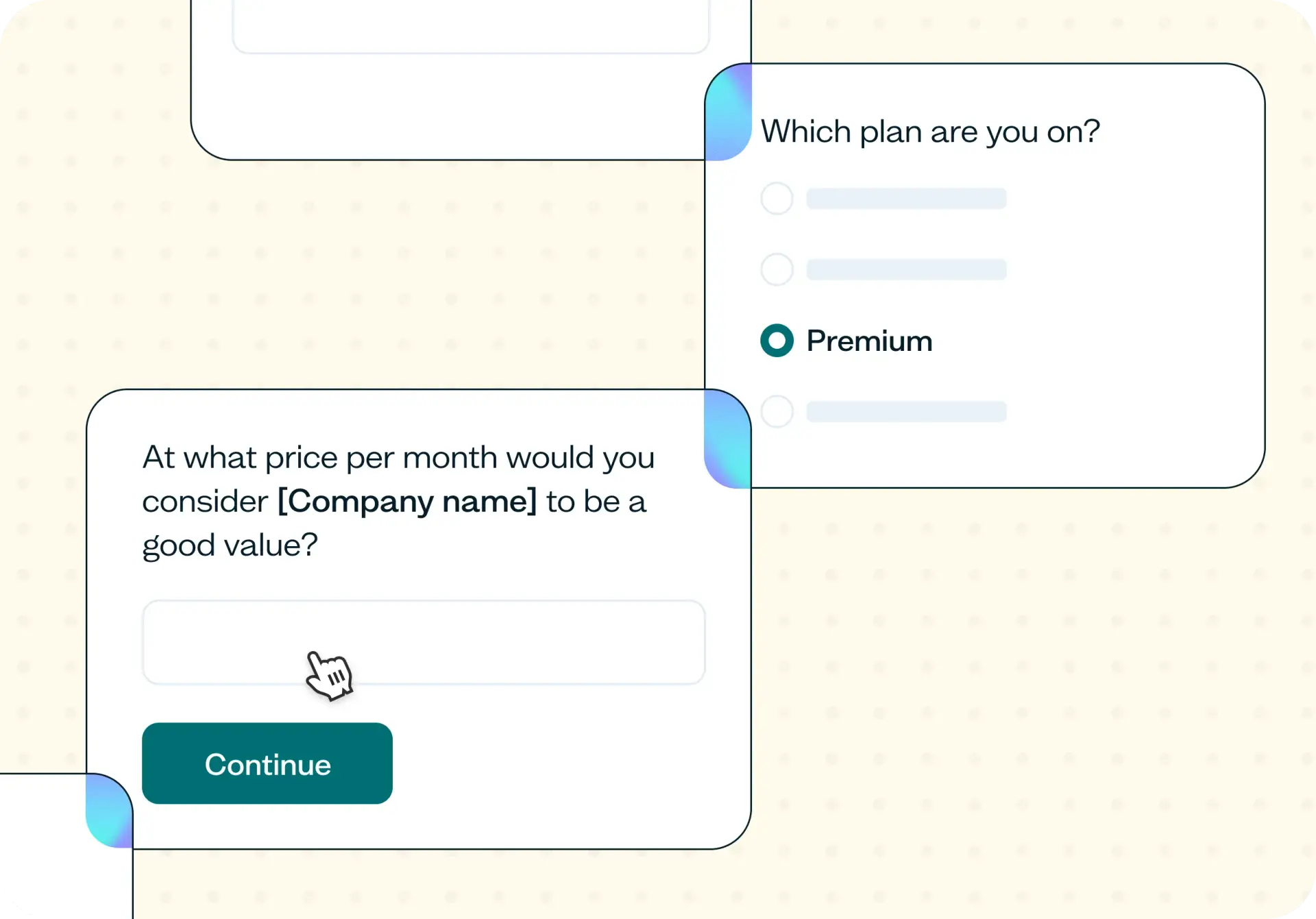

A pricing survey asks the people most likely to buy your product what they'd pay for it, and why – turning a guess based on a competitor's price list into a defensible range grounded in what your own audience actually says. Depending on how you ask, that can mean straightforward price sensitivity questions, willingness-to-pay questions, or a more structured four-question approach that plots where resistance starts and stops. All of them measure stated intent, not purchase behavior, so what you get is a range worth testing in-market, not a final number. This template shows you how to run that survey and read the results with that limitation in mind.
The problem with untested pricing
Most pricing decisions aren't based on what your audience would actually pay. They're based on competitor pricing, internal instinct, or a number someone picked months ago and never revisited.
Here are some common signs your pricing needs testing:
Your price was set by looking at what competitors charge.
Sales keeps discounting to close, and nobody knows the real ceiling.
You're launching a new tier and have no basis for the number.
The team disagrees about whether you're too cheap or too expensive.
You've changed the product substantially since you last set the price.

This template will help you discover
Run this template and you'll come away with more than a single price point. You'll understand how your audience actually thinks about what you're charging.
The price range your audience accepts
Where the price starts to feel too cheap to trust, and where it starts to feel too expensive to consider, plus everything defensible in between.
How sensitive they are to change
Whether a small increase barely registers or triggers a wave of hesitation, and where exactly that resistance kicks in.
How they perceive the value
What your audience believes they're getting for the money, independent of the number itself, because a price only ever reads as high or low relative to perceived value.
How answers differ across your audience
The template also asks who's answering: their role, whether they're already a paying customer, which plan they're on, and who controls the budget on their team. That lets you cut the price answers by segment instead of reading them as one undifferentiated group.
What you'll test
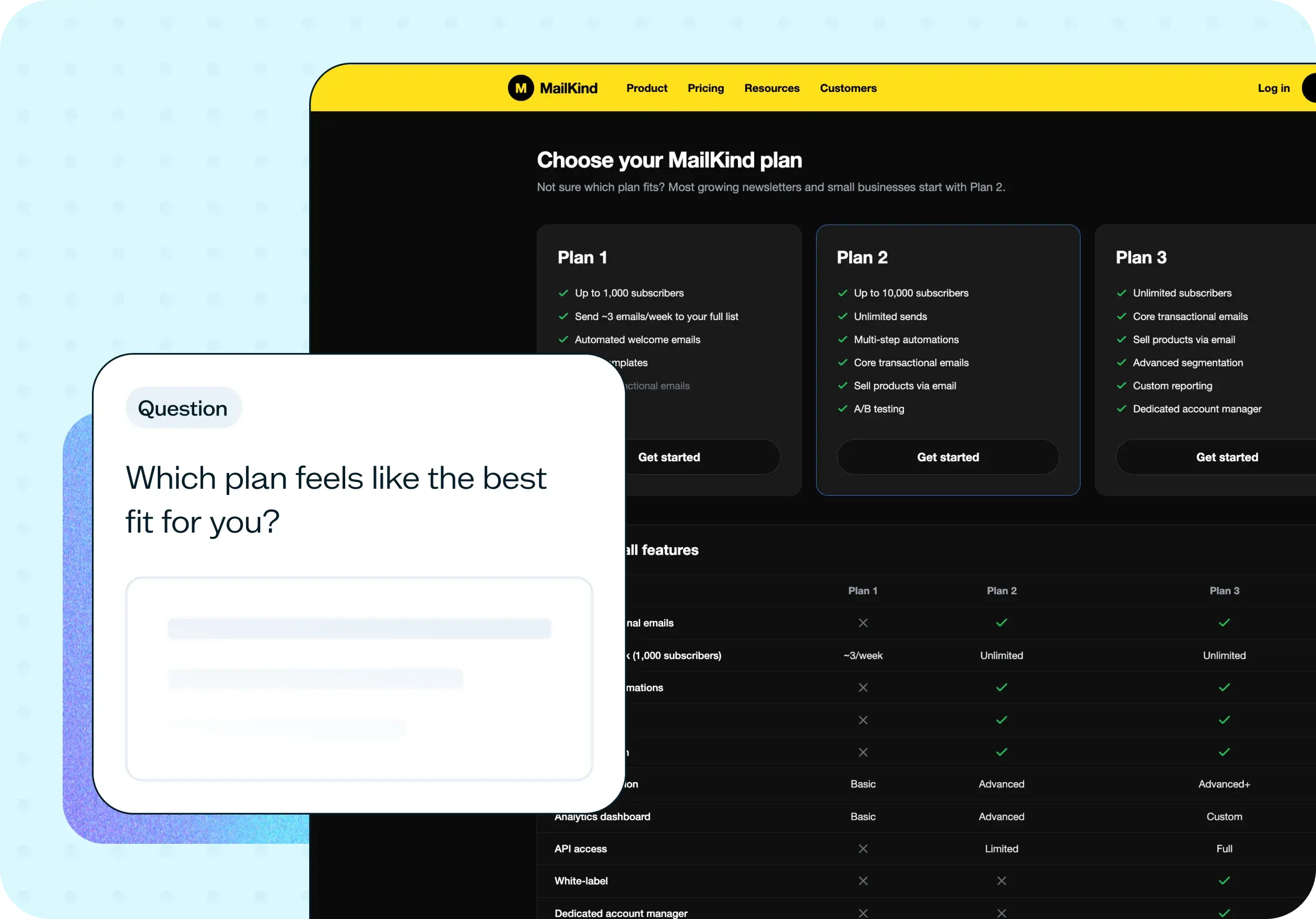
This template runs a classic four-price-point method: it asks what price would feel too cheap to trust, what price feels like good value, what price starts to feel expensive, and what price is high enough that someone would walk away. Plotting all four answers together, rather than reacting to a single price in isolation, is what turns individual responses into a defensible upper and lower bound instead of one guessed number.
Before the pricing questions, the template also asks a few profiling questions: role, whether the person is already a paying customer, which plan they're on, and who controls the budget on their team. If someone says a colleague makes the call, a follow-up question asks who that is, which is useful context if you ever want to go back and talk to the actual decision-maker. Together, these let you cut the price answers by segment rather than treating every response the same way.
How the research works
This template collects pricing data through a structured survey, then gives you tools to read the results as a range rather than a single number.
Survey
This template runs as a survey – Lyssna's Surveys feature lets participants answer a structured set of questions in their own time, rather than in a live session. The screening question matters more than almost anything else in the setup: results are only useful if you're asking people who plausibly buy in this category. Someone who would never consider your product can still answer a price question, but they can't give you a defensible answer.
If you don't have your own audience to draw on, you can recruit through Lyssna's research panel, which gives you access to 690,000+ participants across 124 countries with 395+ demographic and psychographic targeting options, so you can filter down to the profile that actually matters for this test.
Reading the results
Treat the output as a range, not a number. Look at the distribution of answers rather than the mean. A single average can hide a cluster of people who think the product should cost much less, and that cluster is itself a signal about perceived quality, not just price.
Because this template collects all four price points from the same person, you can also look at where the "too cheap" and "too expensive" answers start to cross the "good value" and "getting expensive" answers. That crossover is where a defensible range sits, rather than at either extreme.
Keep the limitation in view while you read: this measures what people say they'd pay, and stated price intent tends to run higher than what people actually spend once real money is involved. Use the range this survey gives you to decide what's worth testing in-market, whether that's a real price change, a new tier, or an experiment. Don't treat the survey itself as the final word.
How to use this template
Start exploring with a free plan. Sign up for Lyssna and open this template to see the default questions, including the four pricing questions and the profiling section.
Customize the questions to match your product. Adjust the price points, product framing, and profiling questions so they reflect what you're actually testing. The more specific the questions, the more useful the answers.
Choose your audience. Recruit from Lyssna's research panel if you need qualified respondents outside your own network, or share the survey link directly with your existing customers or prospects.
Launch the survey and collect responses. Many Lyssna studies start returning results within hours, so you won't need to wait weeks before you can start reading the data.
Review the results as a range, not a single number. Look at where the four price-point answers cluster and cross over, rather than relying on a single average. Use the range to decide what's worth testing in-market next.
When to use this template
Test pricing at the moments when a wrong number costs the most and a right one pays off the most:
Before you launch a new product, so you can set an initial price based on more than a guess.
Before you introduce a new tier or plan, so the pricing structure reflects what your audience actually values, not just what feels logical internally.
When you're entering a new market, because local price expectations rarely match your home market and a survey tells you how far off you might be.
After a significant change in product scope, because if the product has grown since you last set the price, your audience's sense of its value has probably grown too.
Before a planned price increase, so you understand how much room you actually have before testing it against real customers.
Any of these moments is reason enough to run this template before the price goes live.
Who this template is for
This template is built for anyone who has to defend a price number, not just choose one.
Founders often run it before setting an initial price, when there's no pricing history to lean on and the number has to hold up under investor and customer scrutiny alike. Product managers use it before launching a new tier or plan, so the pricing structure reflects what the audience actually values rather than what seemed reasonable in a planning meeting. Product marketers turn to it when positioning and price need to tell the same story, because a price that contradicts the perceived value undermines the message, no matter how good the messaging is. And pricing or revenue leads use it as one input alongside sales data and market research, to bring a defensible customer perspective into a decision that's usually made from spreadsheets alone.
Whether you're setting a price for the first time or revisiting one that's stopped making sense, this template gives you a starting point grounded in your own audience.
FAQs about pricing surveys
You may also like these templates
It wasn’t a big sell to move to Lyssna's paid account due to the speed at which you can put together a test, quickly get feedback, and recruit good participants. It just makes monetary sense. It's so cheap and the feedback is valuable.

Alan Dennis
Product Design Manager at YNAB