
Overview
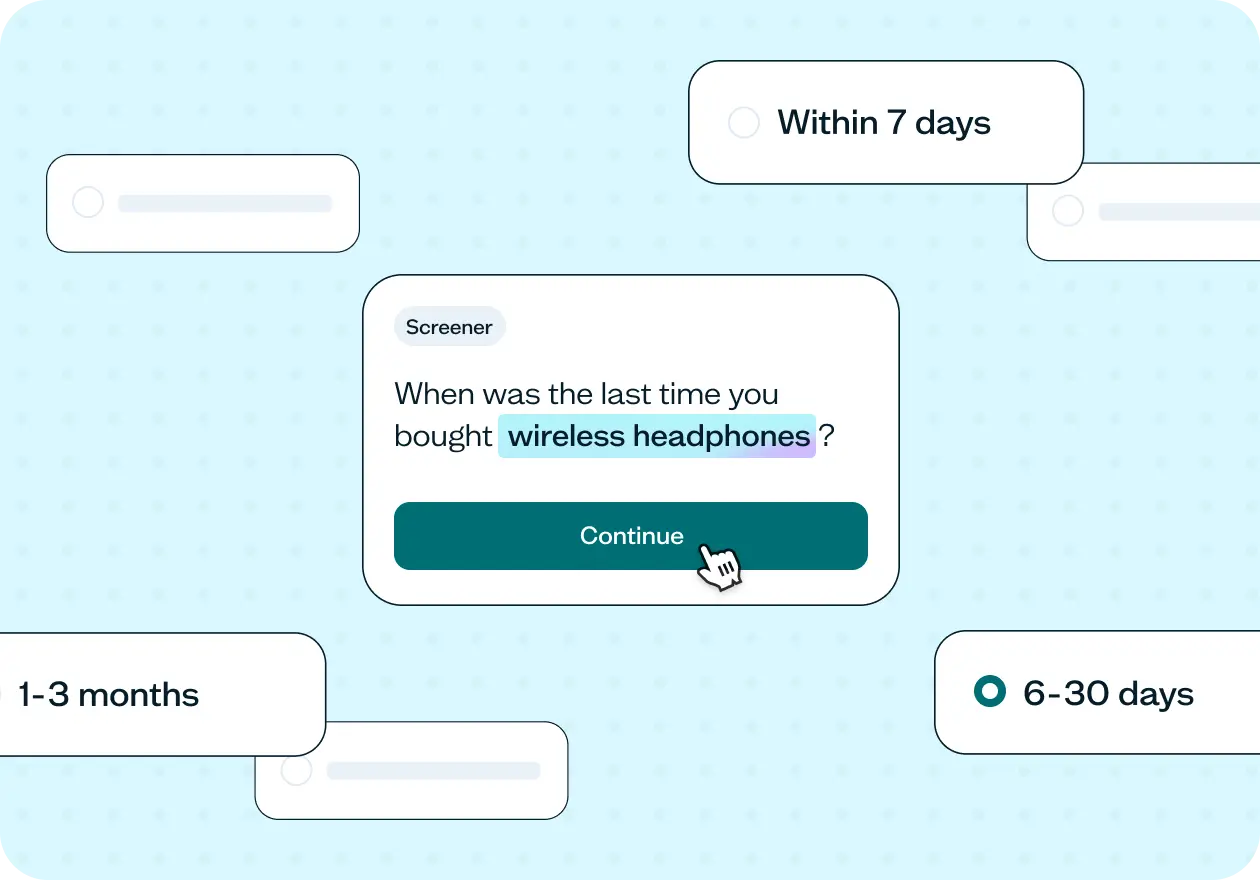
This template helps you screen research participants based on recent purchase behavior, so only people with a fresh, relevant buying experience reach your study. It includes a ready-to-run screener you can adapt to any product category or study type.
Why purchase recency matters
Most research goes wrong before the first question is even asked. You recruit broadly, assume your participants are relevant, and end up with data shaped by people who haven't actually experienced what you're studying – or whose memories are too hazy to be useful.
That can be a problem when you’re researching purchase behavior, because purchase memories fades fast. The motivations, comparisons, and friction points that felt vivid in the moment become less accurate within weeks, and once that clarity is gone, no research method can recover it.
Screening for recency solves that problem. By filtering participants based on when they last made a purchase, you make sure everyone who reaches your study has a recent, real experience to draw from – leading to more reliable insights.
This template gives you a ready-to-run screener built around a recent purchase scenario, so you can qualify the right participants quickly and adapt it to whatever category or product you're researching.
This template will help you discover
The participants who have made a relevant purchase recently enough to recall it accurately.
Exactly when each participant last made a purchase.
How purchase recency is distributed across your respondent pool, so you can segment findings by how fresh each experience actually was.
How the recent purchases screener works
Screener questions filter your participant pool before anyone reaches your core study. The first question disqualifies anyone who hasn't purchased in the relevant category recently, so only qualified respondents proceed.
The second question captures exactly when each participant last made a purchase, giving you a precise picture of recency across your pool and the flexibility to segment findings by how fresh each experience actually was.
While this template pairs the screener with a survey, the screener can be added to the beginning of any study type where recent purchase experience matters.
Here's what it unlocks across different research methods:
Survey – qualify participants before asking questions about checkout friction, delivery satisfaction, or post-purchase sentiment, so every response comes from someone with a real, recent experience to draw on.
Usability test – ensure participants testing a checkout flow, returns process, or product page have actually been through that journey recently enough to give grounded, accurate feedback.
Interviews – filter for buyers who can speak in detail about their decision process, the comparisons they made, and the friction they encountered – without having to reconstruct it from memory.
Card sort – confirm participants sorting product categories or navigation labels have hands-on purchase experience with the category, so their mental models reflect real buying behaviour.
How to use this template
This template is easy to adapt to your own product, category, or study type.
To get started, open the template in Lyssna and replace the category/product placeholder with your specific product or category in the screener questions. The logic stays the same: qualify on recency, then segment by behavior.
Next, decide on your recency window. The 30-day gate works well for most consumer categories, but you can tighten it – 7 days works better for high-consideration purchases like electronics – or loosen it to 90 days for infrequent categories like appliances or furniture.
Use the second screener question to capture purchase timing. Even within a qualified group, someone who bought within 7 days will recall their experience differently than someone who bought 3 weeks ago, and that difference can be analytically useful when you come to segment your results.
If you're using the Lyssna research panel, combine panel-level filters – age, location, income bracket – with your screener questions to reach a highly specific audience before the screener even runs. This keeps your disqualification rate low and makes your participant recruitment budget go further.
Finally, decide which study type you're pairing the screener with. While this template includes a survey, the screener questions can be added to the beginning of any study where recent purchase experience matters. Add your core research questions directly after the screener, and you're ready to launch.

See an example of the screener results
Click the ▸ icon to reveal screener results
When to use this template
When running post-purchase research and you need participants who can recall the experience accurately.
When studying checkout flow, decision journeys, or comparison behavior.
When researching packaging, delivery experience, or returns and refunds.
When launching or iterating on a product and you want feedback from people who have actually bought in the category recently.
When stakeholders need evidence that your research reflects real, current customer behavior – not self-reported habits from months ago.
Who this template is for
Whether you're a UX researcher running a formal study or a product manager who just wants to understand why customers drop off before converting, this template gives you a fast, structured way to make sure the right people are answering your questions.
It's designed for:
UX researchers conducting post-purchase or decision-journey studies.
Product teams iterating on checkout, onboarding, or conversion flows.
Marketing teams studying how customers describe and recall their buying process.
Ecommerce and retail teams investigating abandonment, satisfaction, or returns.
Anyone who has ever launched a research study and wondered whether the participants actually bought what they were being asked about.
FAQs about screening users based on recent purchases
You may also like these templates

The navigation test is god's gift to UI designers. It probably has the best power-to-simplicity ratio of any software, ever.

Nick Franklin
CEO at ChartMogul