
Most NPS surveys stop at the number. Your Net Promoter Score tells you how many customers would recommend you, but the score on its own can't tell you why, or what to do next.
This template helps you run an NPS survey that pairs the standard likelihood-to-recommend question with open-ended follow-up, so you can segment your results, cluster the reasons behind each score, and turn customer feedback into decisions your product and CX teams can act on.
Why guessing on the why behind NPS costs you
When your NPS lands in a board slide as a single figure, it's easy for the conversation to stop there. But a score with no reason attached is a number you can't act on. The longer a detractor's frustration goes unexplained, the more likely that customer is to churn before you've had the chance to follow up.
Averaging every response into one company-wide figure also hides the signal that would change your roadmap. A comfortable overall score can mask a group of frustrated enterprise accounts or a cohort of new users who never made it past onboarding.
Pairing your score with verbatim analysis is what turns customer sentiment into direction. Reading the reasons behind each rating tells you which issues to prioritize, surfaces promoter quotes you can pass to marketing and referral programs, and gives you evidence to bring to stakeholders when you're making the case for a fix.

What this template helps you discover
Running this template gives you both the headline metric and the context that makes it useful. By the time your responses are in, you'll have:
Your overall NPS score, calculated with the standard promoter-minus-detractor formula.
Segment-level scores that break your NPS down by plan, tenure, industry, or persona.
Clustered themes from the open-ended responses, so patterns rise to the top instead of getting lost in a spreadsheet.
Specific detractor reasons, ready for closed-loop follow-up with the customers who need it.
Promoter quotes you can pass straight to marketing, referral, and review programs.
What you'll capture
A useful NPS survey captures two things at once: a comparable score and the reasons behind it. This template is built around a small set of questions you can send as-is or adapt to your product.
The two core questions
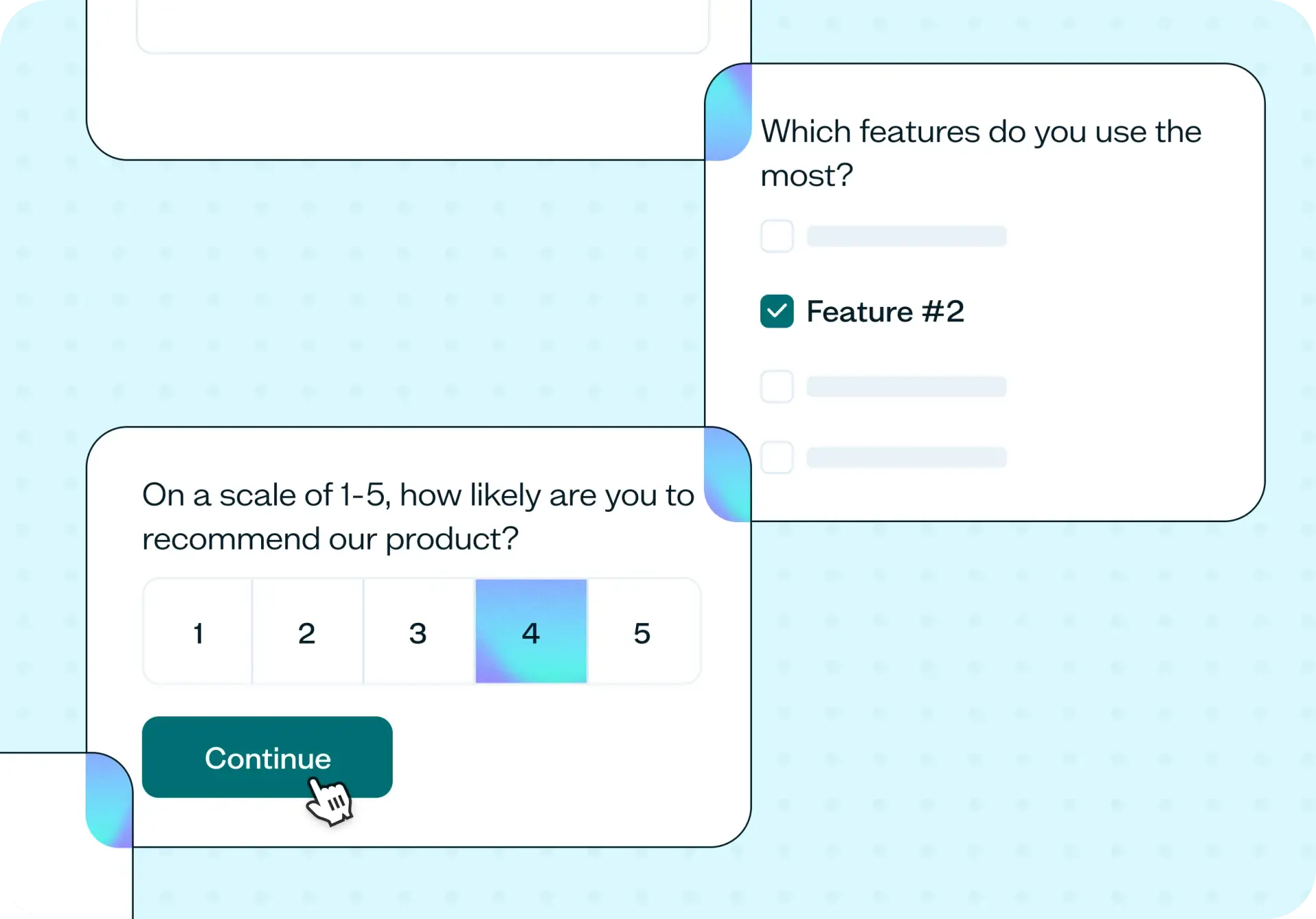
Two questions do the heavy lifting in any NPS survey. The first is the standard likelihood-to-recommend question: "On a scale of 0 to 10, how likely are you to recommend us to a friend or colleague?" Keeping this question standard is what makes your results comparable to published NPS benchmarks. The second is an open-ended follow-up: "What's the main reason for your score?" This captures the verbatim context behind each rating.
Segmentation tags
Segmentation is what turns a single company-wide score into something you can act on. Add tags to each response so you can slice your NPS by the dimensions that matter for your product, such as plan, tenure, persona, industry, or acquisition channel. Where it's relevant, you can also segment by device, region, or lifecycle stage to see exactly which groups are promoting you and which are at risk.
Optional follow-up
For passives and detractors, one more question can turn a low score into a roadmap item: "What would it take to make your score a 10?" It's a simple prompt that surfaces the specific change a customer is waiting for. You can also include an opt-in asking whether they're open to being contacted, so your CX team can start closed-loop conversations with the customers who raised concerns. Beyond the core NPS questions, you can layer in supporting context questions, like asking which features a customer uses most, to help you interpret the scores you get back.
When to use this template
NPS works best as a repeatable signal rather than a one-off exercise, and this template fits a range of moments in that cycle. Reach for it when you're:
Setting up an NPS program for the first time and want a structure that captures reasons, not just ratings.
Moving between relationship NPS (measuring overall loyalty) and transactional NPS (triggered by a specific event), or running both.
Following up after a major product launch, pricing change, or support overhaul to see how the change landed.
Working with existing NPS data that feels flat, and you need segment-level detail to find the story underneath.
Running a quarterly or post-event pulse on customer loyalty.
Preparing for a board or investor reporting cycle and want defensible numbers with context behind them.
How to use this template
Getting your NPS survey live takes just a few steps:
Click "Use this template" and log in to your Lyssna account, or start exploring with a free plan if you don't have one yet. The template opens in the test builder with the recommendation question and follow-up already set up.
Adapt the questions to your product. Swap in your product or service name, confirm the recommendation scale, and add any segmentation tags or supporting questions you want to capture.
Set up how you'll reach your customers. Because NPS measures the people who already use your product, you'll typically share the test link with your own customer list rather than recruiting new participants.
Preview the survey to check the flow and wording, then save and set it live.
Collect responses and analyze the results. Group the open-ended answers into themes, cut your score by segment, and pull out the detractor reasons and promoter quotes worth acting on.
Example outcomes
Here's what you can expect to walk away with once your responses are in:
A clean overall NPS score, reported alongside sample size so you know how much weight it carries.
Segment cuts that show which groups are promoters, passives, or detractors, so you can see where your risk is concentrated.
A prioritized list of verbatim themes, ready to bring into your product backlog.
A detractor contact list your CX team can work through for closed-loop follow-up while the feedback is still fresh.
Promoter quotes you can put forward for marketing, referrals, and case studies.
Who this template is for
This template suits anyone who needs customer loyalty signal they can act on, whether you're running research formally or wearing several hats at once. It's especially useful for:
Product managers who want NPS feeding directly into roadmap decisions.
CX and support leads focused on closing the loop with detractors.
Research ops teams standing up or improving an NPS program.
Founders tracking customer loyalty as they move through funding or growth stages.
Marketing teams sourcing promoter quotes for advocacy and referral programs.
FAQs about NPS surveys
You may also like these templates

We use Lyssna tests to help us make decisions for various projects. From web and mobile design to marketing activities.

Luther Lowe
VP Public Policy & Gov. Affairs at Yelp