Sample Size Calculator
Determine the optimal number of participants for your user research study based on method, study complexity, and confidence requirements.
Unmoderated Tests
Unmoderated Tests
Prototype, card sort, tree test, preference, first click, five second tests & surveys
Moderated Studies
Moderated Studies
User interviews with direct interaction and deep insights
Research Ready
Research Ready
Instant calculations based on UX research best practices
Ready to Calculate
Select your user research method and provide the required parameters to calculate your sample size.
User Research Guidelines
- Select your research method and provide the required parameters
- Consider recruiting 10-20% extra participants to account for no-shows and dropouts.
- For diverse user bases, ensure your sample represents different user segments.
- Qualitative research focuses on depth over quantity - fewer participants with richer insights.
Getting your sample size right is crucial for trustworthy UX research. Too few participants and you might miss important insights. Too many and you're wasting valuable time and budget.
Whether you're running unmoderated tests like card sorting and preference tests, conducting moderated user interviews, or planning quantitative research, each method has different sample size requirements. A usability test needs fewer participants than a large-scale survey, while qualitative interviews need fewer still.
This sample size calculator provides instant recommendations based on your research method, study parameters, and confidence requirements. Choose from minimum, recommended, and ideal sample sizes to match your project constraints and research goals.
Key takeaways
Sample size determines how many participants you need for reliable, actionable research results.
Different methods require different sample sizes: 5–8 for usability testing, 30–50 for preference testing, 300–400 for surveys.
Lyssna’s sample size calculator provides three options: minimum (smallest viable sample), recommended (optimal balance), and ideal (maximum confidence).
Proper sample sizing prevents both under-powered studies and wasteful over-recruitment.
For moderated studies, factor in 10–30% extra participants to account for dropouts and no-shows.
What is sample size?
Sample size is the number of participants you include in your research study. It represents a subset of your larger target audience – the group you're ultimately trying to understand and design for.
Think of it this way: if you want to improve your checkout process, you can't test with every customer. Instead, you recruit a smaller representative group – maybe 50 users – to stand in for your entire customer base.
Your sample size directly affects how much you can trust your research findings:
Reliable patterns: Adequate sample sizes help you distinguish real user behaviors from random noise or outliers.
Confident decisions: When you test with the right number of people, you can trust that your findings reflect what your broader audience actually experiences.
Efficient research: Calculating the optimal sample size prevents both underpowered studies and wasteful over-recruitment.
The key is finding the balance where you have enough participants to trust your results without spending unnecessary time and money on recruitment.
How to find the right sample size for your research
Finding the right sample size depends on several factors specific to your research goals and constraints. Here's how to approach it.
Start with your research method
Different UX research methods have different sample size requirements. The calculator organizes methods into two broad categories:
Unmoderated tests: Card sorting, tree testing, preference testing, first click testing, five second testing, and surveys run without a moderator present.
Moderated studies: User interviews and usability tests conducted with direct interaction and observation.
It also takes into consideration research-ready calculations – statistical recommendations based on UX research best practices for confident decision-making.
Consider your confidence needs
How certain do you need to be about your results? High-stakes product decisions might warrant larger samples and higher confidence levels (99%), while early exploratory research can work with smaller groups and standard confidence (95%).
Think about your audience
Are you studying a broad user base or a specific segment? Broader audiences typically require larger samples to capture the full range of behaviors and preferences. If you plan to analyze subgroups separately, each segment needs adequate representation.
Factor in practical constraints
Your timeline, budget, and recruitment capabilities all influence what sample size is realistic for your project. The calculator provides three tiers to help you balance statistical rigor with real-world feasibility.
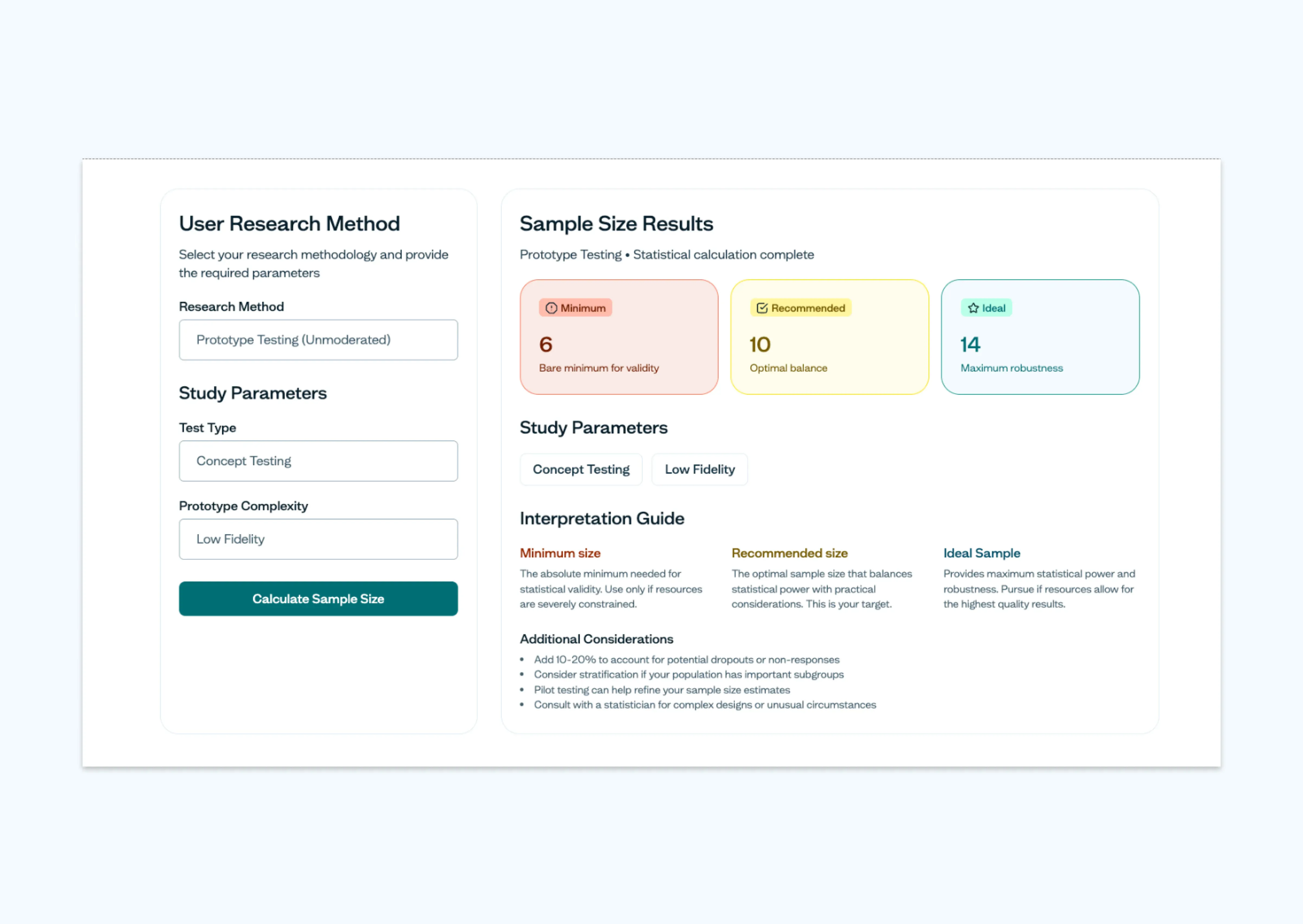
How to calculate sample size
The calculator streamlines sample size planning by applying method-specific best practices to your study parameters. Here's how it works.
1. Choose your research method
Select from common UX research methods available in Lyssna. Each method has different statistical requirements:
Prototype testing and usability studies for evaluating designs.
Card sorting for understanding mental models.
Tree testing for validating information architecture.
Preference testing for comparing design options.
First click testing for navigation analysis.
Five second testing for first impressions.
Live website testing for evaluating live sites with real users.
Surveys for gathering user feedback at scale.
User interviews for qualitative insights.
2. Specify your study details
Enter key parameters like the number of design options you're comparing. For example, a preference test might compare two home page designs, while a card sorting study might involve organizing dozens of items into categories.
For some studies (like preference tests, first click tests, five second tests, live website tests, and surveys), you’ll also set your confidence level:
90% confidence for quick, exploratory research
95% confidence for most product decisions (recommended)
99% confidence for high-stakes, mission-critical research
Higher confidence levels require larger sample sizes but provide greater certainty that your findings reflect true user behavior.
3. Get your recommendations
The calculator provides three sample size options:
Minimum: The smallest sample that provides meaningful results. Use this when facing tight constraints but still wanting actionable insights.
Recommended: The optimal balance of reliability and efficiency. This is your target for most research projects.
Ideal: The sample size for maximum confidence in your findings. Choose this for critical decisions or when you need to present highly defensible research.
This approach eliminates manual calculations while ensuring your sample size fits your specific research method and goals.
Sample size guidelines by research method
Different research methods need different sample sizes. Below are typical recommendations for common UX research approaches – think of these as starting points that you can adjust based on your specific study needs.
Usability testing
Following Jakob Nielsen's widely-cited guidelines, 5–8 participants can uncover most usability issues in a single design. For comparing designs or detecting smaller differences, 8–12 participants per design variant provides more reliable results.
Preference testing
When comparing two options, 30–50 participants typically provide reliable results. Each additional option may require 10–15 more participants to maintain statistical power and detect meaningful preferences.
Tree testing
Information architecture studies generally need 50–100 participants, depending on the complexity of your site structure and the number of tasks you're testing. More complex navigation systems require larger samples.
Card sorting
Most card sorting studies reach reliable conclusions with 15–30 participants. Complex categorization projects with many items or open card sorts might require samples toward the higher end.
First click testing
To understand where users expect to find information, 30–50 participants usually provide clear patterns while remaining manageable to recruit and analyze.
Five second testing
Testing first impressions and immediate comprehension typically requires 25–40 participants per design variant to account for the variability in quick reactions.
Surveys
For statistically representative results across broad audiences, 300–400 participants are standard. Smaller, targeted segments can work with fewer responses, though statistical confidence decreases.
User interviews
Qualitative research focuses on depth over breadth. Most interview studies reach insight saturation with 5–12 participants, though complex topics or diverse user segments may require more.
Sample size comparison table
Research method | Sample size | Study context |
|---|---|---|
Usability testing | 8-12 per design | Identifying usability issues and navigation problems |
Preference testing | 30-50 | Comparing design options to determine user preferences |
Tree testing | 50-100 | Validating information architecture and findability |
Card sorting | 15-30 | Understanding user mental models and categorization |
First click testing | 30-50 | Testing navigation labels and findability |
Five second testing | 25-40 per design | Measuring first impressions and immediate comprehension |
Surveys | 300-400 | Gathering statistically representative quantitative feedback |
User interviews | 5-12 | Exploring behaviors, motivations, and pain points in depth |

Multi-method studies: Combining methods like preference testing and five second testing? Recruit for whichever method needs the larger sample size. This gives you richer feedback while keeping recruitment efficient.
What is a good sample size?
A good sample size balances three key factors: statistical reliability, practical constraints, and research goals. Here's how to evaluate what works for your study.
Adequate for your method: Different research methods have different baseline requirements. A good sample size meets the minimum threshold for your chosen method while fitting your constraints.
Aligned with decision importance: High-stakes product decisions warrant more robust sample sizes than early exploratory research. Match your sample size to the weight of the decisions you're making.
Achievable within your constraints: The best sample size is one you can actually recruit within your timeline and budget. A theoretically perfect sample size isn't useful if it's not realistic for your project.
Sufficient for planned analyses: If you plan to compare different user segments or analyze subgroups, make sure each subset has adequate representation in your sample. Splitting a sample of 50 into five segments leaves only 10 participants per group.
Appropriate for your confidence needs: Consider how much uncertainty you can accept in your results. Some research questions require high confidence (99%), while others can work with standard confidence levels (95%) or even exploratory confidence (90%).
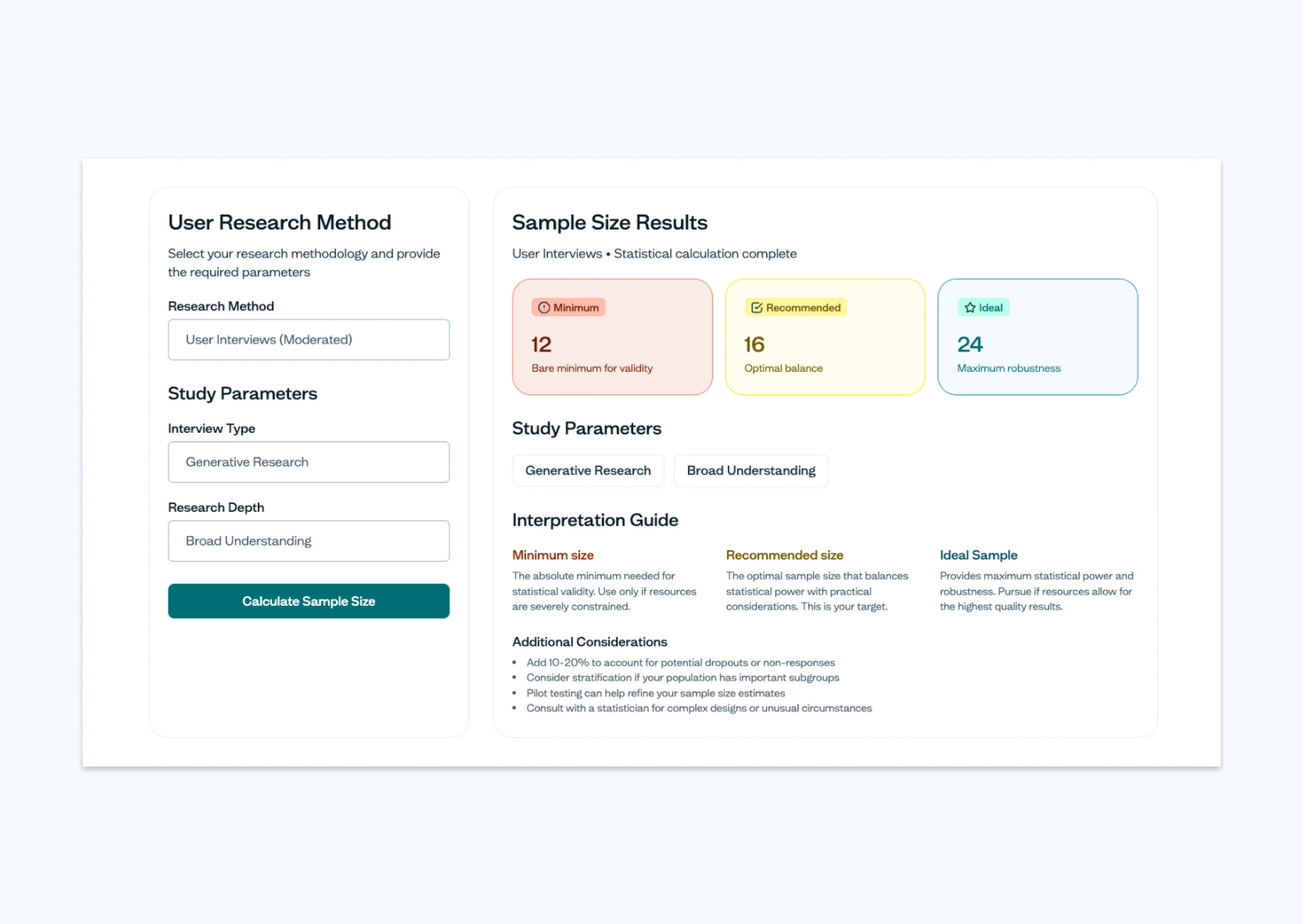
Get the right sample size for your next study
Determining sample size doesn't have to be complicated or intimidating. With the right approach, you can quickly identify how many participants you need for reliable, actionable research results.
This sample size calculator eliminates the guesswork by providing method-specific recommendations tailored to your study parameters. Whether you're testing prototypes, organizing information architecture, or gathering user feedback, you'll get practical sample size guidance that balances statistical reliability with real-world constraints.
Plus, with Lyssna's research panel of over 690,000 participants, you can recruit your ideal sample size quickly and efficiently, no matter what method you choose.
FAQs about calculating sample size for UX research



Get reliable research results with Lyssna
Once you know your sample size, Lyssna helps you recruit the right participants and collect feedback fast.