23 Mar 2026
|50 min
Usability testing tools
A comprehensive list of the top 20 usability testing tools with links and features to help your UX team choose the right platform.

Picking the right usability testing tool shouldn't slow your research down – but with so many options on the market, it often does. You're weighing features, pricing models, and participant recruitment options while trying to stay focused on actually running tests and generating insights your team can act on.
In this guide, we've rounded up 20 of the best usability testing tools available today. Whether you're running quick unmoderated tests to validate a prototype or in-depth moderated sessions to understand complex user behavior, you'll find the right fit for your research process, your team size, and your budget.
Key takeaways
Usability testing tools help you move from assumptions to evidence by showing how real users actually interact with your designs.
Moderated and unmoderated testing serve different purposes – many teams use both, so look for a platform that supports your primary method while offering flexibility.
Built-in participant panels remove one of the biggest bottlenecks in research. Platforms like Lyssna let you launch tests and start receiving results within hours rather than weeks.
The best tool is the one your team actually uses. Prioritize setup speed, design tool integration, and how easily you can share findings with stakeholders.
Why use usability testing tools?
Usability testing tools have become essential for product teams who want to make confident decisions based on real user behavior rather than assumptions. With 25% of US brands' CX quality declining for the second consecutive year according to Forrester's 2025 CX Index, the gap between what teams think users experience and what actually happens is widening.
Whether you're validating a new feature concept or identifying why users abandon a checkout flow, these tools help you see what's actually happening as people interact with your designs.
Usability testing can help you identify pain points and generate data that will inform your decisions about what to fix before launch, or after making changes or adding new features. The insights you gather reveal what's working, as well as any flaws that can tarnish the user experience.
The value of observing real users
There's a fundamental difference between what users say they'll do and what they actually do. Analytics can tell you that users drop off at a particular step, but observing real users shows you why – maybe they're confused by the terminology, can't find the button, or don't trust the process.
Watching users navigate your product surfaces problems you'd never anticipate from your own perspective. As someone who built the product, you have context and knowledge that your users don't. Usability testing bridges that gap by letting you see your design through fresh eyes.
The qualitative richness of observing real behavior also helps with stakeholder buy-in. A video clip of a user struggling with a feature is far more persuasive than a chart showing drop-off rates. It transforms abstract data into human stories that drive action.
How tools accelerate the path to insights
Traditional usability testing required scheduling lab sessions, recruiting participants weeks in advance, and spending hours reviewing recordings. Modern usability testing tools compress this timeline dramatically – whether you're running unmoderated tests for quick heatmaps, click tracking, and survey responses at scale, or moderating live sessions where you can ask follow-up questions in real time.
Teams using usability testing tools like Lyssna can set up a test, launch it, and start receiving results within minutes. That kind of turnaround means you can test multiple iterations within a single sprint, catching problems early when they're cheapest to fix.
Criteria for choosing a usability testing tool
With dozens of usability testing tools available, selecting the right one comes down to understanding your specific research needs.
When evaluating usability testing tools, focus on three core criteria:
Moderated vs unmoderated testing support: Whether you need real-time facilitation, independent task completion, or both.
Device and browser coverage: The platforms and devices your users actually interact with.
Analytics, recording, and recruitment: The supporting features that determine how efficiently you can capture, analyze, and act on user feedback.
The right combination depends on your team's research maturity, testing frequency, and product type.
Support for moderated vs unmoderated tests
Your choice of testing approach shapes which tools will work best for you.
Moderated testing involves a facilitator guiding participants through tasks in real time. This approach excels when you need to:
Complex workflow exploration: Dig into multi-step processes where follow-up questions are essential for understanding decision points.
Decision reasoning: Uncover why users make specific choices – not just what they do.
Accessibility and guided sessions: Test with participants who need guidance or have accessibility needs.
Discovery research: Explore open-ended questions when you're still defining the problem space.
Unmoderated testing lets participants complete tasks independently, typically recorded for later review. This works well when you need to:
Speed and scale: Gather feedback quickly from larger sample sizes without scheduling overhead.
Task validation: Test straightforward tasks with clear success criteria.
Geographic reach: Reach participants across different time zones through remote usability testing.
High-frequency testing: Run frequent tests as part of your regular sprint cycles.
Many teams use both approaches depending on the research question. Look for tools that support your primary method while offering flexibility for occasional needs.
Device/browser coverage
Your users don't all use the same devices, and your testing tool should reflect that reality. Here are the key considerations based on what you're testing:
Live websites: Does the tool support testing on production URLs across browsers?
Prototypes: Can you run prototype testing with Figma, Sketch, or Adobe XD files directly?
Mobile apps: Does the tool support iOS and Android testing?
Responsive designs: Can participants test on their actual devices?
If your audience skews mobile, prioritize tools with strong mobile testing capabilities. If you're testing enterprise software, desktop browser coverage may matter more.
Analytics, session recording, participant recruitment
Beyond the core testing functionality, consider these supporting features.
Analytics and visualization:
Heatmaps: Visual representations showing where users click and scroll, revealing engagement patterns and missed CTAs.
Usability metrics: Task completion rates, time-on-task data, and error rates that quantify how well your design performs.
Automatic transcription: Speech-to-text conversion of verbal feedback, saving hours of manual review.
Highlight reels: Curated clips of key moments for sharing findings with stakeholders.
Session recording:
Screen recording with audio: Capture what users do and say as they navigate your product.
Webcam recording: See facial expressions and emotional reactions alongside on-screen behavior.
Annotation and clipping: Mark and extract key moments for analysis and sharing.
Secure storage and sharing: Control access to sensitive recordings with team permissions.
Participant recruitment:
One of the toughest parts of running usability tests is finding reliable participants. Tools with built-in panels eliminate this bottleneck. Already have your own testers? Look for tools with self-recruitment options and shareable test links to keep costs down.
Top 20 usability testing tools
Tool | Starting price | Best for |
|---|---|---|
Lyssna | Free plan available (paid plans from $166/month) | Fast, flexible testing with built-in recruitment across moderated and unmoderated methods |
UserTesting | Custom pricing | Enterprise-grade research at scale with extensive participant reach |
Maze | Free plan available (paid plans from $99/month) | Rapid prototype testing integrated into design workflows |
Lookback | From $99/month (billed annually) | Moderated research with robust live session and observer tools |
Optimal Workshop | From $199/month (billed annually) | Information architecture, navigation design, and content organization |
Userlytics | From $49/participant (pay-as-you-go) | Detailed video analysis with international participant reach |
Great Question | From $49/month | Unified recruitment, research, and synthesis across teams |
Loop11 | From $49/month | Quantitative usability benchmarking and True Intent Studies |
UXtweak | Free plan available (paid plans from $125/month) | Consolidating multiple research tools into a single platform |
Userbrain | Free plan available (paid plans from $124/month) | Low-friction, video-first unmoderated testing |
PlaybookUX | From $65/participant (pay-as-you-go) | Mixed-methods usability testing with surveys and interviews |
Useberry | Free plan available (paid plans from $67/month) | Prototype testing with deep design tool integrations |
Ballpark | Custom pricing (14-day free trial) | Scalable research with unlimited seats and AI interviewer |
dscout | Custom pricing | Qualitative-heavy research, diary studies, and longitudinal research |
Testbirds | Custom pricing (BirdCoins credit system) | Real-device crowdtesting and combined QA/UX testing |
UserFeel | From $30/session (own testers) | International and multilingual research on a flexible budget |
Helio | From $99/month | Quick validation of design concepts, marketing assets, and campaigns |
Sprig | Free plan available (paid plans from $175/month) | Capturing in-product feedback and behavioral data |
Trymata | Free PayGO tier (credits from $89 each) | Usability testing combined with product analytics and UX scoring |
Conversion Crimes | From ~$200/study | Conversion-focused usability testing for ecommerce teams |
1. Lyssna
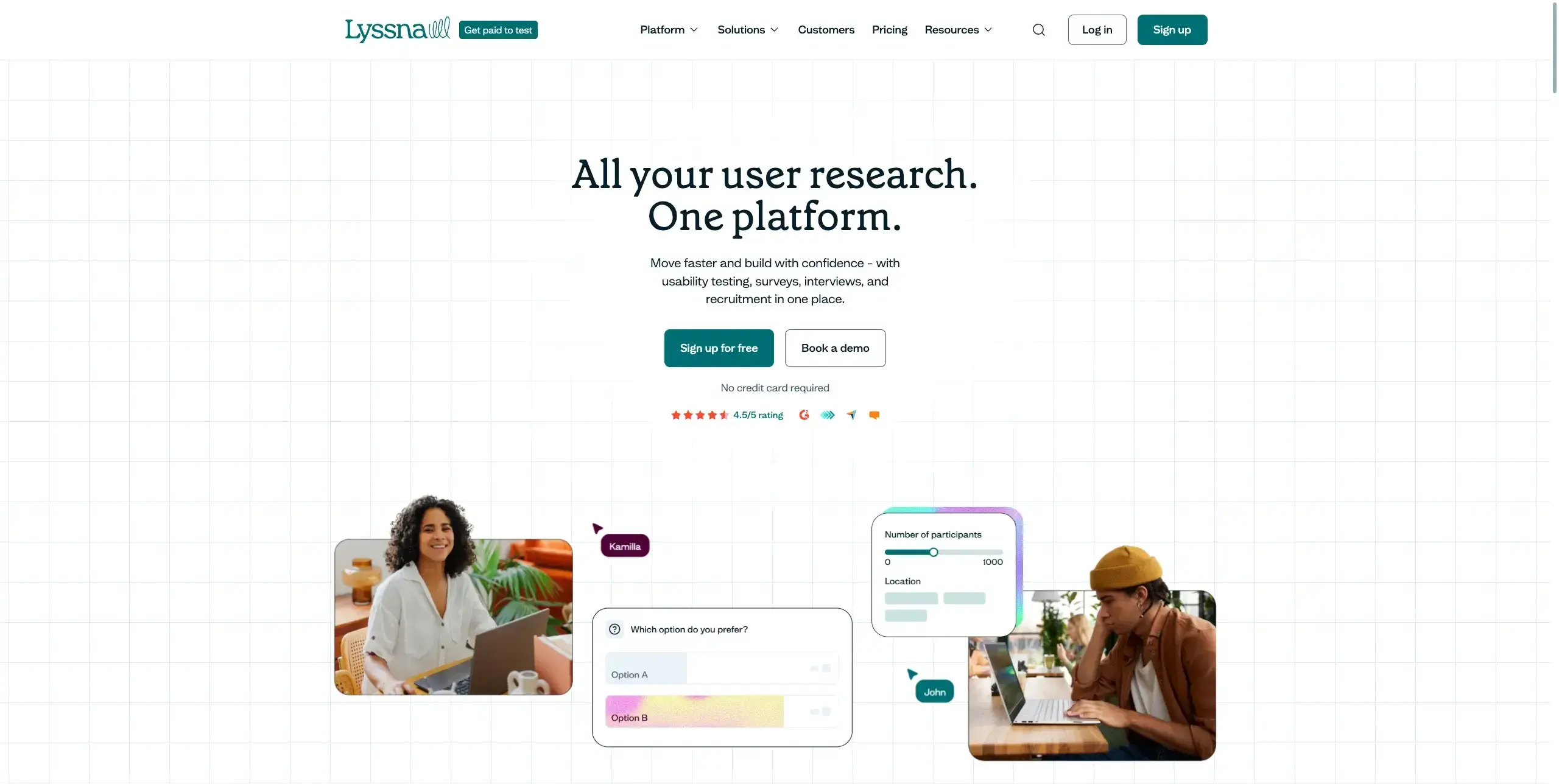
Lyssna is an all-in-one user research platform that combines unmoderated usability testing, moderated user interviews, and surveys with access to a diverse participant panel.
With a range of testing methods and a 690,000+ participant panel with precise demographic targeting, Lyssna gives teams flexibility to validate designs at any stage with the following features:
Live website testing and prototype testing: Test production URLs or Figma prototypes with screen, audio, and camera recordings in both moderated and unmoderated formats.
Five second testing: Measure first impressions by showing participants your design for five seconds, then asking targeted questions to check whether your page communicates its purpose clearly.
Card sorting and tree testing: Validate your information architecture by understanding how users categorize content and navigate your site structure.
Preference testing and first click testing: Compare design alternatives side by side and measure whether users can find the right starting point for key tasks.
User interviews: Conduct moderated research sessions with multi-language support for the participant experience, including emails, calendar invites, and the interview interface.
Recordings: Capture think-aloud feedback with audio, screen, webcam, or any combination during unmoderated tests.
Research panel: Access 690,000+ vetted B2B and B2C participants across 124 countries, with targeting across 395+ demographic attributes including job role, industry, and company size.

Practitioner insight: "The ability for us to design a quick mockup, run it on Lyssna and receive feedback within an hour has helped us reach definitive design decisions much sooner than before."
– Chris Taylor, Senior UX/UI Designer at Canstar
Best for: Teams who need fast, flexible testing with built-in recruitment. Particularly strong for validating designs at any stage – from early concepts to live products.
Pricing: Free plan available, Growth plan from $166/month, Enterprise custom pricing. Panel responses are pay-as-you-go.
Customer ratings: G2 4.5/5 (170 reviews); Capterra 4.6/5 (85 reviews)

Pro tip: Lyssna's research panel calculator lets you input study size, type, and audience to get an estimate of the cost and turnaround time – helpful for budgeting and planning research studies before you commit.
2. UserTesting
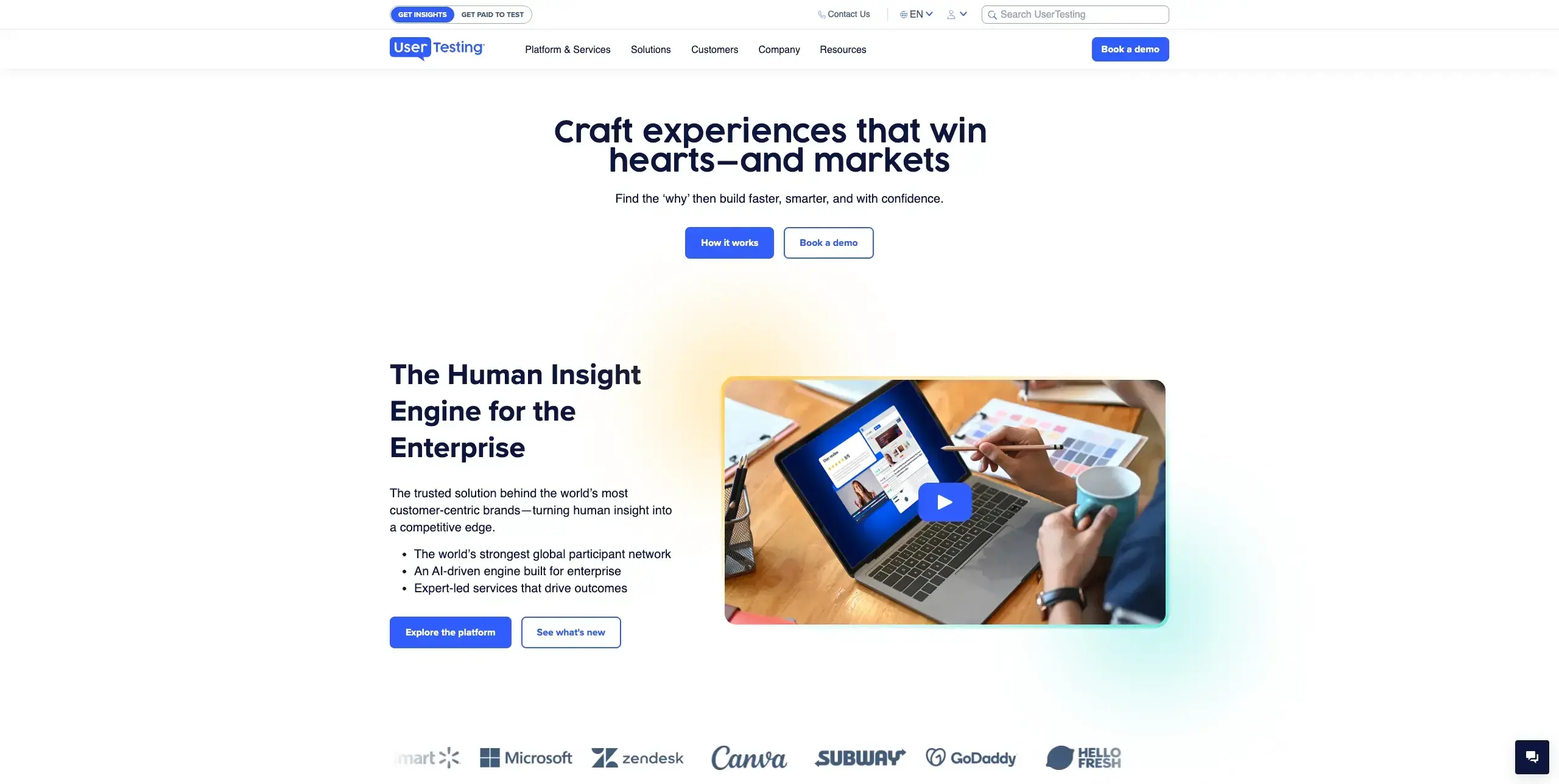
UserTesting is an enterprise-focused platform built around video-based feedback, giving teams direct access to recorded sessions of real people interacting with their products. It's become a go-to for large organizations that need to conduct research at scale across multiple teams and departments.
With a focus on qualitative depth and enterprise-grade infrastructure, UserTesting offers a comprehensive set of research capabilities:
On-demand video feedback: Watch and listen as target audiences interact with your product, with detailed demographic and behavioral targeting to reach specific user segments.
Templates for common research scenarios: Get started quickly with pre-built test templates for checkout flows, onboarding experiences, feature validation, and more.
AI-powered insight analysis: Automatically identify patterns and themes across multiple sessions, with sentiment analysis and keyword grouping to surface recurring feedback faster.
Live Conversation: Conduct moderated 1-on-1 interviews with participants from the contributor network or your own custom audience panels, with scheduling available as soon as the same day.
Mobile app testing: Test iOS and Android apps with device-specific targeting to capture real user behavior on mobile.
Enterprise security and compliance: SSO, advanced role-based permissions, and data residency options for teams in regulated industries.
Global contributor network: Access an extensive, vetted network of participants spanning 40+ countries, with demographic filters and custom screener questions to match your exact audience.
Best for: Large organizations needing enterprise-grade security and extensive participant reach. Ideal for companies running continuous research programs across multiple product lines or those requiring robust compliance features for regulated industries.
Pricing: Custom pricing only; typically requires an annual subscription. Contact sales for a quote.
Customer ratings: G2 4.4/5 (786 reviews); Capterra 4.5/5 (130 reviews)
3. Maze
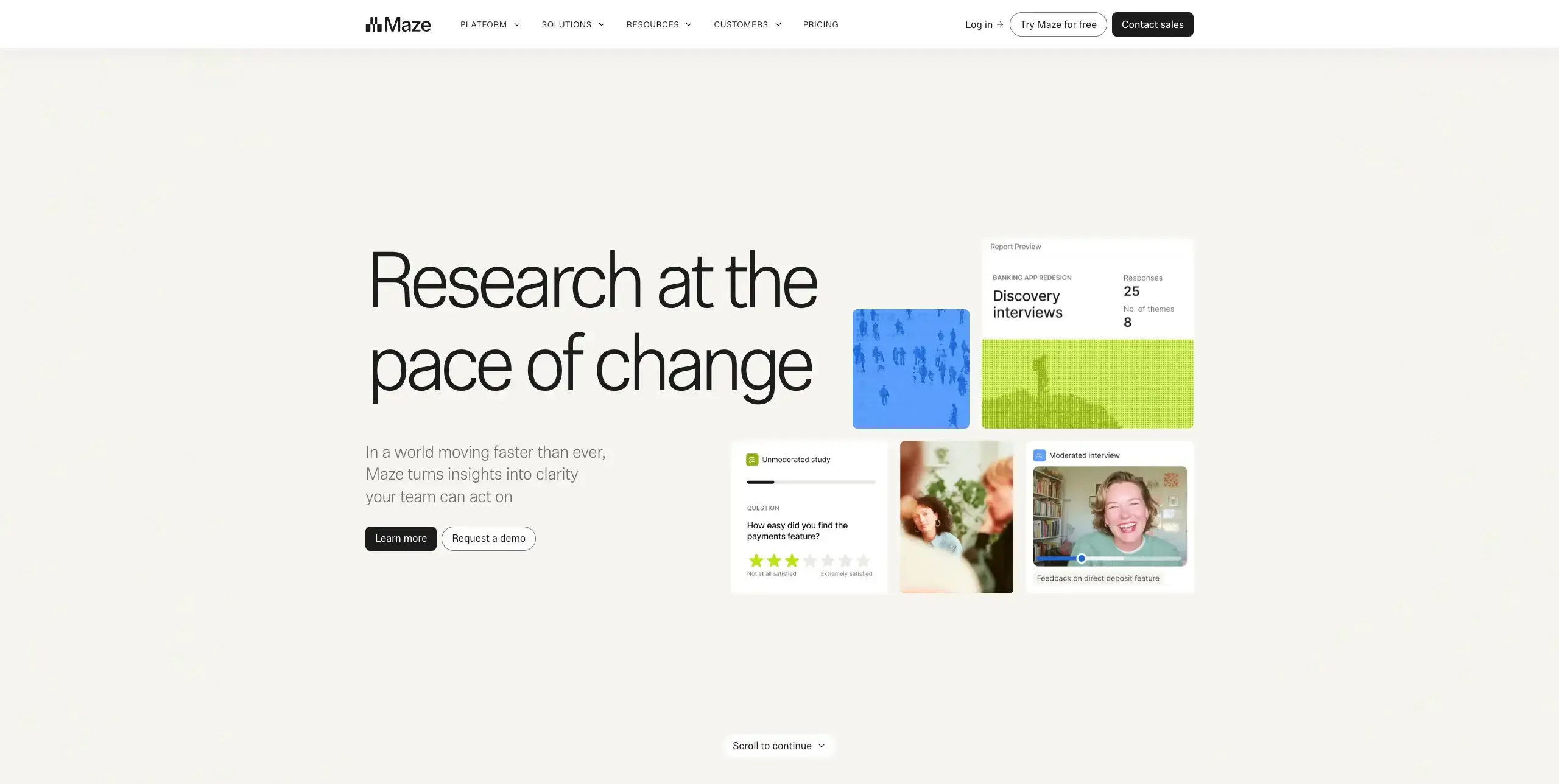
Maze focuses on rapid, unmoderated testing that integrates tightly with design tools. The platform is built around structured test flows called "mazes" that guide participants through specific tasks while automatically collecting quantitative and qualitative data.
With deep prototype testing capabilities and automated reporting, Maze is designed to fit into fast-moving product design workflows:
Design tool integration: Import prototypes directly from Figma, Sketch, and Adobe XD, with the ability to sync updates so your tests always reflect your latest designs.
Automated usability metrics: Capture misclick rates, task completion rates, time on task, and heatmaps automatically – giving you quantitative evidence without manual analysis.
Path analysis: Visualize how users navigate through prototypes to identify where they follow the expected flow and where they deviate, helping pinpoint navigation issues quickly.
Maze AI: Use AI-powered features including dynamic follow-up questions, contextual suggestions, and bias detection to improve research quality and speed up analysis.
Automated reports: Generate shareable, visually rich reports with customizable dashboards that make it easier to communicate findings to stakeholders.
Surveys and follow-up questions: Embed qualitative questions within test flows to capture the "why" behind user behavior alongside the quantitative metrics.
Research panel: Access a panel of over 5 million participants worldwide, with demographic filters and custom screener questions for targeted recruitment.
Best for: Design teams who want to test prototypes quickly without leaving their design workflow. Particularly valuable for teams practicing continuous discovery who need to validate design decisions multiple times per sprint.
Pricing: Free plan available, Starter plan from $99/month, Organization plan with custom pricing. Panel responses are priced separately via credits.
Customer ratings: G2 4.5/5 (113 reviews); Capterra 4.5/5 (10 reviews)
4. Lookback
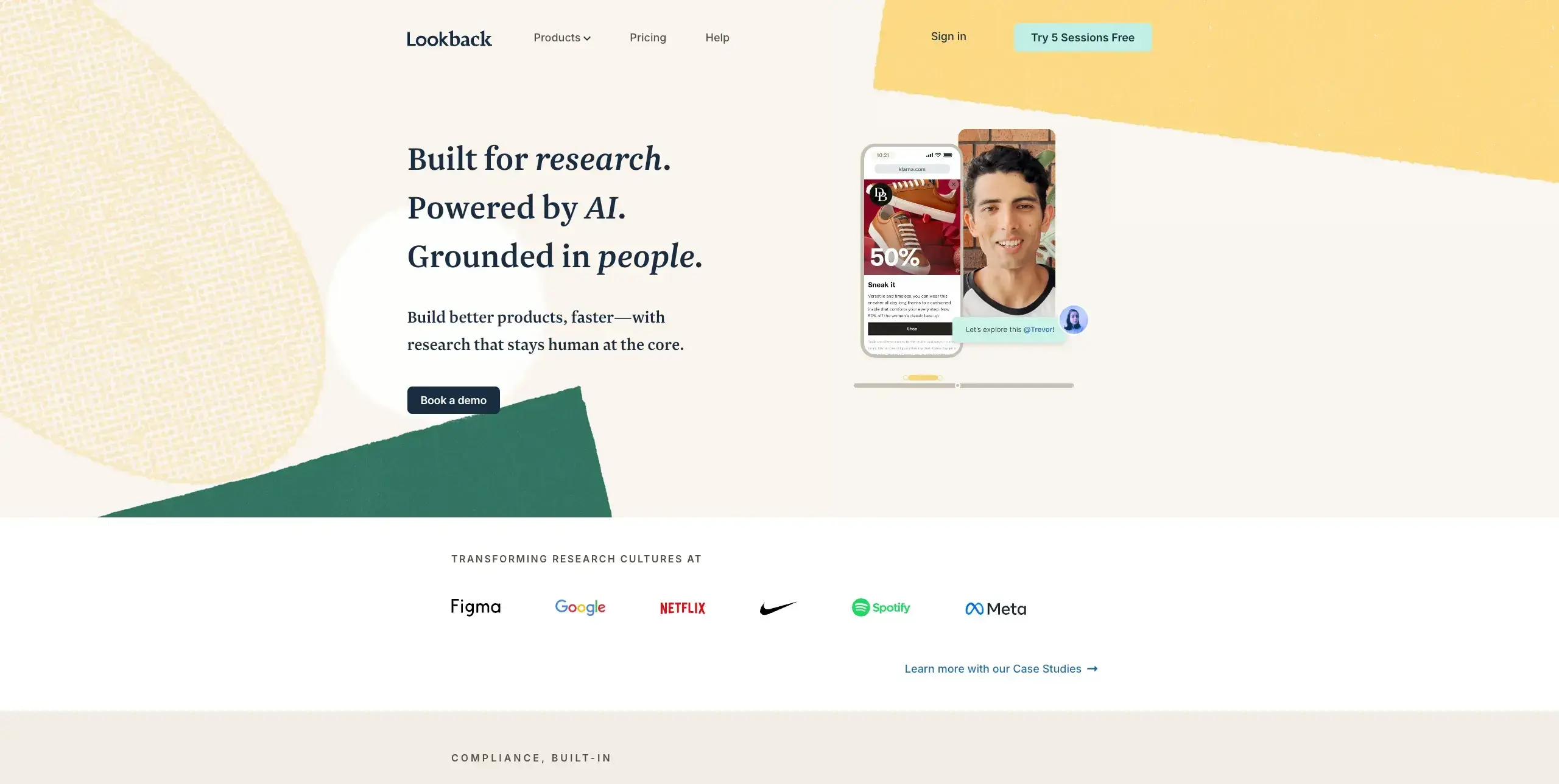
Lookback specializes in moderated research with strong live session capabilities. The platform is designed for researchers who value the depth and flexibility of real-time conversations with participants.
With a focus on qualitative depth and collaborative analysis, Lookback provides a streamlined set of tools for interview-driven research:
Live moderated sessions: Conduct remote moderated interviews with screen sharing, while stakeholders observe in real time through the observer lobby – without overwhelming participants with a visible list of attendees.
Self-guided unmoderated testing: Send test links to participants for asynchronous sessions when you need scale without sacrificing video quality, including screen and face recording.
Timestamped notes and highlights: Tag specific moments during or after sessions, then compile key findings into shareable highlight reels that make it easy to communicate insights to stakeholders.
Team collaboration: Invite unlimited team members to review sessions, add notes, and create findings within shared project workspaces.
Screen and face recording: Capture both the participant's screen interactions and facial expressions simultaneously in high quality, providing full context for behavioral analysis.
Eureka AI assistant: Use AI-powered analysis to navigate session recordings, extract themes, and surface key insights more quickly across multiple sessions.
Participant recruitment: Access Lookback's Recruit feature to source participants at $49 per participant (pay-as-you-go), with discounted rates available for bulk purchases.
Best for: Teams prioritizing moderated research who need robust live session tools. Especially useful for exploratory research, complex workflows, or situations where you need to probe deeper into user motivations and mental models.
Pricing: Freelance plan from $99/month, Team plan from $229/month, Insights Hub and Enterprise plans with custom pricing. All plans are billed annually and include a set number of sessions.
Customer ratings: G2 4.5/5 (21 reviews); Capterra 4.5/5 (13 reviews)
(Note: Review counts are relatively low on both platforms)
5. Optimal Workshop
Optimal Workshop (now rebranded as Optimal) offers a suite of specialized tools for information architecture and UX research. The platform has been a go-to choice for IA specialists and content strategists for over a decade, and has recently expanded into broader usability testing and prototype validation.
With deep roots in IA research and expanding capabilities across the UX research spectrum, Optimal provides a focused set of tools for understanding how users navigate and organize information:
Tree testing (Treejack): Validate navigation structures by testing whether users can find content where they expect it – without the influence of visual design elements.
Card sorting (OptimalSort): Run open, closed, and hybrid card sorts to understand how users naturally categorize and group information, with detailed analysis including similarity matrices and dendrograms.
First-click testing (Chalkmark): Identify whether users can locate the correct starting point for tasks on your designs, helping validate layout and navigation decisions early.
Surveys and qualitative tools: Gather contextual feedback alongside your IA research, with support for importing transcripts, tagging data, and conducting affinity mapping.
AI-powered analytics: Use AI to surface patterns, generate insights, and accelerate analysis across your research studies.
Participant recruitment: Access Optimal's recruitment panel or recruit from your own network using shareable study links.
Advanced IA visualizations: Analyze results using standardization grids, dendrograms, and similarity matrices – purpose-built for understanding information architecture decisions.
Best for: UX teams focused on information architecture, navigation design, and content organization. Particularly valuable during website redesigns, when restructuring navigation, or when validating taxonomy decisions.
Pricing: Starter plan at $199/month (billed annually), which includes five studies per year with unlimited seats and participant responses. Enterprise plan with custom pricing. Additional study bundles are available for purchase.
Customer ratings: Capterra 4.4/5 (7 reviews); G2 rating available but count unclear due to rebrand
6. Userlytics
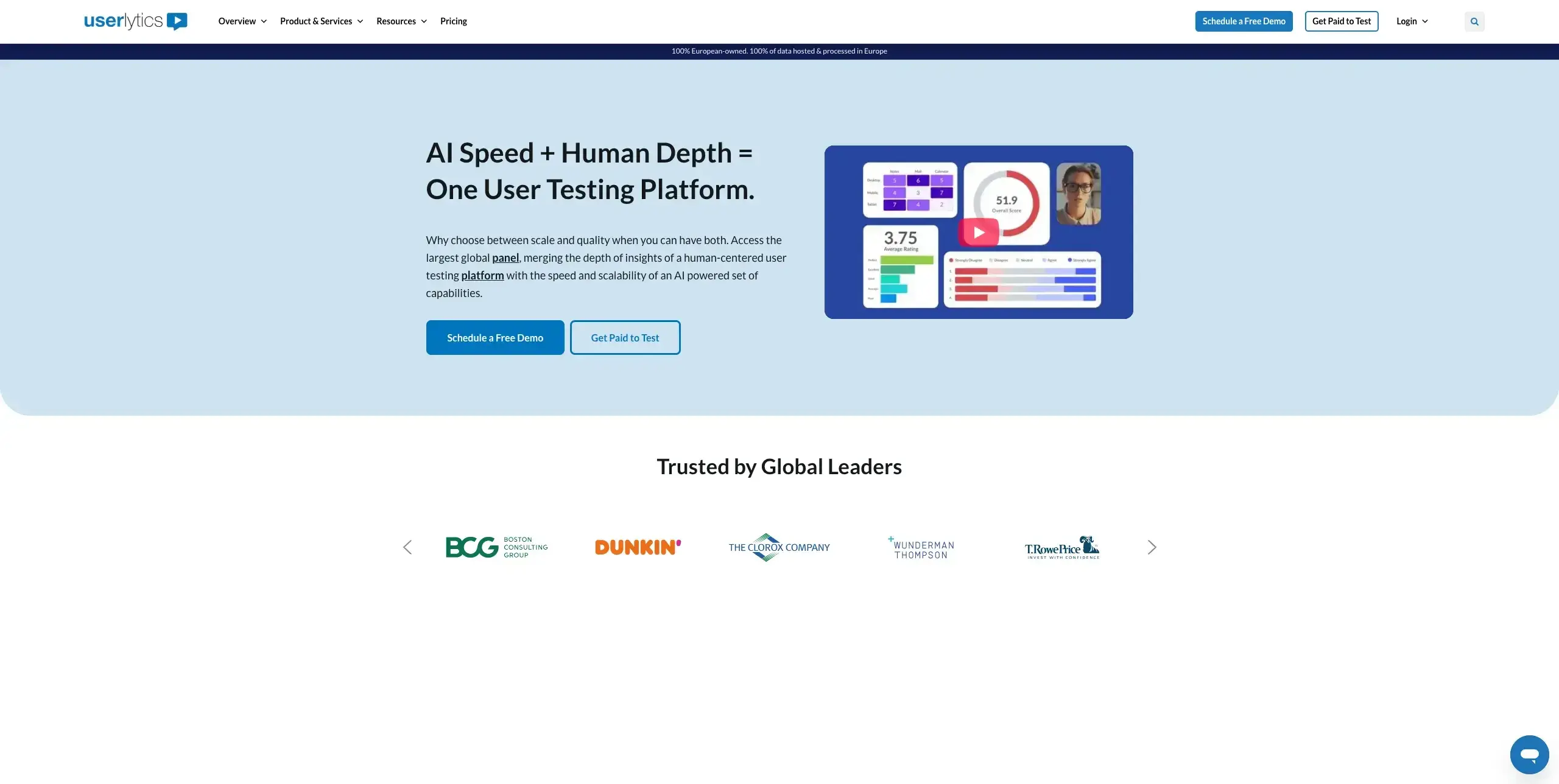
Userlytics provides comprehensive remote testing with advanced annotation features and a strong global participant reach. The platform stands out for its flexibility in test design and its extensive panel of over 2 million participants.
With deep capabilities across both moderated and unmoderated testing, Userlytics offers a full-featured research platform for teams who need detailed video-based insights:
Picture-in-picture recordings: Capture screen interactions alongside webcam footage of participant facial expressions, providing both behavioral and emotional context in a single view.
Branching logic: Build complex test scenarios that adapt based on participant responses, allowing you to create personalized testing paths for different user segments.
Highlight reels and annotations: Mark key moments during session review and compile them into shareable highlight reels – a feature consistently praised by reviewers for streamlining stakeholder communication.
Global participant panel: Access over 2 million panelists with demographic and psychographic targeting, along with custom screener questions to qualify your target audience.
Moderated and unmoderated testing: Run both testing types within the same platform, including live conversation sessions with multiple observers and scheduled participant calls.
Comprehensive testing methods: Conduct prototype testing, live website testing, competitor benchmarking, card sorting, tree testing, and first-click testing all within one platform.
ULX Score benchmarking: Use Userlytics' proprietary scoring system to measure user experience across dimensions like appeal, usability, trust, and performance – useful for tracking improvements over time.
Best for: Teams needing detailed video analysis with international participant reach. Ideal for companies with global audiences or those conducting comparative studies across markets.
Pricing: Pay-as-you-go from $49 per participant for unmoderated testing. Subscription plans start at $499/month, with enterprise pricing based on volume and feature requirements. Moderated sessions with panel participants start from $138 per participant.
Customer ratings: Capterra 4.7/5 (55 reviews); G2 4.4/5 (171 reviews).
7. Great Question
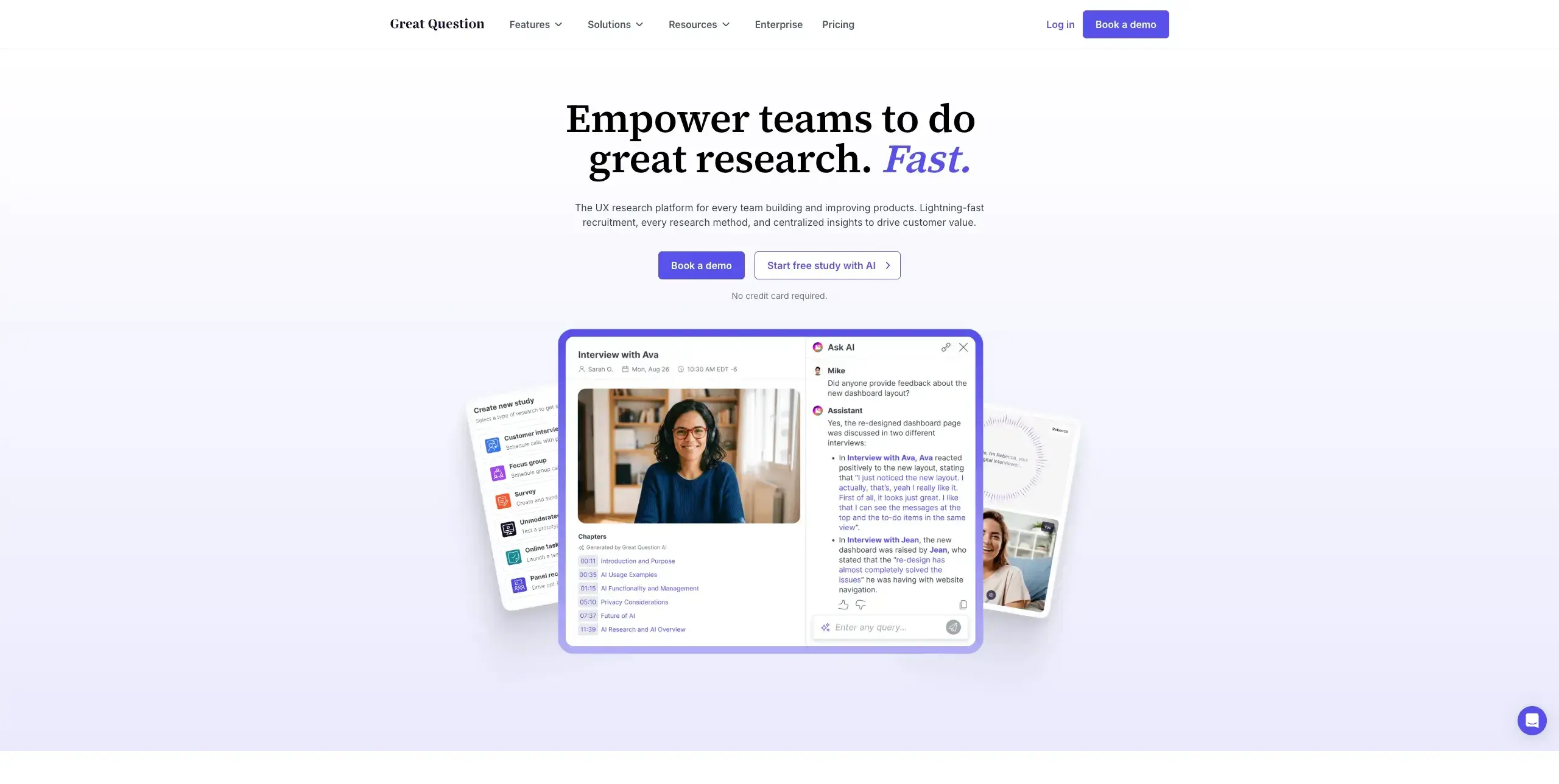
Great Question is an all-in-one, AI-powered UX research platform that unifies recruitment, study creation, interviews, analysis, and insight sharing in a single workspace. The platform is designed to democratize research across entire organizations – helping researchers, product managers, and designers run high-quality studies without juggling multiple tools.
Spanning the full research lifecycle from recruitment through synthesis, Great Question equips teams with a comprehensive set of tools for scaling research across organizations:
Participant CRM and panel management: Build and maintain your own research community with filters, attributes, and automated contact rules to prevent over-recruiting.
AI moderated interviews: Define your research objectives and topics, and Great Question's AI moderator conducts adaptive interviews that probe for detail and capture nuance across time zones – ideal for scaling qualitative research.
AI synthesis and analysis: Query up to 50 hours of transcripts with Ask AI, auto-tag highlights, and generate summaries grounded in your source data with linked verbatim quotes.
Multiple research methods: Run user interviews, surveys, prototype tests (with Figma sync), card sorting, tree testing, focus groups, and unmoderated tasks from a single platform.
Scheduling, incentives, and screeners: Automate calendar coordination, participant payments, and qualification workflows with smart screener logic that routes participants automatically.
Research repository and highlight reels: Organize findings with tags, create shareable video clips, and store all research artifacts in a searchable, centralized repository.
External panel access: A partnership with User Interviews provides access to over 6 million participants across roles, demographics, and niche segments – directly within the platform.
Enterprise-grade compliance: HIPAA compliance and integrations with Snowflake, Salesforce, and other enterprise tools support secure research at scale.
Best for: Research teams and cross-functional product organizations looking for a unified platform to recruit, conduct, and synthesize research. Particularly valuable for enterprises scaling research across multiple teams or for B2B companies managing their own participant panels.
Pricing: Paid plans start around $49/month, with a 14-day free trial available. Great Question introduced updated pricing in late 2025 to support democratized research across organizations – contact them for current plan details.
Customer ratings: G2 4.7/5 (22 reviews). Great Question doesn't currently have enough Capterra reviews for a published rating.
8. Loop11
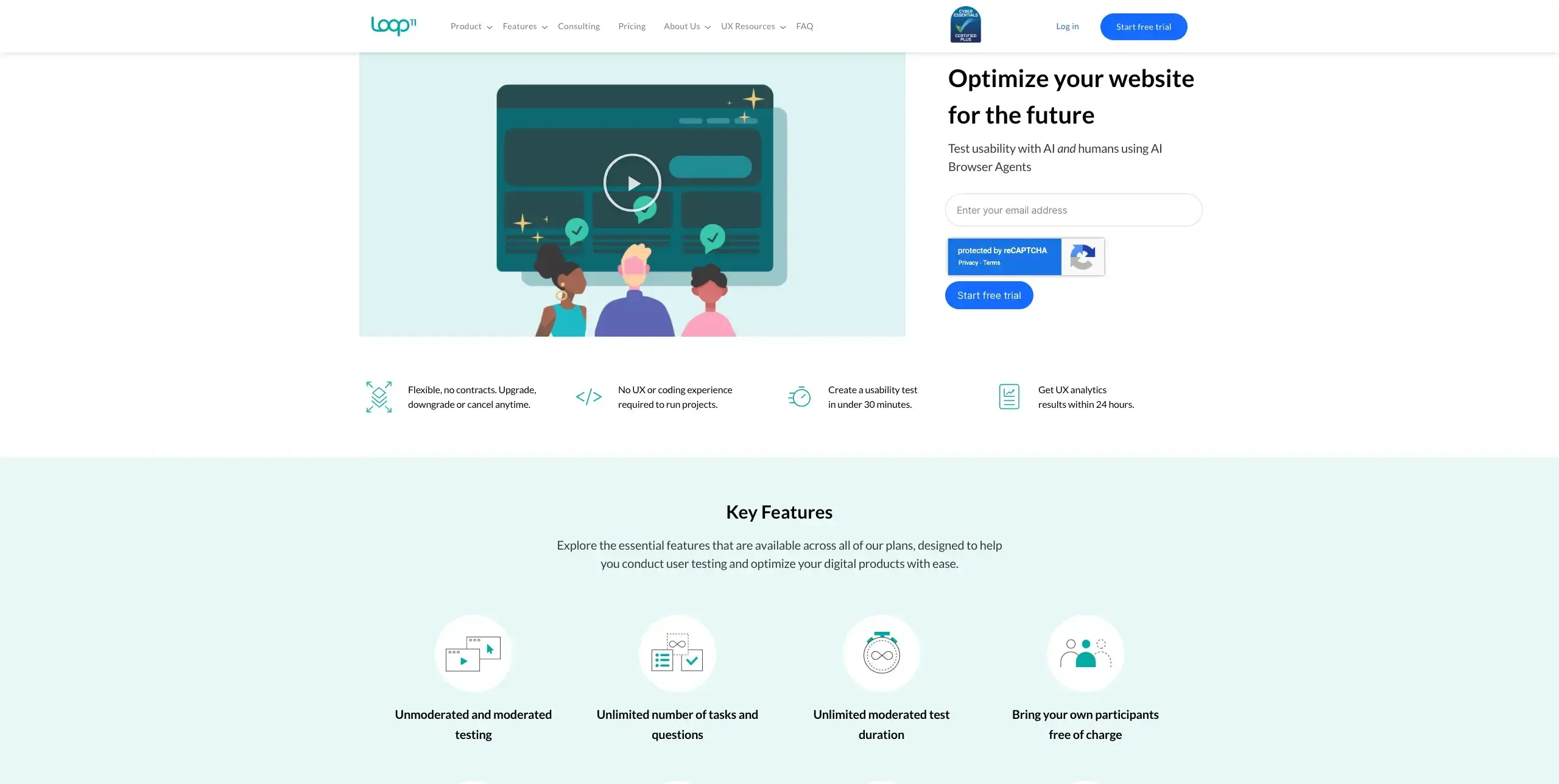
Loop11 is a UX research and testing platform that combines task-based usability testing with AI-powered insights to help teams understand how users interact with websites, prototypes, and competitor sites across any device. The platform stands out for its quantitative benchmarking capabilities alongside qualitative research tools – and unique features like True Intent Studies and Search Engine Findability that few competitors offer.
With quantitative benchmarking at its core alongside unique methods like True Intent Studies, Loop11 delivers a broad toolkit for measuring and improving usability:
Task-based testing with success metrics: Measure completion rates, time on task, and error rates to quantify the usability of your designs and track improvements across iterations.
AI-powered insights and project creation: GPT-4 integration generates actionable findings from your test data, while an AI project creator builds complete test plans with tasks, activities, and questions in seconds.
Heatmaps, clickstream analytics, and path analysis: Visualize aggregate user behavior patterns to understand where users click, how they navigate, and where they encounter friction.
Moderated and unmoderated testing: Run live, guided sessions with real-time observation or launch self-paced tests that participants complete independently – both supported in a single platform.
True Intent Studies: Intercept visitors on your live site to understand their goals, whether they achieved them, and their satisfaction – a distinctive feature for understanding real-world user intent.
Prototype testing with design tool integrations: Import prototypes from Figma, Adobe XD, and other tools to test designs before development, with the same analytics available for live sites.
Benchmarking and A/B testing: Compare results across design iterations, test multiple variations side by side, and benchmark your UX against competitors with standardized metrics.
Session recording and replay: Capture screen, face, and audio recordings of participants to witness their experience firsthand and share key moments with stakeholders.
Search Engine Findability: Measure how easily users can find your online properties through search engines – a unique capability for teams optimizing discoverability alongside usability.
Flexible participant recruitment: Use Loop11's panel of verified participants, bring your own at no extra cost, or use AI Browser Agents for synthetic testing when speed is the priority.
Multi-language support: Run tests in over 40 languages for global research programs.
Best for: Teams who need both quantitative usability metrics and qualitative research capabilities in a single platform. Especially valuable for organizations tracking UX improvements over time, benchmarking against competitors, or running True Intent Studies to understand real visitor behavior on live sites.
Pricing: The Rapid Insights plan starts at $49/month (3 projects, 5 participants each), with the Pro plan at $199/month ($149/month billed annually) for unlimited projects and participants. Enterprise pricing is available for larger teams. A 14-day free trial provides access to full Enterprise-level features.
Customer ratings: G2 3.7/5 (14 reviews). Loop11 doesn't currently have enough Capterra reviews for a published aggregate rating.
9. UXtweak
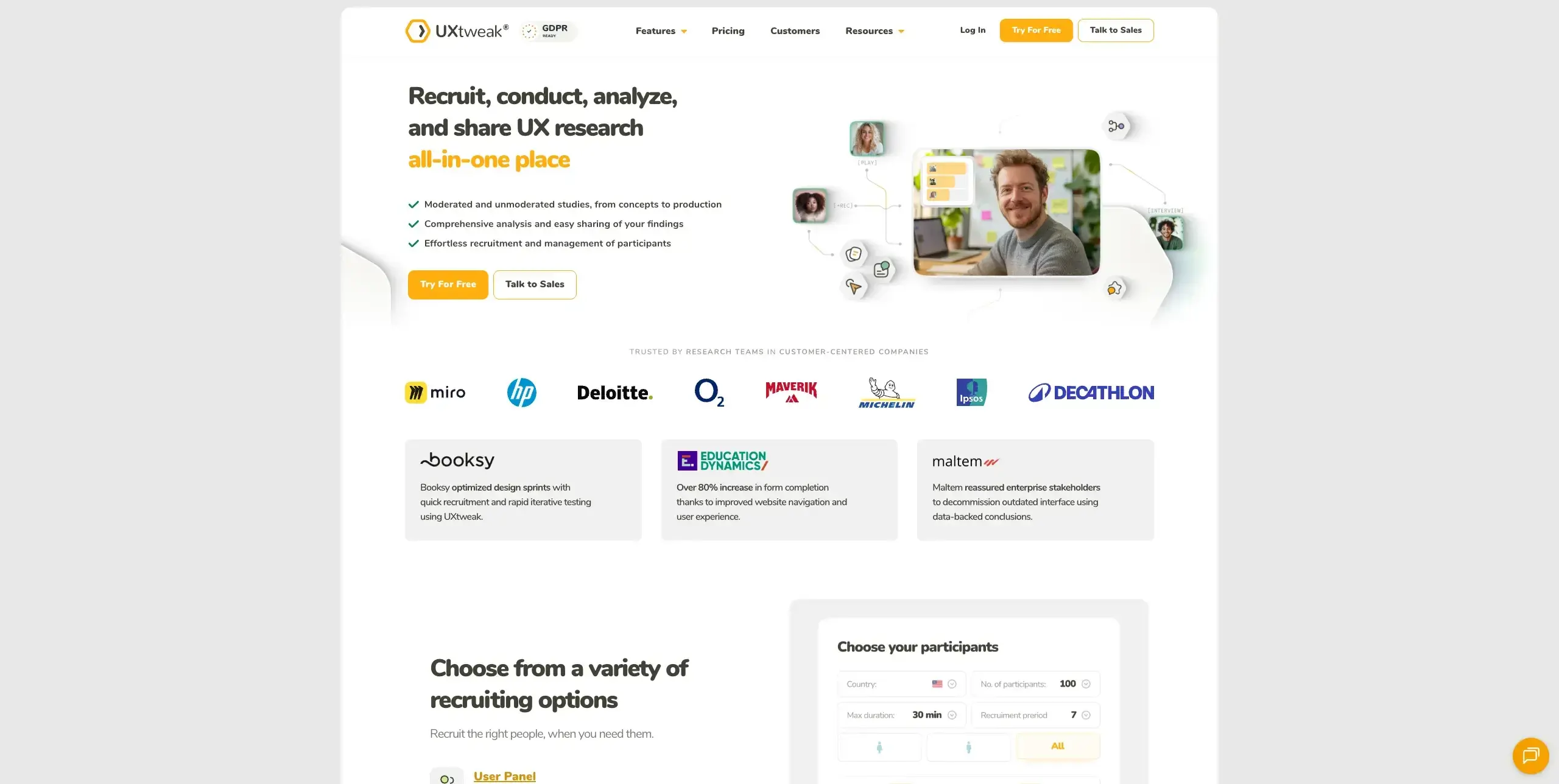
UXtweak is a comprehensive UX research platform that brings together usability testing, information architecture research, behavioral analytics, and participant recruitment in a single workspace.
With tools spanning every phase of the design process – from early-stage card sorting through to live website session recording – UXtweak is built to eliminate the need for juggling multiple specialized tools.
The platform's research capabilities include:
Website and prototype usability testing: Run task-based studies on live websites, web apps, or Figma prototypes with direct import that syncs transitions automatically. Collect both quantitative metrics and qualitative observations in a single study.
Information architecture research: Use card sorting (open, closed, and hybrid) and tree testing to evaluate and refine your navigation structures, with detailed analytics showing how users group and find content.
First click, five second, and preference testing: Run rapid evaluations to test visual hierarchy, first impressions, and design comparisons – ideal for quick validation during iterative design cycles.
User interviews: Conduct live, moderated research sessions directly within the platform alongside your unmoderated studies, keeping all research in one place.
Session recording with advanced analytics: Record visitor sessions on your live site and filter recordings using 40+ criteria, including frustration signals. Analytics go beyond basic heatmaps to include lostness metrics, overall usability scores, task completion rates, and navigation path analysis.
Surveys and feedback widgets: Deploy website surveys and feedback collection tools for continuous insight gathering, with features like answer grouping and conditional logic.
Global user panel: Recruit participants from over 130 countries using 2,000+ targeting attributes, with built-in quality checks and free replacements for unreliable responses.
Recruiting widget and participant management: Embed a JavaScript snippet on your site or through Google Tag Manager to recruit your own visitors directly into studies. A CRM-like participant database lets you store contacts, create segments, and send automated invitations.
Mobile app testing: Test iOS apps with real users to evaluate usability on mobile devices.
Competitive UX benchmarking: Compare your experience against competitors using standardized usability metrics.
Best for: Teams of any size looking to consolidate multiple research tools into a single platform. Particularly well suited for small to mid-size teams who want comprehensive research capabilities without enterprise pricing, as well as freelancers, solo researchers, and educators who benefit from the generous free plan and academic discounts.
Pricing: A free plan is available for small projects with no time limit. The Business plan is $125/month ($92/month billed annually). Custom pricing is available for organizations needing advanced features and unlimited user licenses.
Customer ratings: Capterra 4.8/5 (34 reviews); G2 4.8/5 (43 reviews)
10. Userbrain
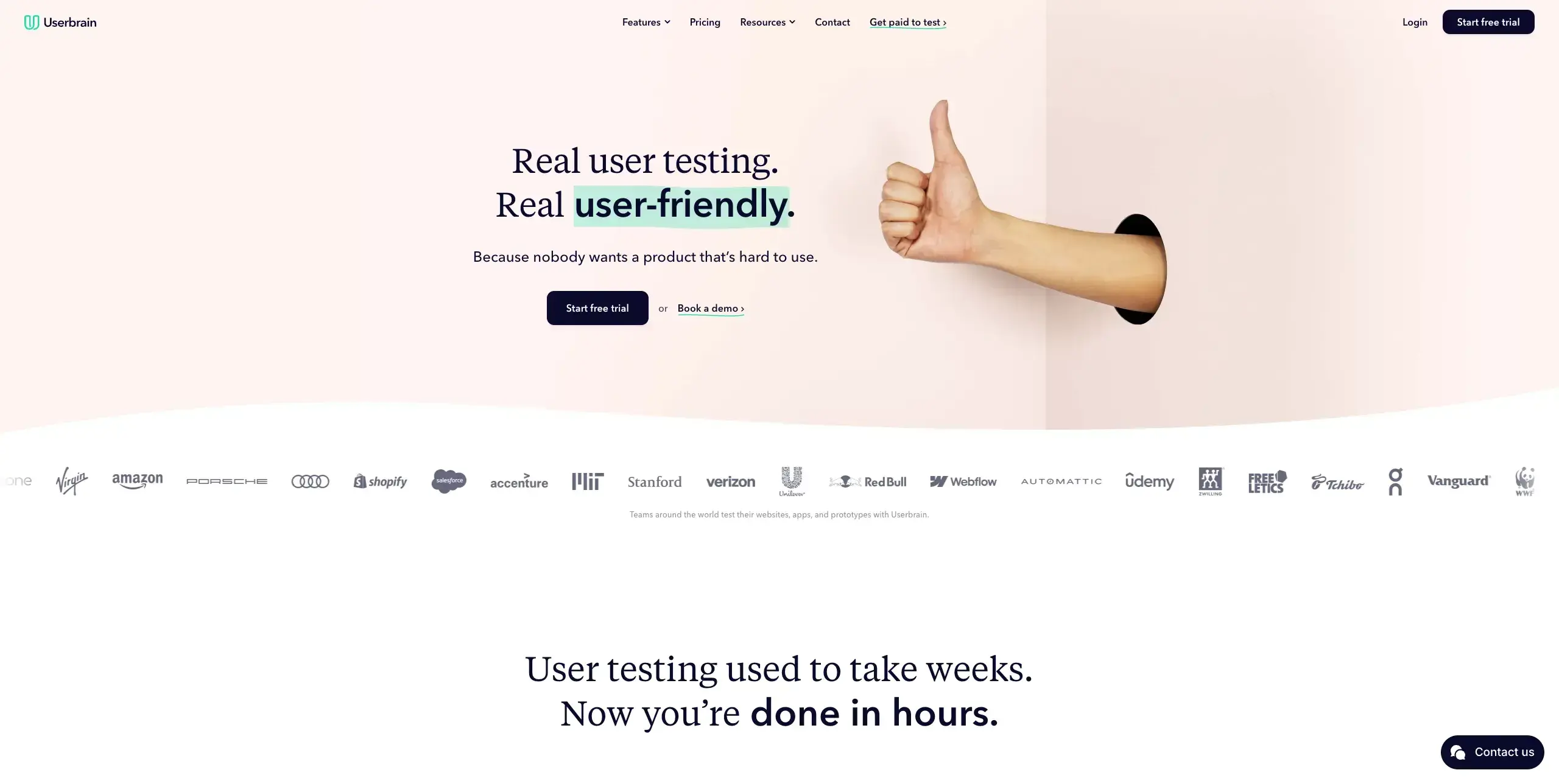
Userbrain emphasizes simplicity and quick setup for unmoderated video-based testing. The platform is designed for teams who want to start testing immediately without a steep learning curve.
Focused on fast, video-first feedback with minimal setup, Userbrain keeps its feature set streamlined and accessible:
Unmoderated video testing: Watch five to 20 minute recordings of real users completing tasks on your website, app, or prototype while thinking aloud.
125,000+ tester panel: Access a global pool of quality-assured testers with demographic targeting and screener questions to filter by experience, habits, or preferences.
AI insights: Automatically surface key moments, themes, and patterns across test sessions, saving hours of manual video review.
Automated reports: Generate presentation-ready summaries with task success rates, time on task, and AI-assisted notes for stakeholder sharing.
Figma integration: Connect Figma prototypes directly to the platform for streamlined prototype testing.
Invite your own testers: Blend panel feedback with insights from your own users (up to 100 sessions per month on paid plans).
Best for: Teams new to usability testing who want a low-friction, video-first experience. Also suitable for solo practitioners, startups, or small teams looking for affordable unmoderated testing.
Pricing: A free plan includes five sessions per month with your own testers. Paid subscriptions start at $124/month for the Starter plan (or $99/month billed annually), which includes three panel testers per month. Pay-as-you-go testing is available at $45 per panel tester with no subscription required. A 14-day free trial includes two panel testers.
Customer ratings: Capterra 4.2/5 (88 reviews). G2 rating not confirmed due to limited profile visibility.
11. PlaybookUX
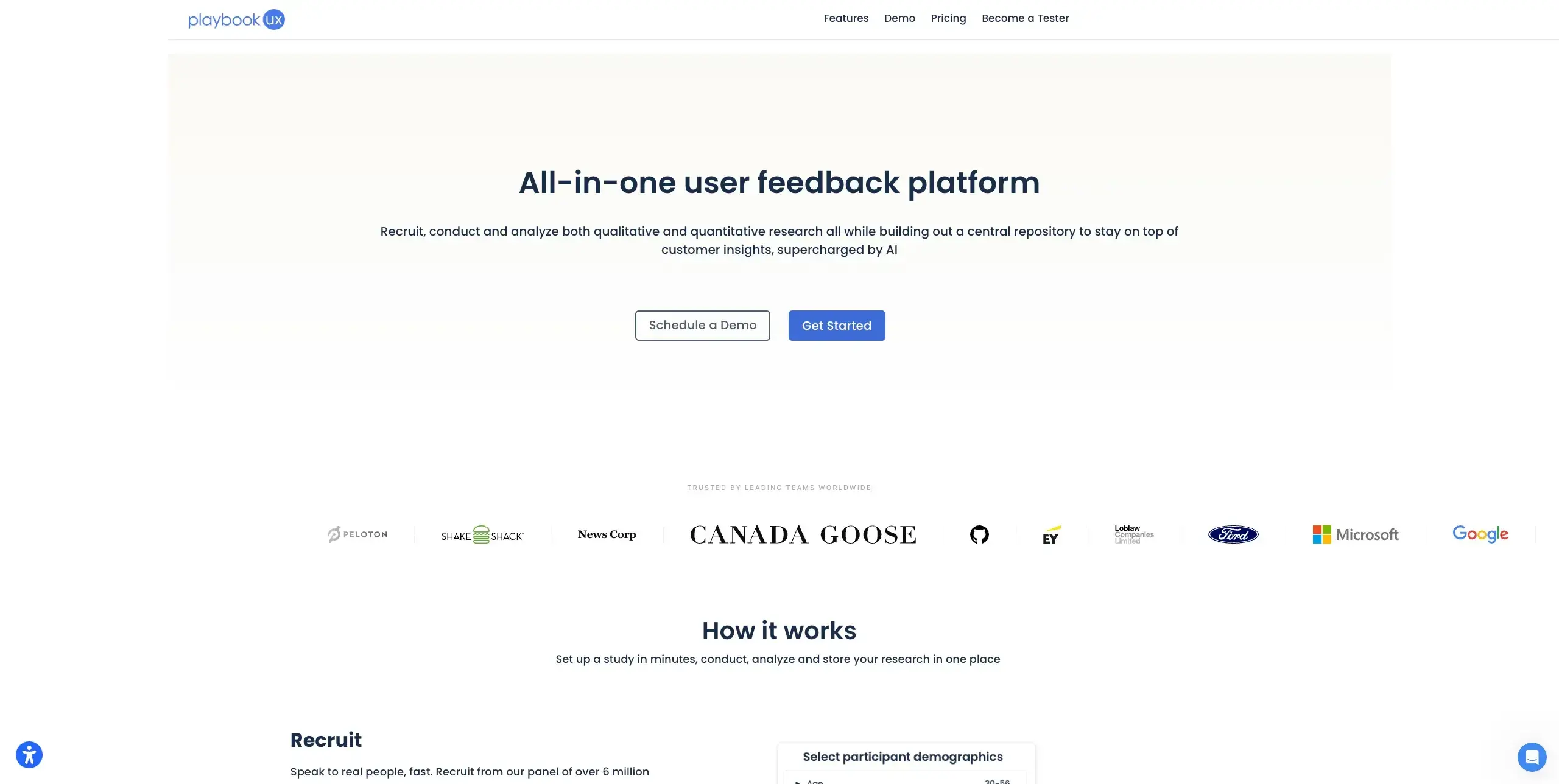
PlaybookUX combines usability testing with survey and interview capabilities. The platform is built around the idea that the best research outcomes come from mixing qualitative observation with quantitative measurement.
Combining behavioral observation with attitudinal data, PlaybookUX brings together a mixed-methods research toolkit:
Moderated and unmoderated testing: Run live interviews or recorded task-based sessions, with flexible formats for both approaches.
Mixed-methods studies: Combine usability testing, surveys, card sorting, and tree testing within a single platform.
Global participant panel: Recruit from 50+ countries with B2B targeting by job role, industry, and company size, plus custom screener questions.
AI-powered analysis: Automatically identify themes and sentiment across sessions, with transcriptions and time-stamped notes.
Figma integration: Connect prototypes directly for goal-based click testing and enhanced metrics.
Session replays and intercepts: Watch real-time recordings of user interactions, and intercept visitors at key moments to invite them into research studies.
Collaboration at scale: Unlimited seats on all plans, with shared highlight reels, clips, and presentation-ready reports.
Best for: Teams who want to combine usability testing with survey research and interviews in one platform. Particularly useful for mixed-methods research where you need both behavioral observation and attitudinal data.
Pricing: Pay-as-you-go at $65 per unmoderated participant and $115 per moderated participant (first 30 minutes), with a 50-session annual limit. Subscription plans start at $5,400/year (Scale) and $8,800/year (Pro), unlocking card sorting, tree testing, surveys, and Figma integration. Enterprise pricing is custom. Panel recruitment is priced separately on all plans.
Customer ratings: Capterra 5.0/5 (7 reviews). G2 profile is currently unmaintained, so the rating could not be verified. Note that the small number of reviews limits the reliability of these scores.
12. Useberry
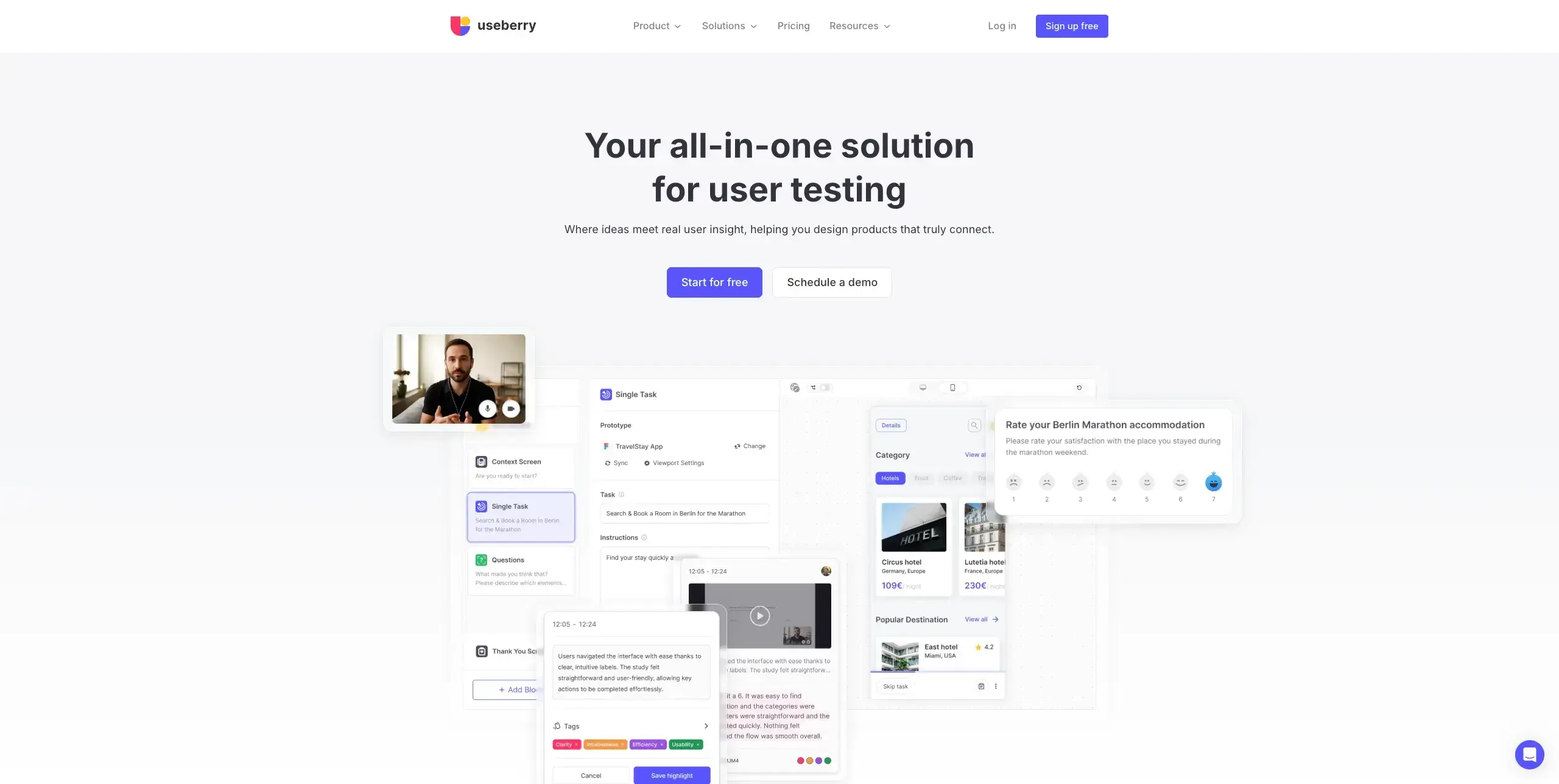
Useberry focuses on prototype and website usability testing with deep design tool integrations. The platform is optimized for design teams who want to validate concepts before committing to development, while also supporting live website testing and information architecture research.
With broad design tool compatibility and versatile study types, Useberry gives design teams a range of research capabilities:
Design tool integrations: Sync prototypes directly from Figma, Sketch, Adobe XD, ProtoPie, and Marvel with automatic updates.
Visual analytics: Heatmaps, click maps, and user flow visualizations show exactly how participants interact with your designs.
Session recordings: Capture mouse movements, screen activity, voice, and face recordings to understand the full context behind user behavior.
Versatile testing methods: Run single tasks, open analytics, first click tests, five-second tests, preference tests, SUS surveys, card sorting, and tree testing from one platform.
Study logic and customization: Use randomization, A/B testing, logic jumps, screening questions, and language localization to build targeted, sophisticated studies.
Participant pool: Access Useberry's vetted participant panel for recruitment, or share test links to bring your own audience.
Collaboration features: Tags, highlights, and highlight reels help teams organize findings and share key moments.
Best for: Design teams who primarily test prototypes and want a platform that integrates directly with their design tools. Also valuable for agencies or consultancies running frequent tests across multiple clients.
Pricing: Free plan available with 10 responses per month. The Growth plan starts at $67/month (billed yearly) and includes 300 responses per month, unlimited projects, session recordings, and screening questions. Enterprise pricing is custom.
Customer ratings: G2 4.3/5 (16 reviews). Capterra rating could not be verified at the time of writing.
13. Ballpark
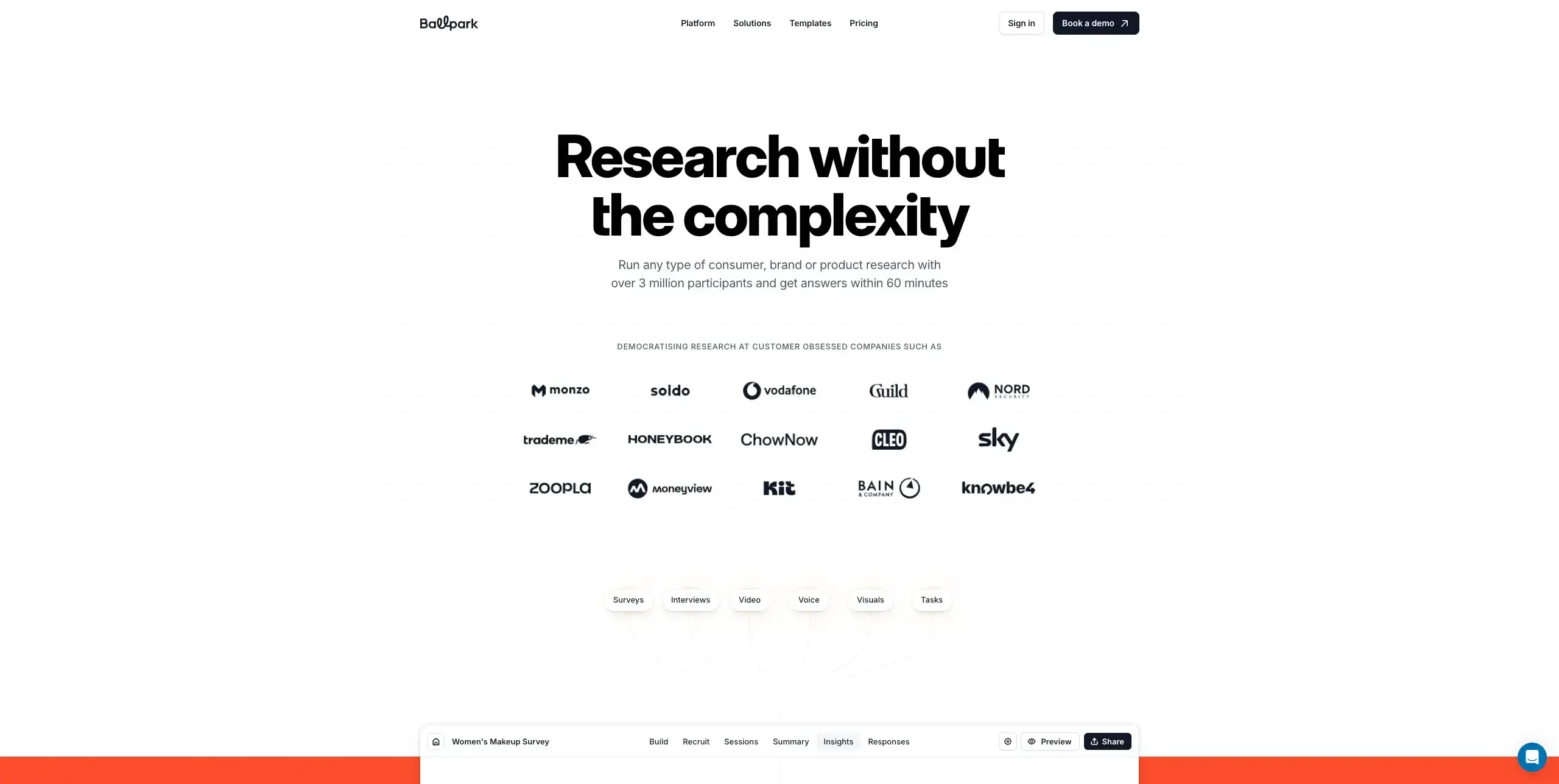
Ballpark is an AI-powered user research platform that combines surveys, usability testing, and video feedback in a single tool. While it's designed to make research fast and accessible, the platform has expanded well beyond lightweight testing into comprehensive research capabilities.
With AI woven into its research workflow and a growing set of study types, Ballpark offers flexible tools for teams at any research maturity level:
AI interviewer: Ballpark's AI moderator adapts in real time, guiding conversations and asking intelligent follow-up questions automatically for unmoderated qualitative research.
Mixed research methods: Combine surveys, prototype testing, first click tests, five-second tests, preference tests, and copy testing in a single study.
Figma and Marvel integration: Test prototypes directly from your design tools, with heatmaps, click tracking, goal conversion metrics, and path analysis built in.
Video and screen recording: Capture participants' webcam and screen interactions during tests for rich qualitative context, including live website testing with no plugins required.
AI-powered analysis: Automatically generated reports highlight key findings and trends, reducing time from data to insights.
Global participant panel: Access over 3 million participants across 150+ countries, with advanced demographic and behavioral targeting including industry, hobbies, and technology use.
Unlimited team members: Every plan includes unlimited seats, making it cost-effective for organizations that want to democratize research across teams.
Best for: Product and design teams at mid-to-large organizations who want an intuitive, scalable research platform with unlimited seats. The enterprise model and managed research option make it particularly suited to companies looking to centralize and democratize research across teams.
Pricing: A 14-day free trial is available with full platform access. Beyond the trial, Ballpark offers custom enterprise pricing across two tiers – Enterprise Platform (self-serve research at scale) and Enterprise Managed (expert-led research delivery). Participant recruitment starts at $1 per credit/minute as an add-on.
Customer ratings: G2 4.6/5 (61 reviews). No Capterra listing was found.
14. dscout
dscout is an AI-powered experience research platform built around capturing rich, in-context insights through video, photo, and text responses.
While the platform is well known for its diary studies and longitudinal research capabilities, it has expanded into a comprehensive multi-method research tool that supports usability testing, live interviews, real-time intercepts, field studies, media-rich surveys, and card sorting.
With a mobile-first approach and expanding multi-method support, dscout brings together a range of tools for capturing rich, contextual feedback:
Mobile-first diary studies: Capture in-the-moment experiences over days or weeks.
Unmoderated usability testing: Screen and voice capture for remote prototype testing.
Live video interviews: Auto-transcription, screen sharing, and observer invites.
Real-time intercepts: Capture feedback during app or website usage.
AI agents: Woven throughout the platform for research planning, moderation, and analysis.
Extensive participant access: dscout's verified "Scout" panel, plus 3 million+ global participants via Partner Panels.
Private Panel management (CRM): Invite and organize your own participants.
Integrations: Figma, Miro, and Slack, plus a playlist builder for sharing insights with stakeholders.
Best for: Mid-market and enterprise teams conducting qualitative-heavy research programs. Particularly valuable for diary studies, longitudinal research, and in-context field studies, but now capable of supporting the full research lifecycle from discovery through validation. Named a G2 Leader in User Research for 10 consecutive quarters.
Pricing: Custom pricing across three tiers (Core, Select, and Enterprise), based on the number of researcher seats, activity credits, and support level. No free plan. Trial available on request.
Customer ratings: G2 4.5/5 (183 reviews). No Capterra listing was found for dscout.
15. Testbirds
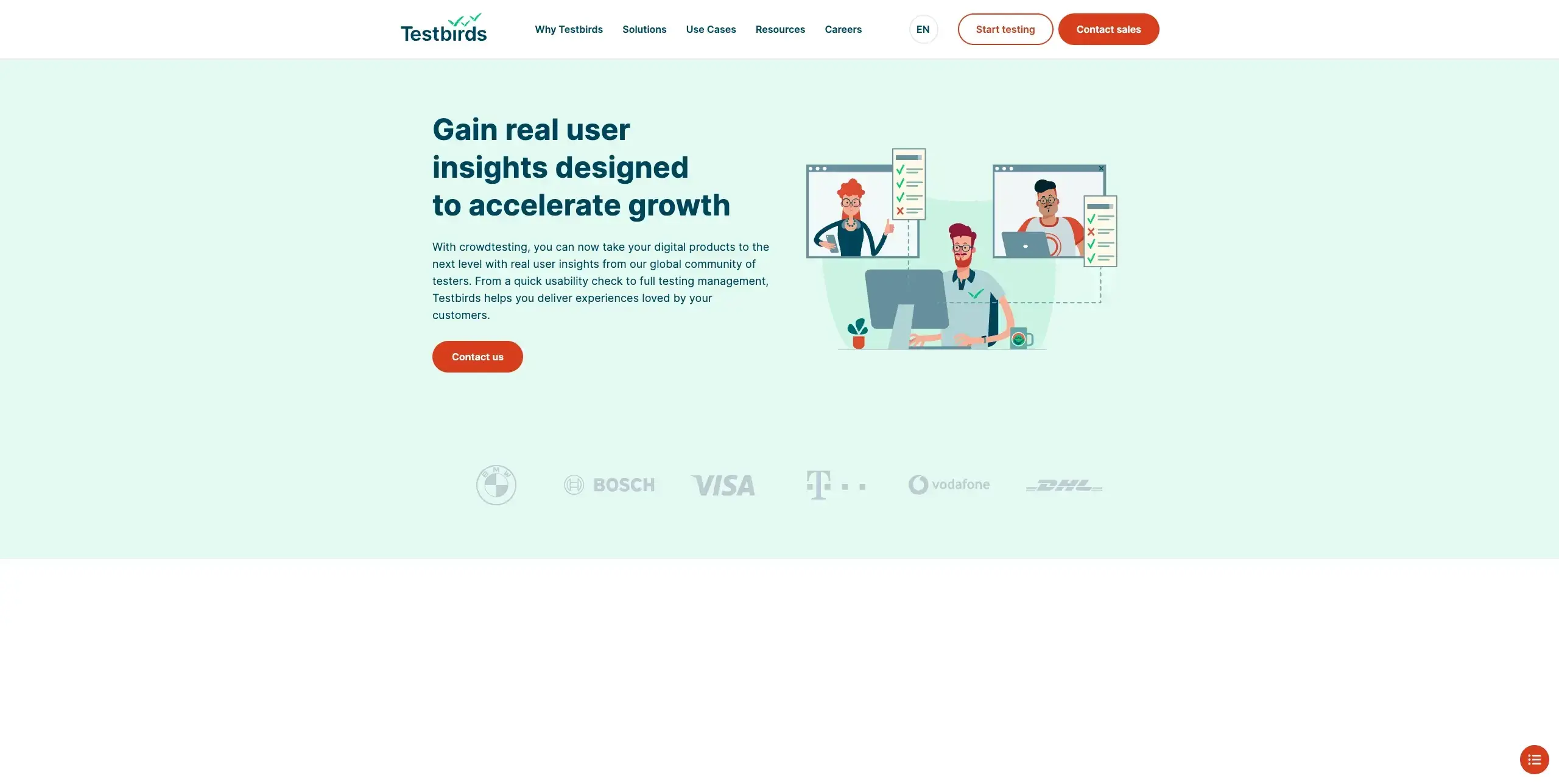
Testbirds offers crowdsourced testing with a focus on real-world device coverage. The platform bridges the gap between QA testing and UX research by combining both perspectives, and is recognized by Gartner as a representative vendor for application testing and UX testing services.
Backed by a massive global testing community and dual QA/UX expertise, Testbirds delivers a broad range of testing services:
Crowdtesting with massive device coverage: Over 1.5 million real devices across 1 million+ testers in 193 countries
Combined QA and UX testing: Bug testing alongside usability testing for comprehensive quality assessment
Over 20 testing services: Including exploratory testing, usability testing, diary studies, accessibility testing, payment processing testing, and localization testing
Self-service and managed service options: Self-service lets you set up and manage tests yourself, while managed service provides full project management from Testbirds' in-house UX and QA experts
Accessibility testing: With testers who use assistive technologies in real-world conditions
IoT and cross-platform testing: Apps, websites, and Internet-of-Things applications
PCI-DSS v4.0.1 certified: For secure payment journey testing
Best for: Teams needing real-device testing across many configurations or combined QA and UX testing. Especially useful for mobile apps, ecommerce platforms, payment flows, or products with complex technical requirements. Trusted by BMW, Audi, Deutsche Telekom, and Allianz.
Pricing: Custom pricing using BirdCoins, a flexible credit-based system. BirdCoins can be spent across Testbirds' full service portfolio whenever needed, with costs varying by project complexity, tester count, and device requirements. Both self-service and managed service levels available.
Customer ratings: G2 4.0/5 (22 reviews). No Capterra listing was found for Testbirds.
16. UserFeel
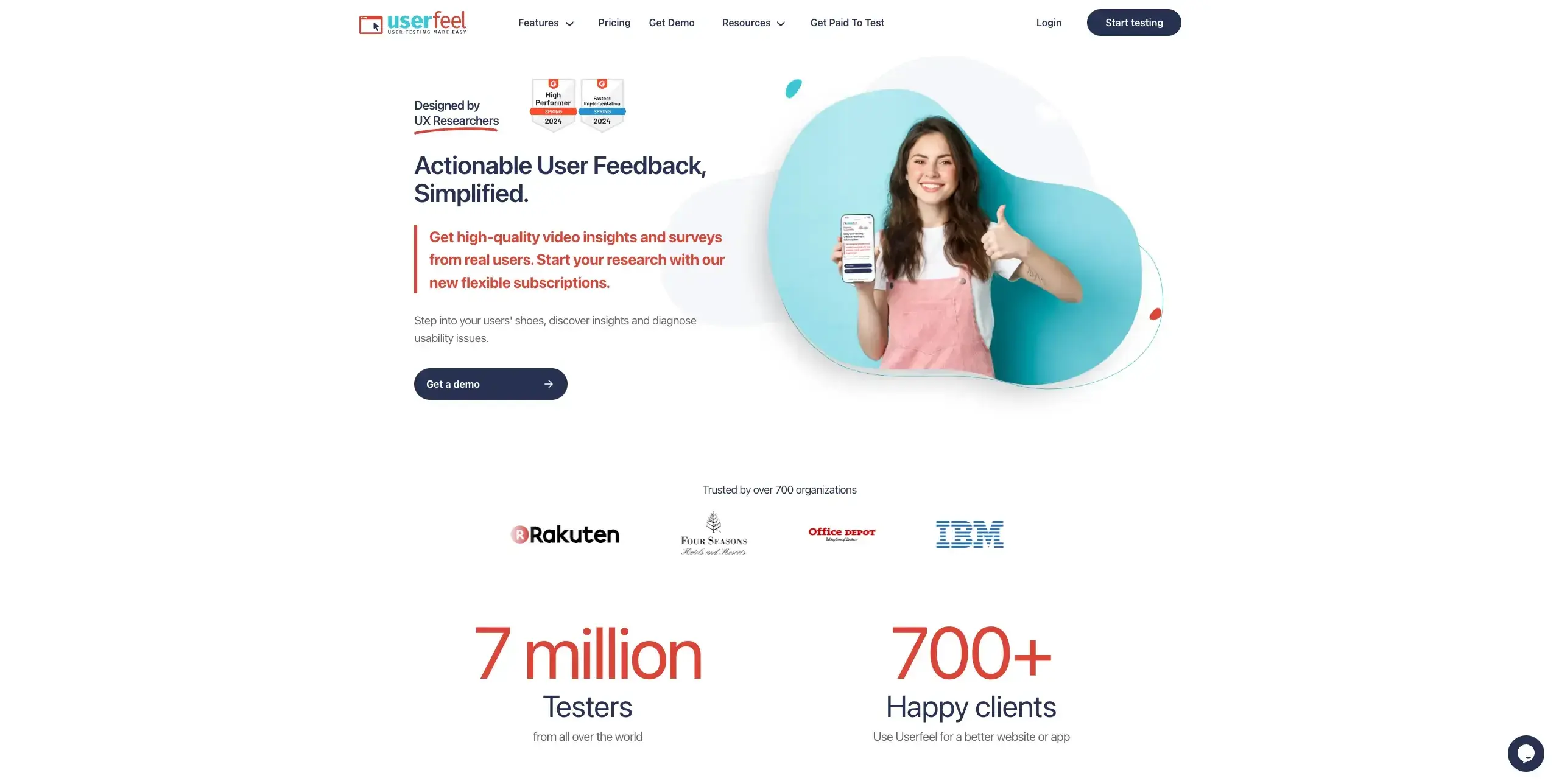
UserFeel is a usability testing platform built by UX researchers, offering both moderated and unmoderated testing with strong multilingual support. The platform provides flexible pricing options – including pay-per-test and subscription plans – making international research accessible to teams of all sizes.
With international accessibility as a core strength, UserFeel offers flexible research tools for teams of all sizes:
Multilingual testing: Test in 40+ languages with access to a panel of over 1 million testers worldwide.
Moderated and unmoderated testing: Run both testing types for websites, apps, and prototypes.
Flexible participant targeting: Use unlimited screener questions and demographic targeting to match your ideal participants.
AI-powered synthesis: Analyze qualitative responses and generate insights automatically.
Video recordings with transcription: Capture sessions with automatic voice transcription, annotations, and highlight reels.
Template tests: Get started quickly with templates curated by experienced UX researchers.
Multiple research methods: Conduct card sorting, information architecture testing, and prototype testing alongside usability studies.
Cross-device testing: Test on desktop, mobile, and tablet across devices.
Best for: Teams conducting international or multilingual research who need flexible, budget-friendly access to a global participant pool. A strong option for companies expanding into new markets or validating localized experiences without committing to annual contracts.
Pricing: Pay-per-test pricing starts at $30 for a 60-minute session using your own testers, or $60 – $180 per session when recruiting from UserFeel's panel (depending on whether the test is unmoderated or moderated). Subscription plans are also available: Plus ($59/month), Business ($151/month), and Enterprise (starting at $5,000/year). Free trial available.
Customer ratings: Capterra 4.5/5 (16 reviews); G2 4.4/5 (105 reviews).
17. Helio
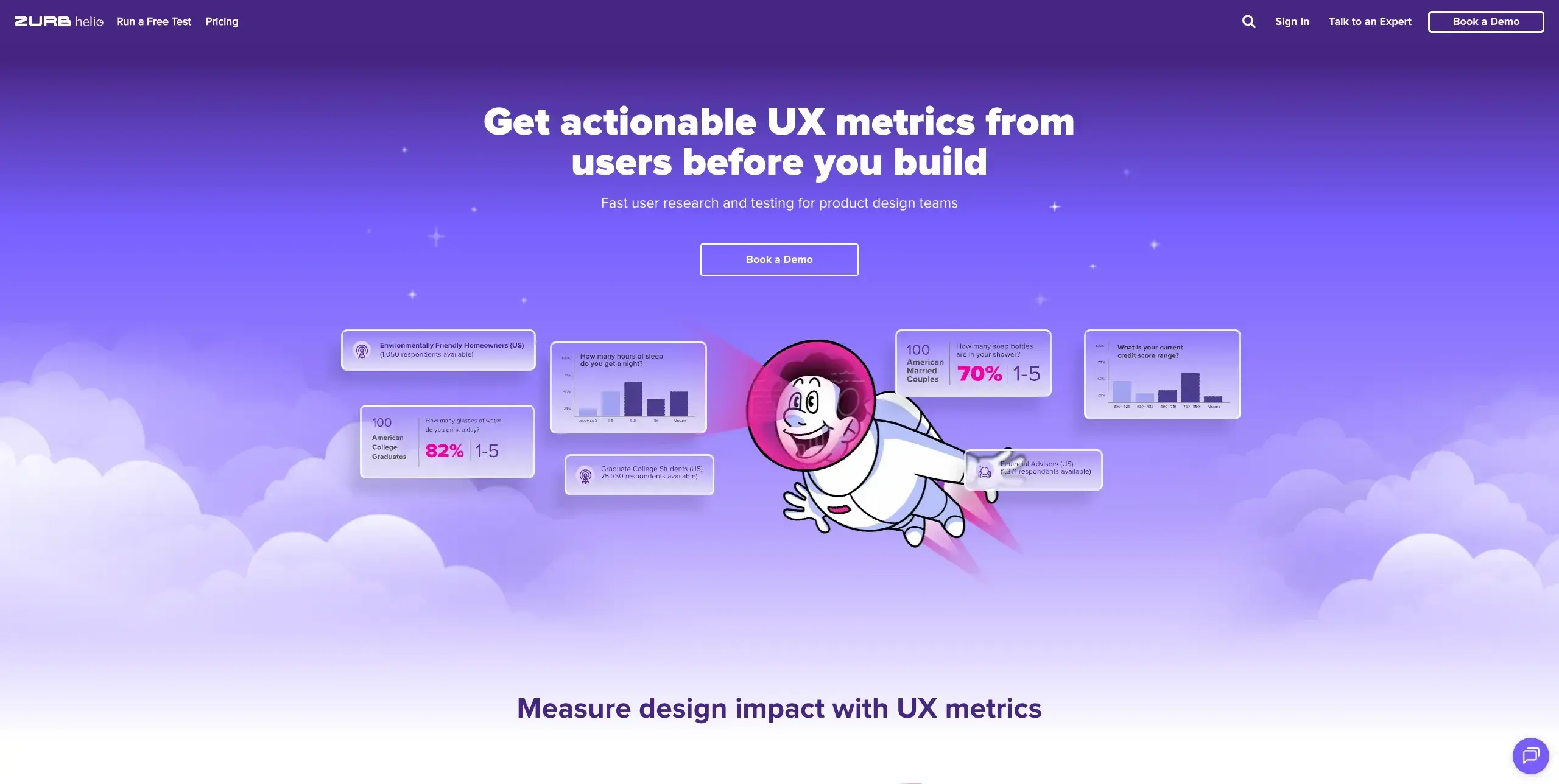
Helio (formerly Verify, built by ZURB) is a survey and testing platform designed for rapid design validation, concept testing, and market research. With access to nearly 1 million active participants and advanced behavior-based audience filters, the platform delivers quantitative and qualitative feedback – often within minutes.
Designed for rapid validation with advanced audience targeting, Helio delivers a versatile set of testing and survey tools:
Versatile test types: Click tests, tree tests, preference tests, and Figma prototype testing with 12 question types.
Behavior-based audience targeting: Reach participants who match your ideal customer profile based on real behaviors.
Media testing: Validate animation, audio, and video content alongside static designs and campaigns.
Advanced test logic: Use branching logic and device targeting (mobile, tablet, or desktop) for tailored test flows.
Real-time reporting: Filter results by demographic, sentiment, keyword, and response data as they come in.
Research services: Access dedicated advocacy teams who can run tests and synthesize findings on your behalf.
Branded tests and custom screeners: Customize the testing experience on higher-tier plans.
Template library: Speed up test creation with templates for common research scenarios.
Best for: Teams who need quick validation of design concepts, marketing assets, and product ideas. Particularly useful for product managers, growth marketers, and brand designers who make frequent decisions that benefit from rapid user input.
Pricing: Agency plan at $99/month (unlimited open link tests, pay-per-use panel access at $199–$599 per test). Business plan at $599/month (includes panel answers). Scale plan at $4,999/month (includes a dedicated Helio researcher). Enterprise pricing is custom. Panel usage is billed per answer – one answer equals one response to one question from one participant. 10% discount on yearly subscriptions.
Customer ratings: G2 listing exists with very few reviews – rating unverifiable. No Capterra listing was found for Helio.
18. Sprig
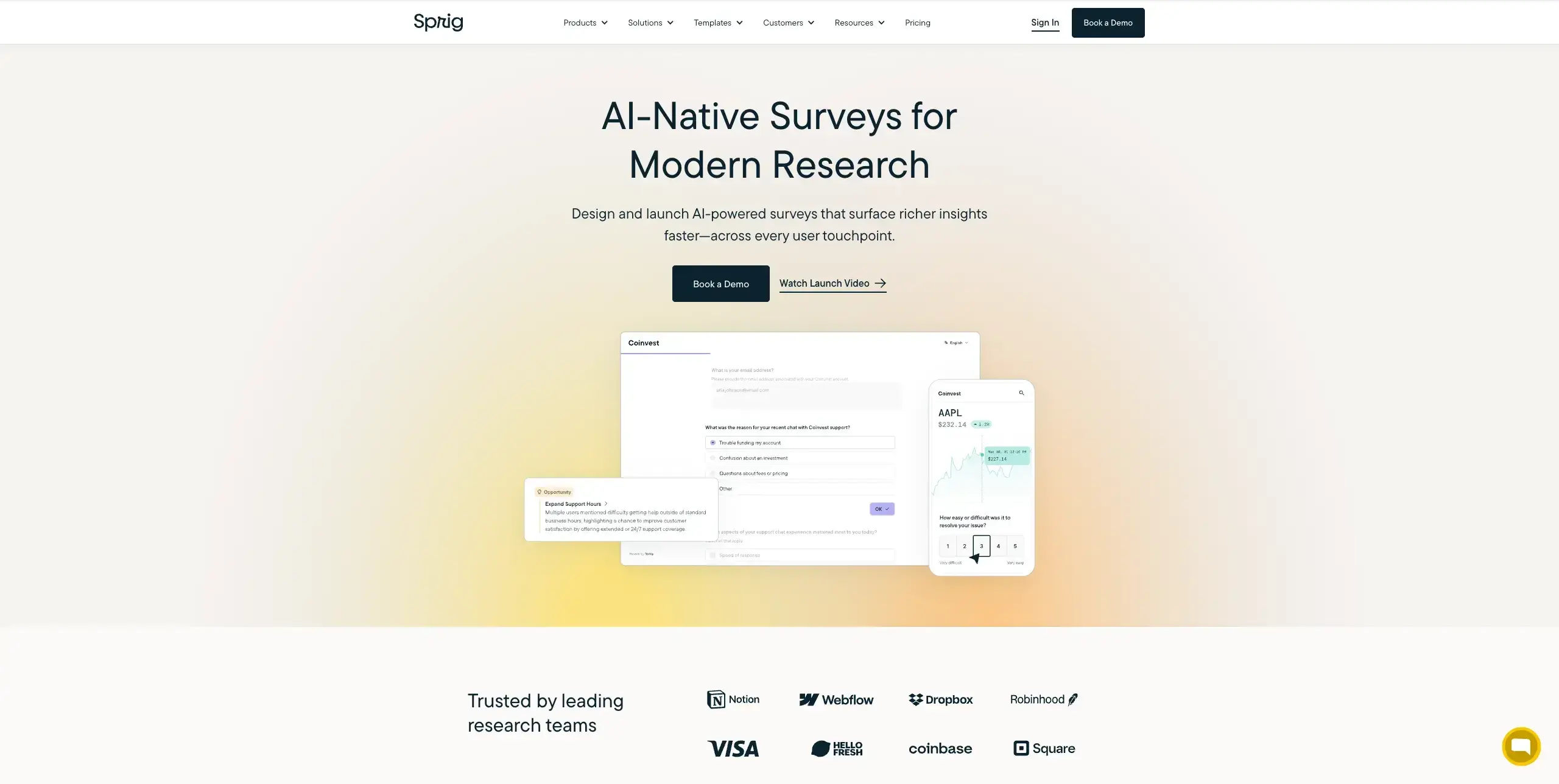
Sprig (formerly UserLeap) is an AI-powered product experience platform that captures feedback and behavioral data directly within your live product. The platform combines in-product surveys, session replays, and heatmaps – all enhanced by AI that automatically surfaces themes, sentiment, and actionable product recommendations in real time.
With AI embedded throughout the platform, Sprig provides an integrated set of tools for capturing and acting on in-product behavior:
In-product surveys: Trigger targeted surveys based on specific user actions, behaviors, or segments, with AI-powered analysis.
Long-form surveys: Distribute via email, SMS, or chat with advanced logic, randomization, and AI follow-ups.
Session replays: Watch exactly what users did, with AI that groups clips into actionable behavior themes.
Heatmaps: Visualize in-product interactions across web and mobile.
Always-on feedback buttons: Collect continuous user input with AI-powered product recommendations.
Behavioral targeting: Reach users based on behavior, properties, or custom segments for precise audience reach.
Integrations: Connect with Amplitude, Mixpanel, Segment, Figma, LaunchDarkly, and collaboration tools.
Modular platform: Start with one bundle (Research Core, Digital Experience, or Digital Behavior) and expand over time.
Best for: Product teams who want to capture feedback within their live product experience. Especially valuable for SaaS companies where you can target specific user segments or trigger research based on feature usage. Trusted by companies like PayPal, Figma, Dropbox, Robinhood, and Notion.
Pricing: Three modular bundles – Research Core (self-serve surveys, no SDK required), Digital Experience (in-product surveys and feedback), and Digital Behavior (session replays and heatmaps). Free plan available with limited access. Starter plan at $175/month (billed annually, includes up to 25,000 MTUs). Enterprise pricing is custom. Costs scale based on monthly tracked users.
Customer ratings: G2 4.5/5 (105 reviews). Sprig has a Capterra listing under its former name UserLeap, but it has no published reviews or rating at the time of writing.
19. Trymata
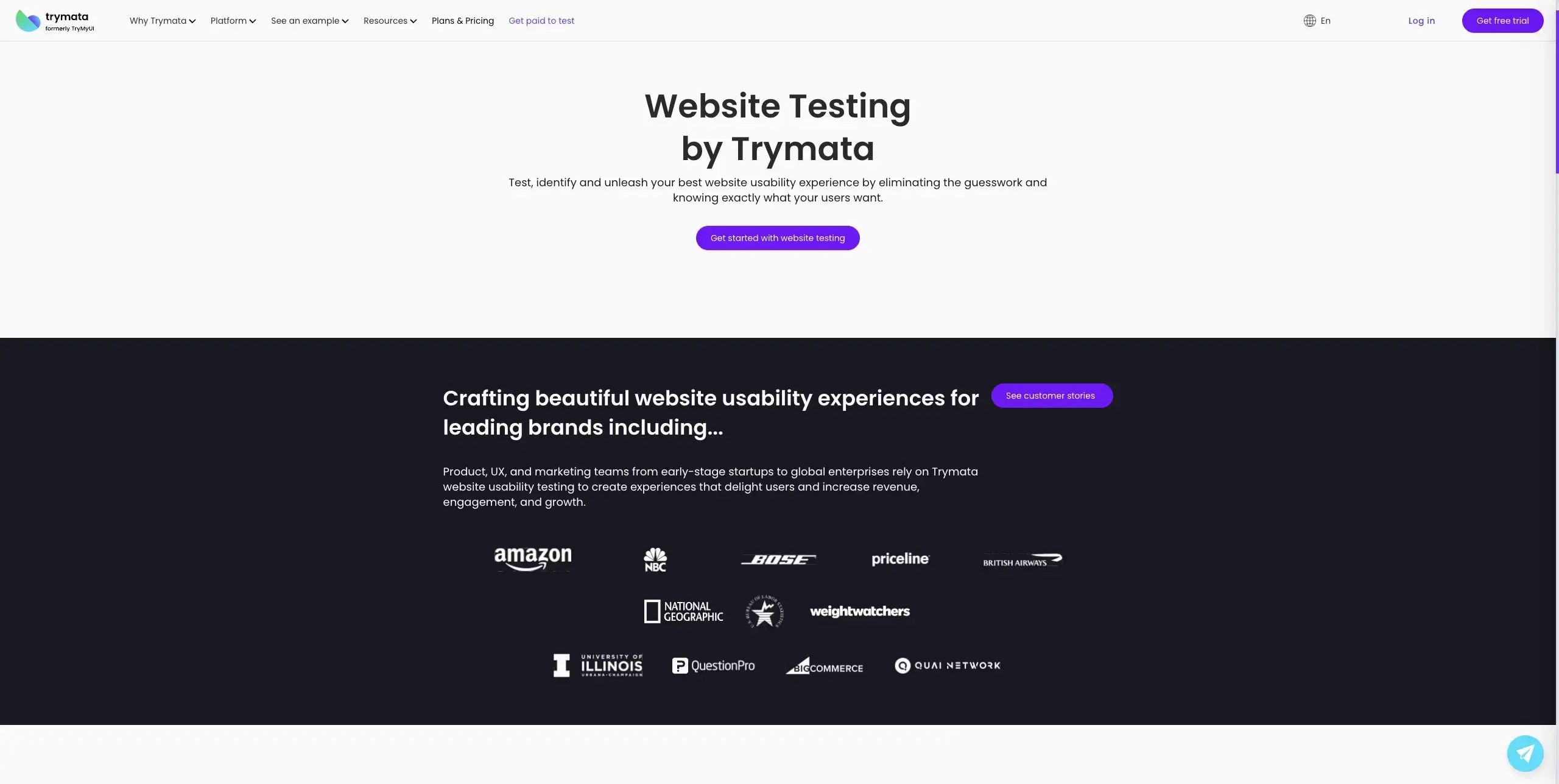
Trymata (formerly TryMyUI) has been in the usability testing space since 2010 and has evolved into a digital experience intelligence platform. Beyond its core unmoderated testing capabilities, the platform now includes moderated testing, product analytics, and a built-in research repository.
Combining traditional usability testing with modern product analytics, Trymata offers a comprehensive feature set:
Unmoderated and moderated usability testing: Task-based tests with video recordings and think-aloud narration, plus live video sessions for moderated research. Supports websites, mobile apps (Android and iOS), prototypes, and beta sites.
UX Diagnostics: Built-in SUS scoring, task-level usability scores (SEQ), task completion rates, and task duration measurements for quantified usability benchmarks.
Product analytics: Session replays, heatmaps, user flow and funnel analysis, goal tracking, and frustration filters for ongoing behavioral insights.
AI analysis and research repository: AI-powered video summaries and automated annotations, plus a centralized research repository for organizing and sharing findings across your team.
UX Crowd and highlight reels: Proprietary crowdsourced voting for large studies, plus shareable highlight reels for communicating key moments to stakeholders.
Best for: Teams looking for a platform that combines traditional usability testing with product analytics and quantified UX scoring. Well suited for organizations that want both moderated and unmoderated capabilities in one place.
Pricing: Free PayGO tier with no subscription (panel credits at $89 each). Team plan at $399/month with 10 panel credits. Enterprise at $2,000/month with 30 panel credits. Unlimited at $5,000/month ($40,000/year). Agency pricing is custom. Product analytics billed separately starting at $300/month.
Customer ratings: Capterra 4.0/5 (listed under TryMyUI); G2 rating unverified (listed under TryMyUI).
20. Conversion Crimes
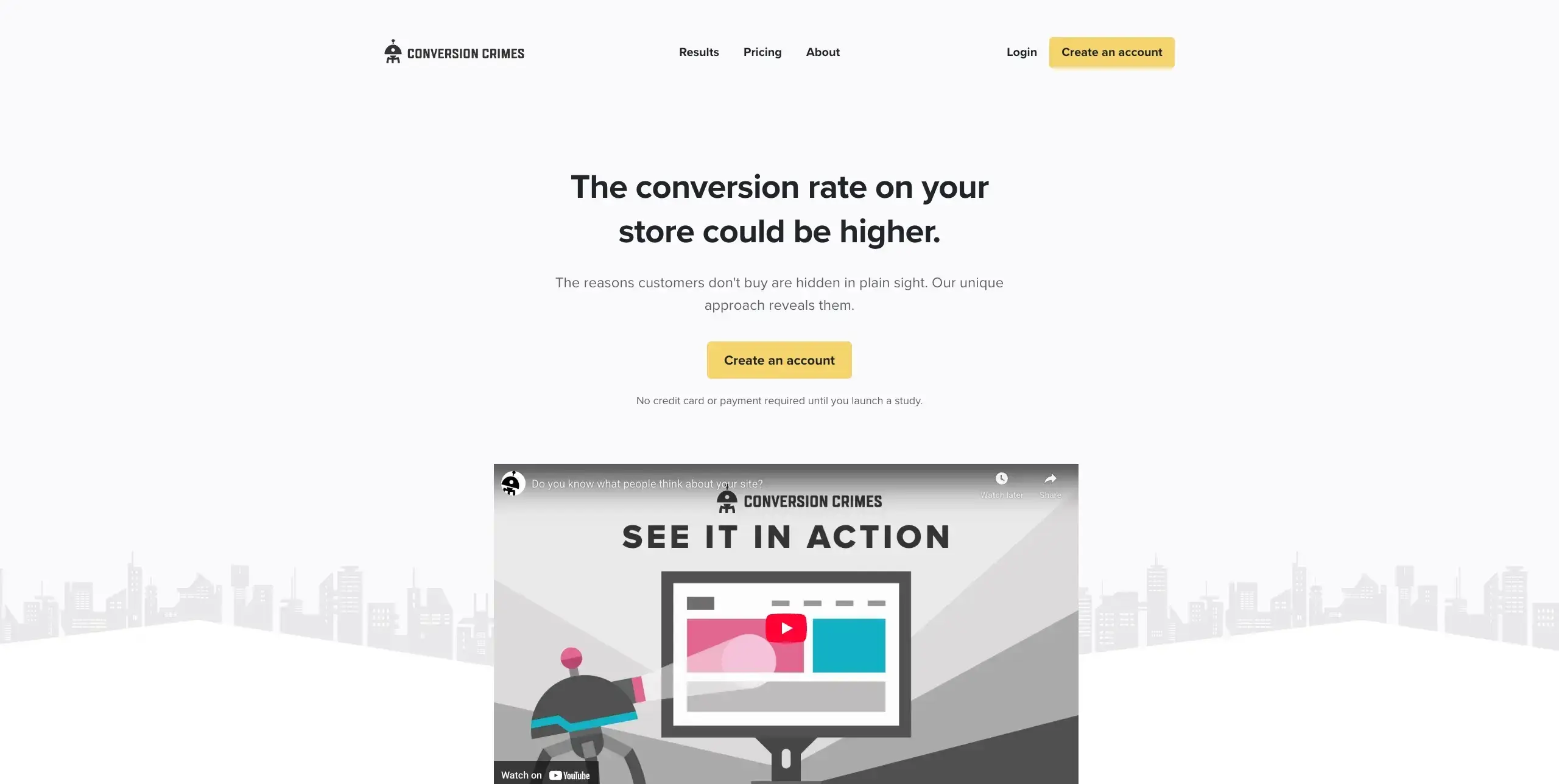
Conversion Crimes is a conversion-focused usability testing service built for ecommerce and small business teams. Rather than offering a full research platform, it takes a streamlined approach: real people in your target audience record their screens and narrate their experience shopping your store, revealing exactly where trust breaks down and purchases stall.
With a streamlined approach focused squarely on conversion optimization, Conversion Crimes provides a focused set of testing tools:
Conversion studies with video feedback: Real users navigate your site while recording their screen and speaking their thoughts aloud. Studies come in short (up to 10 minutes, five tasks) or long (up to 20 minutes, 12 tasks) formats with flexible reviewer counts.
DIY or done-for-you options: Run the study yourself and review the footage, or have CRO experts analyze feedback and deliver a report with specific recommendations.
Pre-built test templates: Templates for checkout flows, product discovery, trustability, first impressions, competitor comparisons, SaaS free trial signups, Amazon listings, and ad-to-landing-page funnels.
Quantitative usability scoring: Site scores covering speed, trust, bugs, design, navigability, and readability, plus task difficulty and completion metrics.
Scout (free tier): One free five-minute usability test per month using Scout templates, with no credit card required.
Best for: Ecommerce and marketing teams focused on improving conversion rates through direct user feedback. Particularly valuable for small to mid-sized online stores that want actionable insights without the complexity of a full UX research platform.
Pricing: Pay-per-study model based on study length, number of reviewers, and DIY vs. done-for-you service. Example pricing shows $200 for a standard study. No subscription required. Contact the founder for bulk or agency pricing.
Customer ratings: No Capterra listing found. G2 listing exists but has minimal reviews. Very limited review presence across major platforms.
How to decide which tool fits your needs
With so many options available, choosing the right usability testing tool comes down to understanding your specific situation and priorities. The following table summarizes key decision criteria to help you evaluate your options at a glance.
Decision factor | What to consider | Tools to explore |
|---|---|---|
Unmoderated testing | Task-based testing, automatic metrics, video playback | Lyssna, Maze, Loop11 |
Moderated research | Live session reliability, note-taking, scheduling integrations | Lyssna, Lookback, Great Question |
Prototype testing | Design tool integration, testing at multiple fidelity stages | Lyssna (Figma integration), Maze, Great Question |
Information architecture | Tree testing, card sorting, specialized IA methods | Lyssna, Optimal Workshop |
Budget-friendly or occasional testing | Free tiers, pay-as-you-go, transparent pricing | Lyssna, Maze, UXtweak |
Built-in participant panel | Fast recruitment, demographic targeting, global reach | Lyssna (690,000+ participants), UserTesting, dscout |
Enterprise-scale research | Repository, team collaboration, security compliance | Lyssna, Great Question, UserTesting, Sprig |
Match tool features to your research method
Start with a usability testing plan and define your research goals. The tool you choose should align with how you actually conduct research.
For unmoderated testing, look for tools with strong task-based testing, automatic metrics, and good video playback features. Lyssna, Maze, and Loop11 excel here.
For moderated research, prioritize tools with reliable live session capabilities, good note-taking features, and scheduling integrations. Lookback and Great Question are strong choices, and Lyssna's interviews feature supports moderated sessions with built-in scheduling, recording, co-hosting, and panel recruitment, making it a solid option for teams who want both moderated and unmoderated research in a single platform.
For prototype testing, ensure tight integration with your design tools. Lyssna's Figma integration allows teams to test prototypes at any stage of development, from validating early ideas to refining designs.
For information architecture, consider tools with specialized IA research methods like tree testing and card sorting. Optimal Workshop and Lyssna offer robust options here.
Pro tip: Before committing to a paid plan, run a pilot test on your top two or three tools using their free tiers. Testing the same study across platforms gives you a direct comparison of setup speed, participant quality, and how actionable the results feel.
Consider budget, audience reach, and integration needs
Your choice of tool should account for practical factors beyond features alone.
For budget, consider whether you're testing occasionally or running research regularly. A free or pay-as-you-go model may suit occasional testing, while regular research benefits from unlimited testing options and transparent pricing. It's also worth comparing the total cost of ownership, including participant recruitment. A tool that seems expensive but includes panel access may cost less than a cheaper tool plus separate recruitment fees.
Pro tip: When comparing tools, factor in the full cost of a study, not just the subscription price. A platform that includes participant recruitment, like Lyssna's research panel, can save significant time and money compared to pairing a cheaper tool with a separate recruitment service.
For audience reach, prioritize tools with built-in panels if you need participants fast. Lyssna's panel of 690,000+ participants across 124 countries with precise demographic targeting helps solve the recruitment challenge that often delays research. If you're testing with your own customers, look for tools that make self-recruitment easy with shareable test links and participant management features.
For integrations, consider how the tool fits your existing workflow. Does it integrate with Figma or your design tool of choice? Can results be shared easily with stakeholders via Slack or email? Does it connect with your project management tools?
For support, Lyssna offers customer support through email and live chat across all plans, including the free tier – helpful when you're getting started or troubleshooting integrations.
Plan for actionability: how results feed into UX workflows
The best usability testing tool is one your team actually uses. Consider how findings will flow from testing into design decisions.
Reporting and sharing. Can you create highlight reels to share with stakeholders? Are results easy to export and include in presentations? Can team members collaborate on analysis?
Speed to insight. How quickly can you go from test completion to actionable findings? Does the tool offer automatic transcription or AI-assisted analysis? Can you filter and search through results efficiently?
Connecting to action. Can you link findings directly to design files or tickets? Is there a research repository to track insights over time? Can you measure whether changes improved the experience?
How Lyssna can complement your toolkit
Lyssna is designed to fit seamlessly into product team workflows, whether you're running quick validation tests or comprehensive research studies.
For rapid validation, clear first impressions make it more likely your audience will take the action you're hoping for. Lyssna's five second testing helps you validate that designs communicate clearly at first glance – giving you confidence before investing in further development.
For prototype testing, test directly from your Figma design files with no need to export or rebuild. Teams can validate concepts at any fidelity level, from early wireframes to polished mockups.
For participant recruitment, Lyssna offers a research panel calculator where you can input study size, type, and audience to get an estimate of the cost and turnaround time. This helps with budgeting and planning research studies.
For international research, Lyssna's user interviews feature includes multi-language support, allowing delivery of the participant experience (emails, calendar invites, and the interview interface) in various languages. This is valuable for teams conducting research across markets.
Practitioner insight: “With the feature additions of interviews and screeners, we've been able to reduce the number of research tools needed to support our work and are able to conduct research more efficiently."
– Jenn Wolf, Senior Director of CX at Nav

FAQs about usability testing tools

Jeff Cardello
Freelance SaaS content writer
Jeff Cardello is a freelance writer who loves all things tech and design. Outside of being a word nerd, he enjoys playing bass guitar, riding his bike long distances, and recently started learning about data science and how to code with Python.

You may also like these articles