27 Feb 2026
|18 min
UX and CRO
Learn how UX and CRO work together to create experiences that delight users and drive conversions. Includes methods, real examples, and tools to get started.


UX and CRO are two disciplines that, when combined effectively, create digital experiences that both delight users and drive measurable business results. While user experience (UX) focuses on understanding and meeting user needs, conversion rate optimization (CRO) ensures those users take meaningful actions that support business goals.
The relationship between these disciplines is more complementary than many teams realize. Think of UX as providing the map of user needs and behaviors, while CRO focuses on optimizing the paths users take toward their goals. When both work in harmony, you create experiences that feel intuitive while naturally guiding users toward conversion.
This guide explores how UX and CRO work together, where they differ, and how you can build a unified strategy that improves both user satisfaction and conversion rates.
Key takeaways
UX and CRO are complementary, not competing. UX removes friction by identifying where users struggle, while CRO optimizes the paths users take toward conversion. The best results come when both disciplines work together.
Different focus, shared goal. UX takes a user-centered approach asking "What do users need?" while CRO takes a business-centered approach asking "What drives conversions?" Both ultimately want users to succeed.
Combine qualitative and quantitative data. UX research methods like usability testing and user interviews reveal why users behave the way they do. CRO techniques like A/B testing and analytics show what users do. Together, they provide the complete picture.
Improvement is continuous. Both UX and CRO are iterative processes that involve ongoing testing, monitoring, and refinement. Establish regular research and testing cadences to stay connected to evolving user needs.
Better experiences drive better conversions. Real-world examples show that UX improvements lead to measurable conversion gains. Angara saw a 25% increase in checkout rates, and Wakefit achieved 15% more add-to-carts, both through UX changes uncovered by CRO testing.
Lyssna supports both UX and CRO. With tools like usability testing, preference testing, first click testing, and surveys, Lyssna helps you gather the insights you need to improve user experience and drive conversions.

What are UX and CRO?
Before exploring how these disciplines work together, let's establish clear definitions and understand why both matter for product success.
Definition of UX (User experience)
User experience encompasses every aspect of a user's interaction with a product, service, or company. It's about designing experiences that are useful, usable, and enjoyable.
The goals of UX include:
User satisfaction: Creating experiences that meet or exceed user expectations.
Usability: Eliminating obstacles that hinder user flow and task completion.
Accessibility: Ensuring the experience works for users of all abilities and contexts.
UX designers conduct research to understand user behaviors, motivations, and pain points. They then translate those insights into designs that solve real problems and create positive experiences.
Definition of CRO (Conversion Rate Optimization)
Conversion rate optimization is the systematic process of increasing the percentage of users who take a desired action on your website or app. These actions might include making a purchase, signing up for a newsletter, or completing a form.
CRO goals include:
Increased conversions: Driving more users to complete actions tied to business goals.
Enhanced conversion pathways: Optimizing the routes users take to reach their desired destinations.
Measurable improvement: Using data to validate changes and demonstrate ROI.
CRO focuses on specific elements that influence conversions, such as button placement, call-to-action messaging, and the steps users take to complete key actions.
Why both matter for product success
Understanding your target audience and their needs, preferences, and frustrations is crucial for optimizing user experiences. This often starts with a solid grasp of qualitative vs quantitative research, which forms the foundation of effective user research in both UX and CRO.
When UX and CRO work in isolation, you risk creating one of two problems:
Beautiful experiences that don't convert: Users enjoy the interface but don't take meaningful action.
High-converting experiences that frustrate users: Short-term gains that damage long-term trust and retention.
The most successful digital products balance both, creating experiences that users genuinely enjoy while naturally guiding them toward actions that benefit both the user and the business.

How UX and CRO work together
UX and CRO aren't competing priorities. They're complementary approaches that strengthen each other when properly integrated.
UX removes friction, CRO drives action
UX research identifies where users struggle, get confused, or abandon tasks. By removing these friction points, you create a smoother path for users to follow. CRO then optimizes that path through user experience optimization to encourage specific actions.
Consider this example: UX research might reveal that users abandon a checkout flow because they can't find shipping information. Fixing this usability issue removes friction. CRO can then test different ways to present that information, such as highlighting free shipping thresholds, to increase completed purchases.
The relationship works both ways. CRO data often reveals where users drop off, pointing UX researchers, designers, product managers, and marketers toward problems worth investigating. When you see a significant drop-off at a particular step, that's a signal to dig deeper into why users are struggling.
Shared goals between UX designers and CRO teams
Both UX and CRO teams ultimately want users to succeed. They share several fundamental objectives:
Understanding user behavior: Both disciplines study how users interact with products.
Reducing abandonment: Neither wants users to leave frustrated or confused.
Improving key metrics: Both track and optimize measurable outcomes.
Creating value: Both aim to deliver experiences that meet user needs.
Creating feedback loops is important for both disciplines. By gathering user feedback to identify pain points, both UX and CRO teams can guide changes that improve the experience and positively impact conversions.

Pro tip: Set up a shared Slack channel or regular sync between UX and CRO teams to review findings together. CRO drop-off data can help UX researchers prioritize what to investigate, while UX insights can help CRO teams understand why certain tests succeed or fail.
When UX and CRO strategies overlap
The most powerful opportunities emerge where UX and CRO strategies intersect:
Area | UX focus | CRO focus |
|---|---|---|
Onboarding flows | Ensures new users understand the product | Optimizes for activation |
Navigation and IA | Makes content findable | Ensures users find conversion opportunities |
Form design | Reduces cognitive load | Increases completion rates |
Mobile optimization | Adapts layout and interactions for usability | Ensures conversion paths work across devices |
Mobile optimization is a perfect example of where UX and CRO goals align completely. Responsive designs that adapt layout, font sizes, and interactions ensure users can navigate and convert regardless of device.

Practitioner insight: "I've been doing CRO for over 15 years and have relied on Lyssna to back up my recommendations and get client buy-in on test ideas. I find it more powerful to SHOW them that 75% of users don't know what their value prop is, for example, rather than merely telling that to them myself."
– Theresa F., Capterra review
Key differences between UX and CRO
While UX and CRO share common ground, understanding their differences helps teams collaborate more effectively.
UX | CRO | |
|---|---|---|
Focus | User-centered | Business-centered |
Primary question | "What do users need?" | "What drives conversions?" |
Approach | Research depth | Experimentation speed |
Methods | User interviews, usability studies, contextual inquiry | A/B testing, analytics, variant experiments |
User-centered vs business-centered focus
UX researchers advocate for users, sometimes pushing back on business requests that might harm the user experience. CRO specialists focus on metrics that directly impact revenue and growth. Neither approach is wrong. They're different lenses for viewing the same product, and the best outcomes happen when both perspectives inform decisions.
Research depth vs experimentation speed
UX research tends toward depth. User interviews, contextual inquiry, and comprehensive usability studies take time but reveal rich insights about user motivations and behaviors. CRO emphasizes speed, with A/B tests providing statistically significant results within days or weeks.
Both approaches have value. Deep research prevents you from optimizing the wrong things, while rapid experimentation helps you find winning solutions faster.
Pro tip: Use UX research to generate hypotheses, then validate them with CRO experiments. This way you get the depth of qualitative insights and the speed of quantitative testing.
Metrics used to measure success
Each discipline tracks different indicators to evaluate performance.
UX metrics | CRO metrics | How they connect |
|---|---|---|
Task success rates | Conversion rates | Users who complete tasks are more likely to convert |
Time on task | Bounce rates | Faster task completion reduces abandonment |
Error rates | Cart abandonment rates | Fewer errors mean fewer drop-offs |
User satisfaction scores | Revenue per visitor | Satisfied users spend more |
System Usability Scale (SUS) | Click-through rates | More usable interfaces make CTAs clearer and easier to act on |
Net Promoter Score (NPS) | Cost per acquisition | Referrals from promoters lower acquisition costs |
The most effective teams track metrics from both categories, recognizing that improvements in UX metrics often lead to improvements in CRO metrics over time.

Benefits of combining UX and CRO
When UX and CRO work together, the results compound. Here's what you can expect from an integrated approach.
Higher conversions through better experiences
Users convert more readily when experiences feel natural and trustworthy. When UX and CRO teams collaborate, the results speak for themselves. For example, digital agency Jellyfish helped a home warranty company achieve a 20.99% increase in visit-to-purchase rates by combining UX research with CRO experimentation to simplify a complex quote-and-buy flow.
Rather than relying on dark patterns or manipulative tactics that might boost short-term conversions, combining UX and CRO creates sustainable growth through genuine value delivery.
Reduced user drop-off
By identifying and fixing friction points through UX research, then optimizing the remaining experience through CRO, you systematically reduce abandonment at every stage of the user journey.
Common drop-off points that benefit from combined UX/CRO attention:
Registration and sign-up flows
Checkout processes
Onboarding sequences
Feature discovery moments
Upgrade and upsell touchpoints
Lower acquisition costs
When more visitors convert, your cost per acquisition decreases. Instead of spending more on advertising to drive traffic, you extract more value from existing traffic through better experiences.
This efficiency compounds over time. Happy users who convert also tend to return and recommend your product to others, further reducing acquisition costs.
Data-driven design decisions
Combining qualitative UX research with quantitative CRO data gives you confidence in your data-driven design decisions. You understand not just what users do (from analytics) but why they do it (from research).
This combination helps teams:
Prioritize improvements based on impact
Build consensus around design decisions
Measure the effectiveness of changes
Continuously learn and improve
Pro tip: When presenting design recommendations to stakeholders, pair your UX research findings with CRO data. Showing both the "why" and the "what" makes a stronger case for change.
UX methods that support CRO
Several UX research methods directly inform and improve conversion optimization efforts.
Method | What it reveals | CRO benefit |
|---|---|---|
Usability testing | Where users struggle to complete tasks | Identifies friction points causing abandonment |
Heatmaps and session recordings | Where users click, scroll, and focus attention | Shows whether users notice CTAs and key content |
User interviews and surveys | Motivations, concerns, and decision-making processes | Explains the "why" behind conversion behavior |
Information architecture and flows | How users navigate and find content | Creates natural pathways toward conversion points |
Usability testing
Usability testing reveals where users struggle to complete tasks, including conversion-critical tasks like checkout or sign-up. By watching real users interact with your product, you identify specific friction points that analytics alone can't explain.
How usability testing supports CRO:
Identifies confusing interface elements that cause abandonment
Reveals unexpected user behaviors and workarounds
Validates whether proposed changes actually improve the experience
Provides qualitative context for quantitative conversion data
Unmoderated usability testing allows you to gather feedback quickly from a larger number of participants, making it easier to integrate testing into rapid CRO cycles.
Heatmaps and session recordings
Visual data showing where users click, scroll, and focus attention helps both UX and CRO teams understand behavior patterns. Heatmaps reveal whether users notice important elements, while session recordings show the complete context of user interactions.
Insights from visual analytics:
Are users seeing your calls to action?
Where do users hesitate or get stuck?
What content do users engage with most?
Are there unexpected interaction patterns?
User interviews and surveys
Direct conversations with users reveal motivations, concerns, and decision-making processes that influence conversion. Surveys can gather feedback at scale, while interviews provide deeper understanding.
Questions that inform both UX and CRO:
What almost stopped you from completing this task?
What information were you looking for that you couldn't find?
What would make this experience better?
How does this compare to alternatives you've tried?
Pro tip: Ask users about their hesitations immediately after they complete a conversion action. You'll capture insights while the experience is still fresh, and you'll hear from people who converted despite friction.
Information architecture and flows
How content is organized and how users navigate through your product directly impacts both usability and conversion. Card sorting and tree testing help create intuitive structures that users can navigate easily.
Well-designed information architecture:
Helps users find what they're looking for quickly
Reduces cognitive load during decision-making
Creates natural pathways toward conversion points
Supports both browsing and goal-directed behavior
CRO techniques that improve UX
CRO methods often reveal UX improvements, creating a virtuous cycle of optimization.
Technique | What it does | UX benefit |
|---|---|---|
A/B testing | Compares page or element variants to find what performs better | Reveals which designs users actually prefer |
Optimized messaging and CTAs | Tests headlines, button text, and value propositions | Improves clarity and reduces confusion |
Reducing steps in critical flows | Eliminates or combines unnecessary steps | Respects users' time and reduces frustration |
Personalization | Tailors content based on behavior, preferences, or context | Makes experiences feel more relevant and efficient |
A/B testing and variant experiments
A/B testing compares different versions of a page or element to determine which performs better, using specialized conversion rate optimization tools. While primarily a CRO technique, the insights often reveal UX improvements.
For example, testing two different checkout flows might reveal that a simpler, single-page checkout not only converts better but also receives higher satisfaction scores, a win for both CRO and UX.
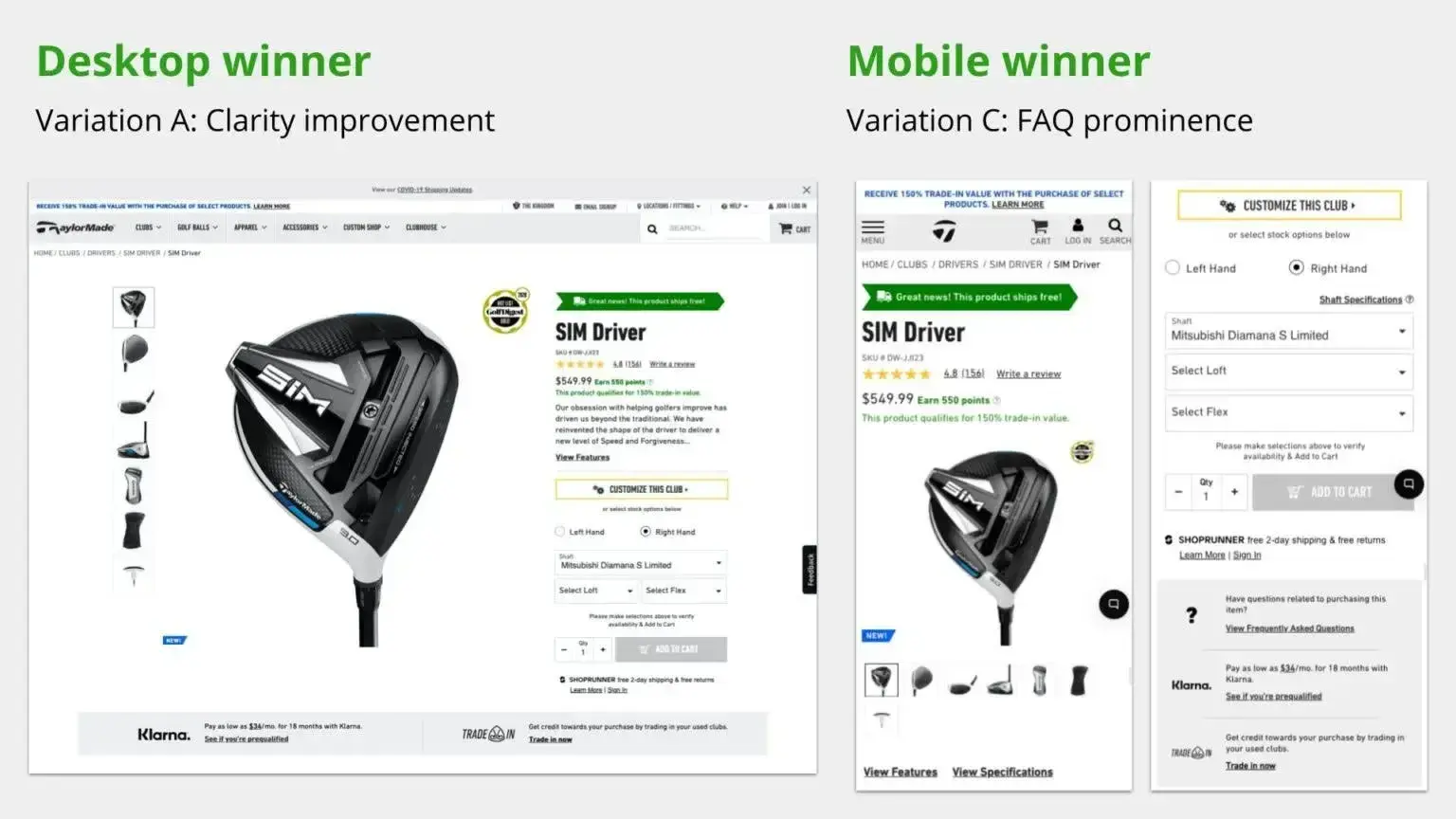
Conversion.com worked with TaylorMade, a golfing gear manufacturer, to improve conversion rates on their website. By experimenting with the wording and placement of their free shipping message, they achieved a 2.9% increase in order confirmations. They tested different versions on mobile and desktop to determine the most impactful approach, demonstrating how small CRO tweaks can drive measurable improvements.
Optimized messaging and CTAs
CRO testing of headlines, button text, and value propositions often reveals what resonates most with users. This isn't just about conversion; it's about communicating more clearly.
Effective messaging optimization:
Tests different ways to explain product value
Identifies language that matches user mental models
Reduces confusion about what actions do
Builds confidence in taking next steps
Reducing steps in critical flows
Every additional step in a conversion flow creates an opportunity for drop-off. CRO analysis identifies which steps can be eliminated or combined without harming the experience.
Common simplification opportunities:
Combining form fields or using smart defaults
Removing unnecessary confirmation steps
Enabling guest checkout options
Pre-filling information when possible
These changes improve both conversion rates and user satisfaction by respecting users' time.
Pro tip: Before removing steps, use usability testing to confirm users don't need them. Sometimes what looks like friction is actually reassurance, like order confirmation screens that build trust.
Personalization
Showing users relevant content based on their behavior, preferences, or context improves both conversion rates and user experience. McKinsey research shows that personalization typically drives a 10 to 15 percent revenue lift. Personalization makes experiences feel more tailored and efficient.
Personalization approaches:
Recommending products based on browsing history
Adjusting content based on user segment
Remembering preferences across sessions
Adapting experiences based on device or location
How to build a unified UX + CRO strategy
Creating alignment between UX and CRO requires intentional effort. Here's how to build a strategy that leverages both disciplines.
Align goals across product, design, and marketing
Start by establishing shared objectives that both UX and CRO teams can rally around. These should connect user outcomes to business outcomes.
Example shared goals:
Increase trial-to-paid conversion while maintaining user satisfaction scores
Reduce time-to-value for new users while improving activation rates
Improve checkout completion while reducing support tickets about the process
When teams share goals, they naturally collaborate rather than compete.
Prioritize experiments informed by user research
Use qualitative research to identify what to test, then use quantitative methods to validate solutions. This prevents wasting time optimizing the wrong things.
A research-informed prioritization process:
Conduct user research to identify pain points and opportunities
Prioritize issues based on impact and frequency
Generate hypotheses about potential solutions
Design experiments to test hypotheses
Analyze results and iterate
Pro tip: Create a shared backlog where UX research findings automatically feed into CRO test ideas. This keeps both teams aligned and ensures experiments are grounded in real user needs.
Validate learnings with continuous testing
Both UX and CRO are iterative processes that involve continuous testing, monitoring analytics, and making refinements based on performance. Ongoing improvement helps you adapt to evolving user needs and preferences.
Establish a continuous testing cadence:
Regular usability testing to catch new issues
Ongoing A/B tests to optimize key flows
Periodic user interviews to understand changing needs
Consistent analytics review to spot trends
Combine qualitative and quantitative data
The most powerful insights come from combining what users do (quantitative) with why they do it (qualitative).
Quantitative data tells you where users drop off; qualitative data tells you why they leave.
Quantitative data tells you what users click; qualitative data tells you what they expected to happen.
Quantitative data tells you how long tasks take; qualitative data tells you whether that feels acceptable.
Quantitative data tells you which variant performs better; qualitative data tells you why users prefer it.
Neither type of data is complete on its own. Together, they provide a full picture of user behavior and experience.
Real-world examples of UX and CRO working together
Let's look at how real companies have used CRO to uncover UX improvements and drive results.
Angara: Higher checkout conversions through better mobile UX
Jewelry retailer Angara found that while customers liked shopping on its mobile website, small screen sizes made it difficult for them to navigate the many customization options on product pages. This hindered shoppers from completing their purchases.
Working with marketing performance company Jellyfish, the team used A/B testing to compare different product page designs for rings. They discovered that text-heavy product descriptions were creating cognitive overload for mobile shoppers.
The solution was replacing text-heavy descriptions with clear, sticky call-to-action buttons like "Customize this ring," helping shoppers move more quickly to checkout. The result was a 25% increase in checkout rate and a 32% increase in revenue from ring purchases on mobile.

Wakefit: More conversions through improved information discovery
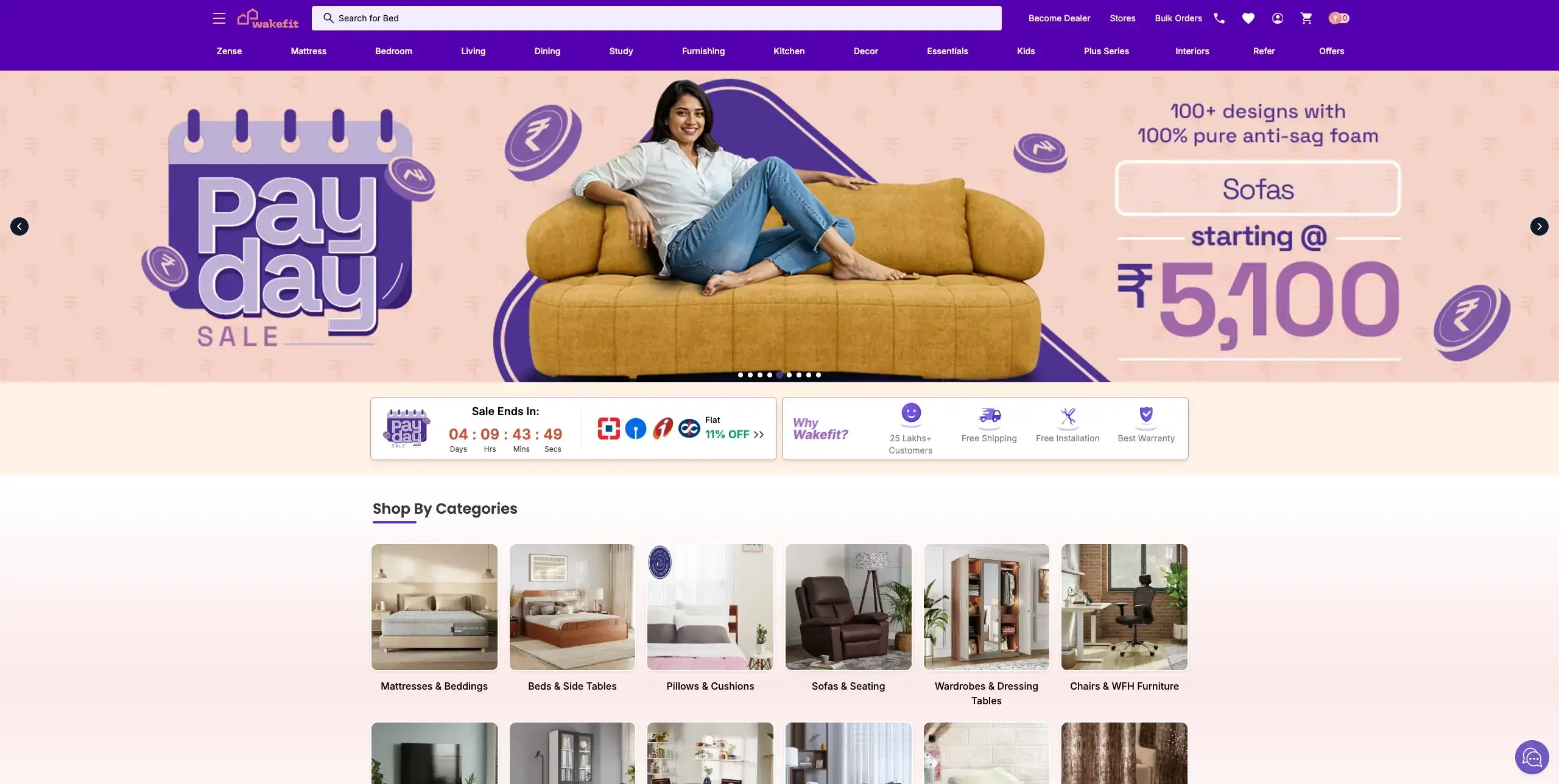
Furniture retailer Wakefit had a site where information was presented in a long, flat layout. Customers struggled to navigate and discover products.
Working with CRO agency VWO, the team ran A/B tests comparing the original flat layout against a redesigned version with content organized under sticky tabs. The simpler structure made it easier for customers to find the information they needed to make purchase decisions.
The result was 15% more shoppers adding products to their carts and a 9% increase in purchases. The entire CRO process took just one month.
Pro tip: Start with mobile. Both case studies show that UX improvements on mobile can drive significant conversion gains, since mobile users often face the most friction due to screen size constraints.
How Lyssna can help
Lyssna offers a comprehensive suite of tools designed to support both UX research and CRO efforts. These features help you gather valuable data and insights, enabling you to make informed decisions and continuously improve your product.
Tools for user research and rapid testing
Tool | What it does | How it supports CRO |
|---|---|---|
Usability testing | Gather insights about your website or app's usability, functionality, and design | Identifies friction points that may be hurting conversions |
Preference testing | Compare design variants to understand user preferences | Validates design decisions with statistical significance before development |
First click testing | Evaluate whether users can identify the correct starting point for completing tasks | Reveals navigation issues affecting conversion paths |
Card sorting | Understand how users naturally categorize and organize information | Optimizes information architecture for better findability |
Surveys | Collect feedback, explore trends, and validate designs | Reveals user needs to inform conversion strategies |
Practitioner insight: "Preference testing is the main feature we use with Lyssna, and it gives us the insights we need to make data-backed decisions quickly."
– Brady Josephson, VP of Marketing & Growth at charity: water
Insights to guide CRO experiments
Lyssna helps you generate hypotheses for CRO testing by uncovering why users behave the way they do. Usability testing reveals where users struggle, preference testing shows which designs resonate, and first click testing identifies whether users can find key conversion points. These qualitative insights give your CRO experiments a stronger foundation than guesswork alone.
Data to improve experience and conversions
With Lyssna, you can gather both quantitative and qualitative data to inform your decisions. Preference testing automatically calculates statistical significance when comparing designs, while surveys and follow-up questions capture the reasoning behind user choices. This combination helps you prioritize improvements that enhance user experience and drive conversions.
FAQs about UX and CRO
You may also like these articles